
Architecture Trade-offs: CAP Theorem and Distributed Systems Design Decisions
Master the limits. Learn why your database can never be perfectly Consistent, Available, and Partition-Tolerant at the same time.
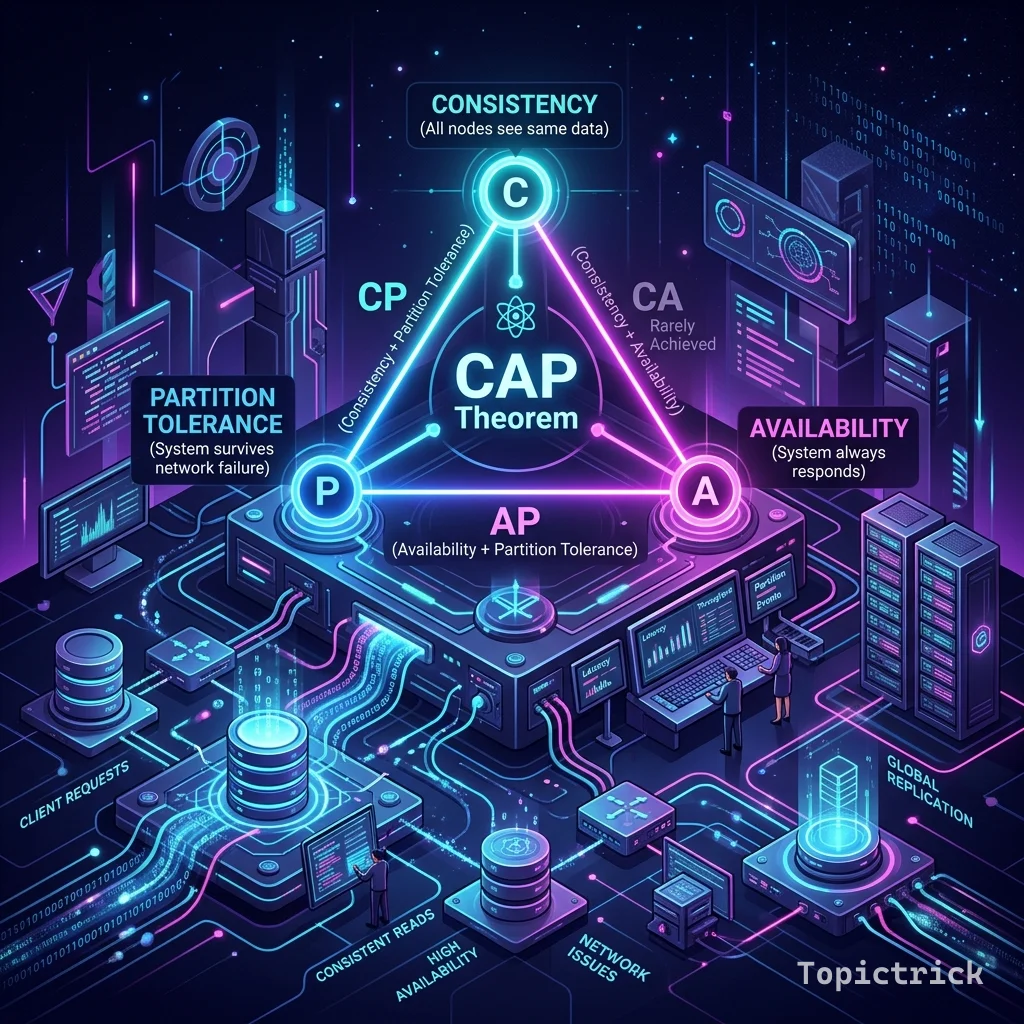
Architecture Trade-offs: CAP Theorem
"In a distributed world, you can't have your cake and eat it too. You have to choose which way you want to fail."
Imagine you have a global app. A user in New York updates their profile. $1$ millisecond later, a user in London looks at the same profile.
- Do they see the "Old" data? (High availability, low consistency).
- Does the London user see a "Loading..." spinner while the database syncs? (High consistency, low availability).
This is the CAP Theorem. It is the unbreakable law of distributed systems. This 1,500+ word guide is your architectural manual for choosing the right "Compromise" for your data.
1. The Three Pillars of CAP
- Consistency (C): Every user sees the exact same data at the exact same time.
- Availability (A): The system is always up. No user ever gets an error message.
- Partition Tolerance (P): The system continues to work even if the wires between two servers are cut.
The Rule: In a world of "Cloud Computing" and "Networking," Partition Tolerance is NOT optional. Networks break. Therefore, the choice is always: CP vs. AP.
2. CP Architecture: The "Truth" seekers
If you are a Bank, you choose CP.
- If New York and London lose their connection, the Bank Shuts Down for one region.
- Why? Because it's better to have a "Down website" than to allow someone to spend $$1,000$ that they don't have.
- Databases: PostgreSQL, CockroachDB (in strict mode).
3. AP Architecture: The "Always On" seekers
If you are a Social Network (Meta, X), you choose AP.
- If a user in London sees a post from $2$ seconds ago instead of the absolute latest one, No one cares.
- It is much more important that the website loads fast.
- Databases: Cassandra, DynamoDB, CouchDB.
4. The PACELC Evolution: Beyond CAP
In 2026, we don't just ask about "Failures." we ask about "Normal time."
- PACELC: If there is a Partition (P), choose between Availability (A) and Consistency (C); Else (E), choose between Latency (L) and Consistency (C).
- Even when the app is working perfectly, you still have to choose: "Do I wait 1 second for a perfect answer, or do I give a fast answer in 1 millisecond that 'Might' be slightly old?"
5. Eventual Consistency: The compromise
Most modern apps use Eventual Consistency.
- When you "Like" a photo, the counter goes up on your screen immediately.
- But it might take $10$ seconds for your friend in Japan to see that Like.
- This allows for the Maximum Speed while ensuring the "Truth" eventually reaches everyone.
Summary: The CAP Checklist
- P is mandatory: Never assume your network is 100% reliable.
- Consistency for Money: Always choose CP for financial ledgers or inventory.
- Availability for Content: Always choose AP for social media or news.
- Monitor Latency: If your "Consistency sync" takes more than 500ms, your users will leave.
- PACELC Thinking: Remember that trade-offs happen even when everything is healthy.
The CAP Theorem is the "Reality Check" of the architect. By mastering the balance between the absolute truth and the absolute uptime, you gain the ability to build global systems that are both resilient and high-performing. You graduate from "Building apps" to "Architecting Distributed Realities."
Part of the Architecture Masterclass - engineering the limits.