
TOGAF Learning Hub: Certification, ADM & EA Resources 2026
Certification guides, ADM phase deep-dives, exam practice questions, and real-world case studies — all TOGAF and EA resources in one place.
What Is TOGAF and Why Does It Matter?
TOGAF (The Open Group Architecture Framework) is the world's most widely adopted enterprise architecture framework. Over 80% of Global 50 companies use TOGAF to align their technology investments with business strategy. For architects, certification in TOGAF is often a prerequisite for senior roles at major consultancies, banks, and government agencies.
This hub covers everything from first principles to exam readiness. If you are new to enterprise architecture, start with the Foundation section. If you are preparing for the certification exam, jump directly to the exam preparation section.
Who This Hub Is For
- Enterprise architects building or documenting architecture for their organisation
- IT professionals moving into architecture roles from development or infrastructure
- Students and consultants preparing for the TOGAF Foundation or Practitioner exam
- Business analysts and project managers who work alongside architecture teams and need to understand the vocabulary
TOGAF Foundation: Core Concepts
Before studying the ADM, you need to understand what TOGAF is and how its components relate to each other.
| Article | What You Will Learn |
|---|---|
| What is TOGAF 9.2? | Overview of the framework, its history, and adoption |
| TOGAF Architecture Framework Introduction | The four architecture domains and how TOGAF structures them |
| TOGAF Four Architecture Domains | Business, Data, Application, and Technology architecture explained |
| TOGAF Core Concepts Glossary | The 50 terms every TOGAF exam candidate must know |
| TOGAF 10 vs 9.2: What Changed? | Key differences between the two versions |
| Why TOGAF Matters More Than You Think | The business case for enterprise architecture investment |
The ADM: Architecture Development Method
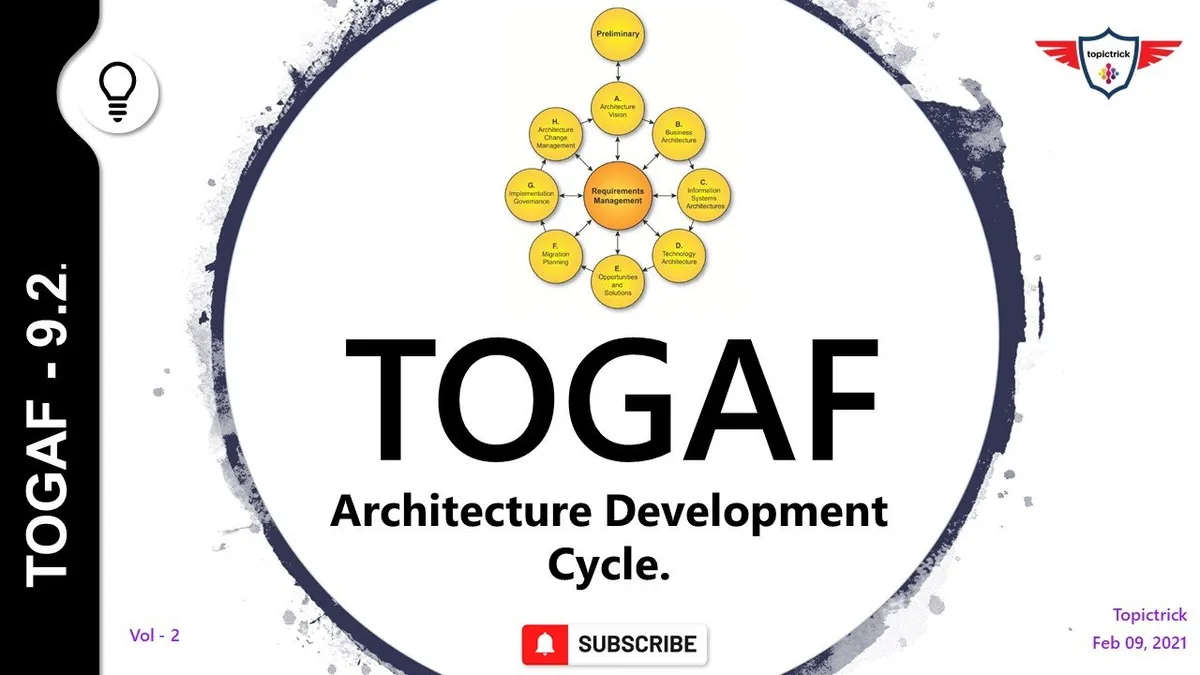
The ADM is the core process of TOGAF - a ten-phase method for developing and managing enterprise architecture.
| Article | What You Will Learn |
|---|---|
| TOGAF ADM Cycle: All 10 Phases Made Simple | Complete ADM overview with key outputs per phase |
| TOGAF ADM Phases Deep Dive | Detailed breakdown of every input, output, and activity |
| TOGAF Preliminary Phase Guide | Setting up the architecture capability before Phase A |
| TOGAF Phase A: Architecture Vision Outputs & Deliverables (2026) | Scope, stakeholders, Architecture Vision document |
| TOGAF Phase B: Business Architecture | Business services, functions, and gap analysis |
| TOGAF Phase B: Business Services | Cataloguing and mapping business services |
| TOGAF Phase C: Application Architecture | Application portfolios, interfaces, and integration |
| TOGAF Phase C: Data Architecture | Data entities, logical data models, data governance |
| TOGAF Phase D: Technology Architecture | Infrastructure, platforms, and technology standards |
| TOGAF Phases E & F: Migration Planning | Architecture roadmap, work packages, and sequencing |
| TOGAF Phases G & H: Governance and Change | Architecture contracts, compliance, and change requests |
| TOGAF Requirements Management: How It Works Across All ADM Phases | The central process that runs through every phase |
| TOGAF ADM Iteration and Scoping | How to adapt the ADM for Agile and scaled programmes |
TOGAF Artifacts and Deliverables
One of the most tested areas in the certification exam - and the most misunderstood in practice.
| Article | What You Will Learn |
|---|---|
| TOGAF Artifacts vs Deliverables: Definitions + Exam Traps | The critical distinction, with a phase-by-phase reference table |
| TOGAF Content Metamodel | The formal model behind all TOGAF artifacts |
| TOGAF Architecture Requirements Specification | How requirements are documented across the ADM |
| TOGAF Architecture Repository | The six components of the repository and what lives where |
| TOGAF Enterprise Continuum | Foundation, Common Systems, Industry, and Organisation architectures |
TOGAF Governance and Principles
| Article | What You Will Learn |
|---|---|
| TOGAF Architecture Principles and Governance | Writing and applying effective architecture principles |
| TOGAF Architecture Capability Framework | Roles, responsibilities, and governance structures |
| TOGAF Pitfalls and Best Practices | Common implementation failures and how to avoid them |
| TOGAF Real-World Case Studies | How enterprises have applied TOGAF in practice |
TOGAF with Other Frameworks and Tools
| Article | What You Will Learn |
|---|---|
| TOGAF and ArchiMate Modeling | Using ArchiMate notation within TOGAF deliverables |
| TOGAF and Agile: Digital Transformation | Reconciling iterative delivery with ADM governance |
| TOGAF and SABSA Security Integration | Embedding security architecture into the ADM |
| TOGAF and Green IT Sustainability | Environmental considerations in technology architecture |
| TOGAF Tools and Software Comparison | ArchiMate tools, EA platforms, and modelling software |
| TOGAF vs Zachman: How They Relate | Using both frameworks together |
Certification Exam Preparation
Foundation (Part 1) Exam
The Foundation exam tests knowledge of TOGAF terminology, concepts, and the ADM structure. It is 40 multiple-choice questions in 60 minutes, open-book.
| Resource | What You Will Get |
|---|---|
| TOGAF Foundation Study Guide | Chapter-by-chapter summary of the official syllabus |
| TOGAF Foundation vs Practitioner Comparison | Which level to target and in what order |
| TOGAF Certification Levels Explained | AL1, AL2, and the new TOGAF 10 structure |
| TOGAF Certification Complete Guide 2026 | End-to-end guide: registration, preparation, and exam day |
| Best TOGAF Courses 2026: Ranked by Pass Rate & Price | 8 providers ranked - includes free options |
Practice Questions and Mock Exams
| Resource | What You Will Get |
|---|---|
| TOGAF Exam Questions: 50 Practice Questions with Answers | The most tested topics with answer explanations |
| TOGAF Foundation Mock Exam | Timed 40-question mock in exam format |
| TOGAF 9 Practice Questions | Additional question bank with explanations |
| TOGAF Certified Mock Scenarios | Scenario-based questions for the Practitioner paper |
| TOGAF Certified Scenario Strategy | How to approach and deconstruct scenario questions |
| TOGAF Certification Exam Questions: Full Bank | Comprehensive question bank covering all exam topics |
| TOGAF Exam Questions & Answers (Explained) | Detailed answer explanations for common exam questions |
Zachman Framework
The Zachman Framework is a complementary schema for enterprise architecture. Where TOGAF provides a process, Zachman provides a classification system.
| Article | What You Will Learn |
|---|---|
| What is the Zachman Framework? | The 36-cell matrix and its purpose |
| Zachman Framework: The 6 Questions Every Row Answers (2026) | What, How, Where, Who, When, Why across all perspectives |
| Zachman Framework: Six Perspectives | Planner, Owner, Designer, Builder, Subcontractor, Enterprise rows |
| Zachman 36-Cell Overview | Every cell defined with examples |
| Zachman History and Evolution | From the 1987 paper to modern practice |
| Zachman Framework Ontology | Why Zachman is a classification schema, not a process |
| Zachman vs TOGAF | When to use each and how they complement each other |
| Zachman vs FEAF and DoDAF | Comparing government and defence frameworks |
Zachman Rows Deep Dive
| Article | Perspective |
|---|---|
| Zachman Planner Row: Strategic Scope | Executive / Contextual perspective |
| Zachman Owner Row: Business Operations | Business owner / Conceptual perspective |
| Zachman Designer Row: Architecture | Architect / Logical perspective |
| Zachman Builder Row: Implementation | Developer / Physical perspective |
| Zachman Subcontractor Row: Code | Out-of-context details perspective |
| Zachman Enterprise Row: Operations | Functioning enterprise perspective |
Zachman Columns Deep Dive
| Article | Interrogative |
|---|---|
| Zachman What Column: Data and Inventory | Entities, data models, and data dictionaries |
| Zachman How Column: Function and Process | Functions, process flows, and application logic |
| Zachman Where Column: Network and Location | Locations, network topology, deployment |
| Zachman Who Column: People and Organization | Roles, responsibilities, and org structures |
| Zachman When Column: Time and Schedule | Events, cycles, and master schedules |
| Zachman Why Column: Motivation and Strategy | Goals, strategies, and business rules |
Zachman Applied
| Article | Application |
|---|---|
| Zachman and ArchiMate Modeling | Notation for Zachman cells |
| Zachman for Cloud Migration | Mapping cloud transformation across the matrix |
| Zachman and Agile Transformation | Adapting Zachman to iterative delivery |
| Zachman for Data Governance | Using Zachman to structure data governance programmes |
| Zachman for Digital Transformation | Enterprise-wide transformation planning |
| Zachman Enterprise Integration | Integration architecture across rows and columns |
| Zachman Security Architecture | Embedding security across all perspectives |
| Zachman Modern Relevance 2026 | Is Zachman still useful in cloud-native environments? |
| Zachman Case Studies | Real organisations using the Zachman matrix |
| Zachman Pitfalls | Common misapplications and how to avoid them |
| Zachman Artifacts and Deliverables | Output artefacts for each cell of the 36-cell matrix |
| TOGAF Certification: Framework Overview | Framework structure, ADM cycle, and certification alignment |
Exam Prep: Zachman Practice Questions | Zachman Study Guide | Zachman Mock Exam
Enterprise Architecture Certifications
| Article | What You Will Learn |
|---|---|
| Enterprise Architecture Certifications Guide 2026 | TOGAF, Zachman Certified, SABSA, CITA - which to pursue |
| TOGAF Certification: Complete Guide 2026 | Registration, study plan, exam day tips |
| Best TOGAF Courses 2026: Ranked by Pass Rate & Price | 8 providers compared - with free options highlighted |
Frequently Asked Questions
How long does it take to pass the TOGAF Foundation exam? Most candidates need 4-8 weeks of part-time study (1-2 hours per day) to pass the Foundation paper. The exam is open-book, but it is fast-paced - you need to know where to look, not memorise everything. The Foundation Study Guide maps exactly which chapters cover which exam topics.
Do I need work experience to sit the TOGAF exam? No. The Open Group does not require work experience for either the Foundation or Practitioner papers. Many candidates sit Foundation directly after completing a training course.
What is the difference between TOGAF Foundation and Practitioner? Foundation tests whether you understand the terminology and concepts. Practitioner tests whether you can apply TOGAF in scenario-based situations. Foundation is multiple-choice; Practitioner is scenario-based. Most employers require Practitioner (now called "TOGAF Certified") for senior architecture roles. See the comparison guide.
Is TOGAF 10 replacing TOGAF 9.2? Yes - TOGAF 10 is the current version. However, TOGAF 9.2 exam materials remain widely used and the core ADM is unchanged between versions. See TOGAF 10 vs 9.2 for a detailed breakdown of what changed.
Can TOGAF be used with Agile? Yes. The ADM is explicitly designed to be adapted and iterated. The TOGAF and Agile guide explains how to compress phases, run lightweight ADM cycles alongside sprint cadences, and produce architecture artefacts at the right level of detail for iterative delivery.
All articles in this hub are aligned with the current TOGAF Standard (10th Edition) and the TOGAF 9.2 examination syllabus.