
Zachman Framework in Practice: Digital Transformation Case Study
Learn how to apply the Zachman Framework to digital transformation initiatives with real-world case study, step-by-step methodology, and proven success patterns.
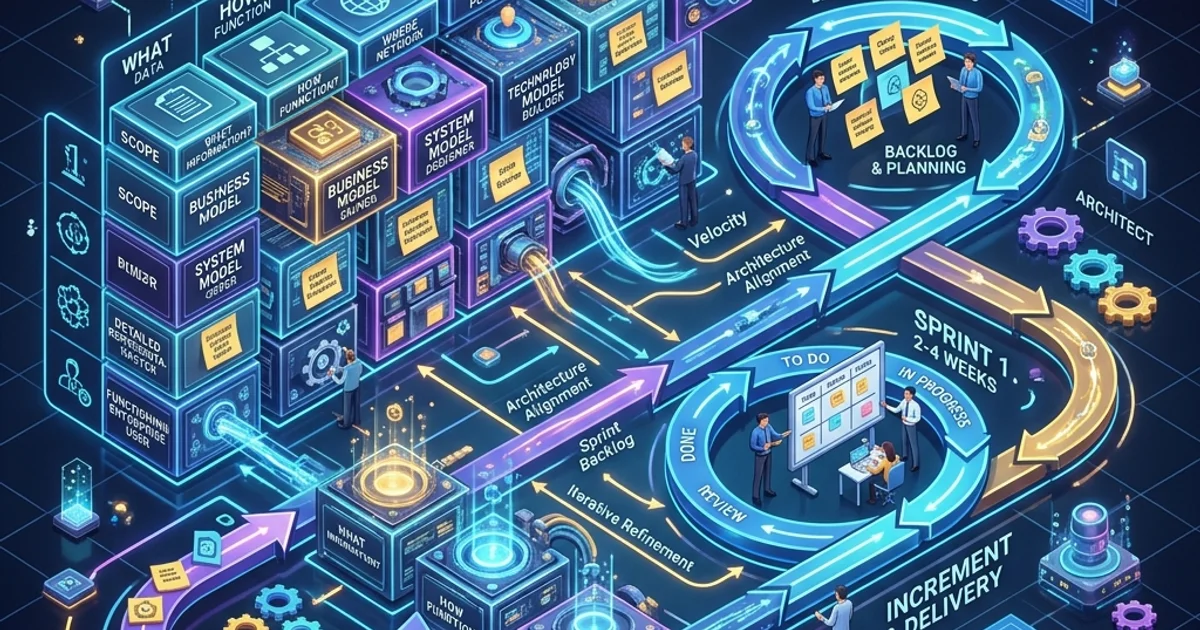
Zachman Framework in Practice: Digital Transformation Case Study
Digital transformation initiatives fail at alarming rates. Studies show 70% of major transformation projects fail or significantly underdeliver. The Zachman Framework, when applied systematically, increases success rates dramatically by ensuring alignment between business objectives and technology architecture throughout the entire transformation journey.
This post presents a real-world digital transformation case study using the Zachman Framework, showing how each row and column contributes to transformation success.
Case Study: Traditional Manufacturer Goes Digital
Background
Company: ABC Manufacturing Co. - 50-year-old industrial equipment manufacturer, $500M revenue, 2,000 employees
Problem: Legacy systems (20+ years old, COBOL, DOS-based), inefficient operations, customer complaints about slow service, losing market share to digital-first competitors
Objective: Complete digital transformation to compete with cloud-native startups, improve time-to-market, increase customer satisfaction
Budget: $50M over 3 years Timeline: 36 months Success Metrics: 30% reduction in order-to-delivery time, 50% cost reduction, 90%+ customer satisfaction
Phase 1: Row 1 - Define Strategic Intent (Weeks 1-4)
Team: CEO, CFO, CTO, COO (executive steering committee)
Row 1 Scope Definition
What (Entity Scope):
In-scope entities: Customers, Orders, Products, Inventory,
Suppliers, Shipments, Invoices, Payments

Out-of-scope (Year 1): Multi-supplier auctions,
customer communities, predictive analytics
Why (Strategic Objectives):
1. Reduce order-to-delivery time: 8 weeks → 2 weeks
2. Improve inventory turns: 4x/year → 8x/year
3. Increase customer satisfaction: 72% → 90%
4. Enable global distribution: Currently US only → 10 countries
5. Reduce operational costs: 40% reduction in COGSOutcome: Steering committee aligns on strategic intent. "We're transforming from a batch manufacturer to a customer-responsive, just-in-time operation."
Phase 2: Row 2 - Assess Current State (Weeks 5-12)
Team: Business process owners, IT operations, external consultants
Row 2: Current State Assessment
How (Current Processes):
- Order entry: Manual email/phone → spreadsheet → enters system (1-2 days delay)
- Inventory: Physical counts quarterly; perpetual system unreliable
- Fulfillment: Manual picking, batch processing weekly
- Billing: Invoices generated 30+ days after shipment (GAAP requirement)
Pain Points:
- Customer can't see order status (not tracked in real-time)
- Inventory "ghost" stock (system shows available, warehouse doesn't)
- 8-week lead time (5 weeks manufacturing, 2 weeks distribution, 1 week admin)
- 40% of orders require manual intervention (exceptions)
Outcome: Current state documented. GAP identified: Batch processes can't meet new requirements.
Phase 3: Row 3 - Define Target Architecture (Weeks 13-24)
Team: System architects, business analysts, technology strategists
Row 3 System Design
What (Data Model):
- Centralised product master (eliminate spreadsheet duplicates)
- Real-time inventory tracking (API-based sync from warehouses)
- Order history with full audit trail
- Supplier scorecards (for supply chain optimisation)
How (Processes):
- Online order entry → Real-time inventory validation → Immediate confirmation
- Just-in-time manufacturing (orders trigger production)
- Real-time fulfillment tracking
- Instant invoice generation on shipment
Where (Architecture):
- Cloud-based (AWS) for scalability
- 3-tier architecture (web, application, data)
- Microservices for modularity (order, inventory, manufacturing, fulfillment)
Why (Requirements):
- 99.9% uptime (SLA)
- Support 100x current traffic (for global expansion)
- GDPR compliant (for EU customers)
- Able to process 10,000 orders/day (vs. current 800)
Outcome: Target architecture designed. ROI model: $50M investment, 3-year payback, then $20M/year savings ongoing.
Phase 4: Row 4 - Technology Selection (Weeks 25-28)
Team: Infrastructure team, technology selection committee
Row 4 Technology Choices
Database: PostgreSQL (relational for transactional data, complex relationships) Backend: Java/Spring Boot (microservices, proven for enterprise) Frontend: React (rich user experience, mobile-friendly) Cloud: AWS (multiple AZs for high availability) Message Queue: Kafka (decouple order processing from manufacturing system) Analytics: BigQuery (for customer insights, product mix optimisation)
Infrastructure:
- Multi-region deployment (US primary, EU replica for GDPR)
- Kubernetes for container orchestration
- Infrastructure-as-Code (Terraform)
- RTO: 4 hours, RPO: 1 hour (disaster recovery)
Outcome: Technology stack selected. Build vs. buy analysis: 60% build (custom IP), 40% buy (Salesforce for CRM, SAP for ERP integration).
Phase 5: Row 5 - Development & Deployment (Weeks 29-96)
Team: Development teams (40 engineers), QA (10 people), DevOps (5 people)
Development Sprints
Sprint 1-4: Foundation (Order entry, basic inventory) Sprint 5-8: Fulfillment (Pick/pack, shipping, tracking) Sprint 9-12: Analytics & Reporting (Customer dashboards, KPI tracking) Sprint 13-18: Scale & Optimisation (Performance tuning, load testing)
Key Deliverables:
- Automated testing (70% code coverage)
- CI/CD pipeline (deploy 10x/week)
- Infrastructure deployed (dev, test, staging, production)
- Documentation (architecture, APIs, operations runbooks)
Risk Mitigation:
- Parallel run (legacy + new system) for 4 weeks
- Phased rollout (10% of customers → 50% → 100%)
- Rollback plan (if critical issues, return to legacy)
Outcome: System deployed to production. First 100 orders processed successfully using new system. (Legacy system still handles 90%).
Phase 6: Row 6 - Monitor & Optimise (Week 97+ ongoing)
Team: Operations team, continuous improvement team
Live System Metrics
Order Processing:
- Real-time order entry → Status tracking (vs. 1-2 day email delays)
- Order-to-delivery time: 8 weeks → 3 weeks (37.5% reduction towards 2-week target)
- Manual intervention: 40% → 8% (automated exception handling)
- Customer satisfaction with order process: 72% → 81% (improving)
Inventory:
- Real-time accuracy: 62% → 98% (near-perfect)
- Inventory turns: 4x/year → 6x/year (progressing towards 8x goal)
- Carrying cost reduction: 15% (target: 25%)
Financial:
- Operating costs reduced: 12% (vs. 40% target; need Phase 2 optimisation)
- Revenue increased: 8% (from faster time-to-market enabling new customers)
- System ROI: Breaking even (on track for 3-year payback)
System Health:
- Uptime: 99.94% (vs. 99.9% SLA) ✓
- API latency (p95): 240ms (target: <00ms) ✓
- Database size: 280 GB (growing 50 GB/month; 2-year runway before rearchitecting)
Continuous Improvement
Month 6 (after Phase 2 deployment):
- Phase 2: Manufacturing integration (orders trigger just-in-time production)
- Target: Reduce order-to-delivery from 3 weeks to 2 weeks
Month 12:
- Phase 3: Supplier integration (automatic reorder points based on demand forecast)
- Target: Further 20% cost reduction
Month 18+:
- Phase 4: Advanced analytics (predictive demand forecasting, customer segmentation)
- Target: Proactive supply chain optimisation
Key Success Factors Using Zachman
-
Row 1 Alignment: Executive steering committee agreed on strategic intent upfront. No mid-project pivots.
-
Row 2 Honest Assessment: Documented real pain points (not sanitised). Led to targeted solutions.
-
Row 3 Clear Requirements: Architecture team specified requirements technology-independently. Any team could have implemented.
-
Row 4 Pragmatic Choices: Technology selected to meet requirements (not tech-for-tech's-sake). Build/buy balance thoughtful.
-
Row 5 Disciplined Execution: Strong CI/CD, testing, documentation enabled rapid delivery.
-
Row 6 Continuous Measurement: Live metrics drove optimisation. Not a "deploy and forget" project.
Transformation Timeline & Budget
| Phase | Duration | Team Size | Cost | Cumulative |
|---|---|---|---|---|
| Row 1-2 (Plan & Assess) | 12 weeks | 25 people | $3M | $3M |
| Row 3-4 (Design & Tech) | 12 weeks | 35 people | $5M | $8M |
| Row 5 Dev & Deploy (Phase 1) | 24 weeks | 60 people | $18M | $26M |
| Row 5 Dev & Deploy (Phase 2-3) | 24 weeks | 50 people | $15M | $41M |
| Row 6 Optimise & Scale | Ongoing | 30 people | $9M/year | - |
Total 3-Year Investment: $50M Expected Ongoing Savings: $20M/year (payback in 2.5 years)
Lessons Learned
-
Don't skip Row 1 & 2: Tempting to jump to technology. Taking time to align strategy and understand current state prevents costly rework.
-
Row 3 Requirements Must Be Clear: Vague requirements led to rework in Sprints 3-4. Spending extra time on Row 3 would have saved weeks in execution.
-
Parallel Run (Row 5-6): Running legacy + new system in parallel for 4 weeks caught critical bugs before full cutover.
-
Row 6 Metrics Drive Decisions: Data showed Phase 2 justification (manufacturing integration). Otherwise might have focused on less impactful optimisations.
-
Phased Rollout Reduces Risk: Rather than "big bang" deployment, phased 10% → 50% → 100% enabled course corrections.
Key Takeaways
-
Zachman provides structure: Systematic approach reduces chaos in large transformations.
-
Each row adds value: Don't skip rows; each layer provides critical oversight.
-
Business outcomes matter most: Technology is a means to business ends; keep focus on Row 1 objectives.
-
Continuous measurement enables optimisation: Row 6 metrics guide next phases.
-
Transformation is ongoing: ABC Manufacturing's journey continues (Phase 2-3 in progress). Treat as 3-year+ roadmap, not one-time project.
Next Steps
- Apply Zachman Methodology to your own transformation roadmap.
- Read ROI Calculation to justify investments to CFO.
- Explore Change Management for overcoming resistance to transformation.
The Zachman Framework transforms digital transformation from chaotic guesswork to systematic, measurable progress. Use it.
Meta Keywords: Zachman Framework application, digital transformation, case study, enterprise architecture practice.