
Data Governance Framework Using Zachman Matrix: Comprehensive Strategy
Implement enterprise data governance using Zachman Framework - 6x6 matrix approach to data architecture, quality, stewardship, and compliance.
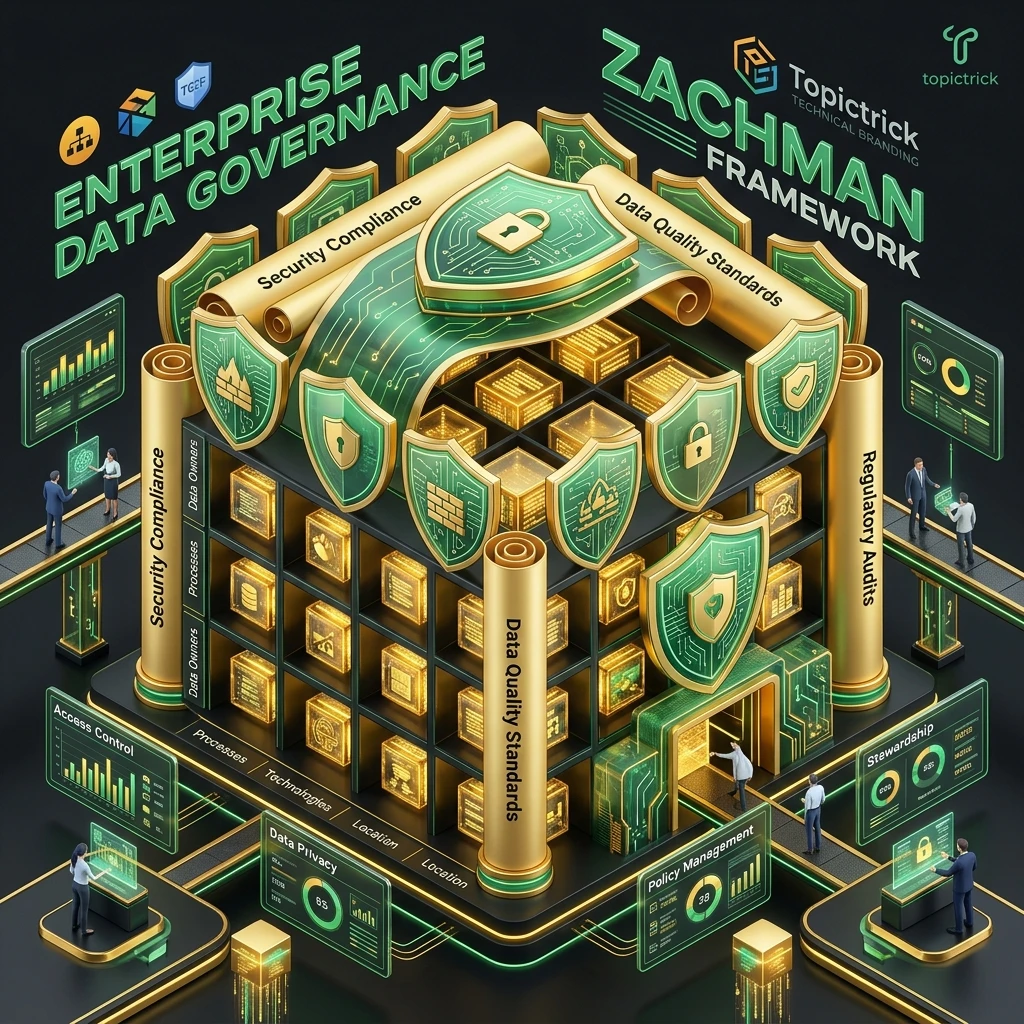
Data Governance Framework Using Zachman Matrix: Comprehensive Strategy
Data has become the most valuable asset in enterprises. Yet 60-70% of data initiatives fail because governance is applied ad-hoc or as an afterthought. The Zachman Framework, when applied to data governance, provides a systematic, complete approach to ensuring data quality, compliance, and strategic value.
This post shows how to use Zachman's 6x6 matrix to build a comprehensive data governance framework.
Why Zachman for Data Governance?
Traditional data governance frameworks (DMBOK, DAMA) focus on organizational structures and processes. Zachman uniquely provides a complete matrix ensuring no aspect is overlooked:
- All perspectives represented (Planner, Owner, Designer, Builder, Operator, Enterprise)
- All interrogatives covered (What, How, Where, Who, When, Why)
- No blind spots (each cell addressed)
Result: Data governance that's holistic, not piecemeal.
Zachman Data Governance Matrix
Row 1: Planner (Strategic Data Vision)
Column 1 (What): Data entities in scope
- Customer, Product, Order, Supplier, Account, Transaction data
- Strategic data assets (customer insights, predictive models)
Column 2 (How): Data flow and value chain
- Data collection → cleansing → enrichment → analytics → action
- Value generation: Insight → Decision → Competitive advantage
Column 3 (Where): Geographic/regulatory scope
- US operations, EU (GDPR), APAC (data residency requirements)
- Data must stay in-region per regulations
Column 4 (Who): Stakeholder commitment
- CEO: Data-driven decision making (strategic intent)
- CFO: Cost control (data management costs <% of IT budget)
- CTO: Technology enablement (data platform)
- Business unit heads: Data quality accountability
Column 5 (When): Timeline and milestones
- Year 1: Governance framework (policies, roles, standards)
- Year 2: Master data management (single source of truth)
- Year 3: Advanced analytics (predictive insights)
Column 6 (Why): Business value and objectives
- Reduce risk (compliance, data breaches)
- Increase revenue (better customer insights)
- Reduce costs (eliminate redundant data, automated insights)
Row 2: Owner (Current State Data Assessment)
Column 1 (What): Inventory of existing data
Existing databases: 47
  - CRM (Salesforce): 2.3M customer records
  - ERP (SAP): 89M transaction records
  - Data warehouse (Teradata): 450 GB
  - Data lake (Hadoop): 2.1 PB unstructured

Data quality: 54% (defined as "complete, accurate, timely")
  - Customer emails: 78% match (duplicates, typos)
  - Product hierarchy: 12% incorrect classifications
  - Transaction amounts: 99.8% accurate (good)
Column 2 (How): Current data processes
- ETL: Manual, scheduled batch jobs (1 engineer manages all)
- Data quality: Reactive (detected in reporting failures)
- Master data: Replicated across systems (inconsistent)
Column 3 (Where): Current infrastructure
- Single US datacenter (RTO 8 hours, RPO 24 hours)
- No geographic distribution (EU customers get poor latency)
Column 4 (Who): Current ownership
- No data governance function
- Business units own their data (creates silos)
- No accountability for quality
Column 5 (When): Current SLAs
- Data availability: 99.2% (target: 99.95%)
- Data refresh: Batch daily (target: Real-time)
Column 6 (Why): Current business impact
- Data quality issues cost 15% of revenue (incorrect orders, shipped to wrong address)
- Compliance violations: 3 in past 2 years (fines: $500K total)
Row 3: Designer (Target Data Architecture)
Column 1 (What): Data model
- Unified customer view (360° view across all channels)
- Product hierarchy (standardised, single classification)
- Order-to-cash process (end-to-end visibility)
- Master data repositories for: Customer, Product, Supplier, GL account
Column 2 (How): Data architecture
  Operational Systems (Real-time)
         ↓
  Integration Layer (API, ETL)
         ↓
  Master Data Management (MDM) - Single Source of Truth
         ↓
  Data Warehouse (Historical + dimensional)
         ↓
  Data Lake (Raw, unstructured, Big Data)
         ↓
  Analytics/BI (Reporting, dashboards, ML models)
         ↓
  Business Applications (CRM, ERP, Marketing)
Column 3 (Where): Multi-region architecture
- US primary (East region)
- EU (Frankfurt) - GDPR compliant, no cross-border transfer
- APAC (Singapore) - for regional customers
- Backup sites for disaster recovery (RTO: 4 hours, RPO: 1 hour)
Column 4 (Who): Governance structure
Chief Data Officer (new role)
  ├─ Data Governance Lead (policies, standards)
  ├─ Master Data Management Lead (MDM platform)
  ├─ Data Quality Lead (quality metrics, remediation)
  ├─ Data Architecture Lead (technical design)
  └─ Business Data Stewards (one per business unit)
     ├─ Finance Data Steward (GL, budgets)
     ├─ Sales Data Steward (customers, opportunities)
     ├─ Marketing Data Steward (campaigns, leads)
     └─ Operations Data Steward (orders, inventory)
Column 5 (When): Data lifecycle management
- Retention: Keep operational data 7 years (regulatory requirement)
- Archival: Move to cold storage after 3 years (cost optimisation)
- Deletion: Remove personal data after retention period (GDPR right to be forgotten)
Column 6 (Why): Data governance policies
- Data ownership: Each business unit accountable for their data quality
- Data classification: Public, internal, confidential, personal data
- Data lineage: Track data from source to consumption (compliance)
- Metadata management: Document all data assets (discoverability)
Row 4: Builder (Data Technology Specifications)
Column 1 (What): Database technology choices
- Master Data Management (MDM): Informatica MDM (industry standard)
- Data warehouse: Snowflake (modern, cloud-native)
- Data lake: AWS S3 (scalable, cost-effective)
- Metadata repository: Apache Atlas (open source)
Column 2 (How): Data integration patterns
- API-first integration (vs. file-based)
- ELT (vs. traditional ETL): Extract, Load, Transform (big data approach)
- Event-driven architecture (Kafka for real-time data sync)
- Data quality rules: Defined in code (gitOps)
Column 3 (Where): Infrastructure configuration
Multi-region Snowflake clusters:
  - US: 8-node cluster (storage: 100 GB/day)
  - EU: 6-node cluster (GDPR-compliant, isolated)
  - APAC: 4-node cluster (read-only copy, for local BI)

Replication:
  - US → EU: Daily batch (GDPR compliant, no real-time EU)
  - US → APAC: Real-time read replica (performance)
Column 4 (Who): Access control specification
- Role-based access: Analyst, Data Scientist, Engineer, Admin
- Masking: PII (phone, email, SSN) masked for analysts
- Row-level security: Sales team sees only their customer data
- Audit logging: All data access logged (compliance)
Column 5 (When): Data refresh schedules
Real-time (sub-1 second):
  - Customer transactions (point-of-sale)
  - Website behavior (real-time personalization)

Hourly:
  - Inventory levels
  - Campaign performance

Daily:
  - Financial data (GL)
  - Supplier data

Weekly:
  - Market data (external sources)
  - Competitive pricing
Column 6 (Why): Data governance configurations
- Data quality rules: Automated tests (pass/fail on ingestion)
- Compliance controls: GDPR (EU customer data), CCPA (CA customers), PCI DSS (payment card data)
- Data lineage: Automated tracking (from source system to final report)
- Metadata: Auto-generated technical + manual business descriptions
Row 5: Builder (Implementation & Deployment)
Column 1 (What): Data pipeline code
# Data quality validation (executed before data loads)
def validate_customer_data(batch):
    """Validate customer records meet quality standards."""
    validations = {
        'email_not_null': batch['email'].notna().all(),
        'email_valid': batch['email'].str.match(r'^.+@.+\..+$').all(),
        'duplicate_check': len(batch) == len(batch.drop_duplicates(subset=['email'])),
        'phone_format': batch['phone'].str.match(r'^\d{3}-\d{3}-\d{4}$|^$').all()
    }

    if not all(validations.values()):
        failed = [k for k, v in validations.items() if not v]
        raise ValidationError(f"Data quality failed: {failed}")

    return batch  # Validation passed
Column 2 (How): ETL/ELT code (Apache Airflow)
# Pipeline: Load customer data to MDM
dag_name: daily_customer_load
schedule: 0 2 * * * # 2 AM daily
tasks:
1_extract:
type: salesforce_api
source: Salesforce CRM
query: "SELECT * FROM Customer WHERE modified >= yesterday"
2_validate:
type: quality_check
rules: ['email_valid', 'phone_format', 'duplicate_check']
on_failure: pause_and_alert
3_transform:
type: python
script: transform_customer.py
operations: [standardize_names, deduplicate, enrich_with_firmographics]
4_load_mdm:
type: informatica_mdm
target: Master Customer MDM
action: upsert (update if exists, insert if new)
5_quality_check:
type: sql_query
query: "SELECT COUNT(*) as error_count FROM customer_quality_errors"
pass_if: error_count <= 5 (allow <% error rate)Column 3 (Where): Deployment automation
# Deploy MDM configuration to prod
terraform apply  # Infrastructure

# Deploy data pipelines
airflow dags test daily_customer_load
airflow dags unpause daily_customer_load

# Deploy quality checks
dbt test
dbt run

# Monitor deployment
datadog dashboard: https://app.datadoghq.com/dashboard/data-governance
Column 4 (Who): Access provisioning automation
-- Create analyst role (read-only, data masked)
CREATE ROLE analyst_role;
GRANT SELECT ON SCHEMA analytics TO analyst_role;
GRANT ROLE analyst_role TO USER john.doe@company.com;

-- Apply row-level security (sales team sees only their region)
CREATE POLICY sales_region_policy ON orders
  USING (region = current_setting('session.user_region'));

-- Apply column masking (hide PII)
ALTER TABLE customers
  ALTER COLUMN email MASKED WITH (FUNCTION = 'email()');
Column 5 (When): Scheduled jobs configuration
0 2 * * * /scripts/customer_daily_load.sh         # Daily 2 AM
0 * * * * /scripts/real_time_order_sync.sh        # Hourly
0 6 * * 0 /scripts/weekly_data_quality_report.sh  # Weekly
0 0 1 * * /scripts/monthly_compliance_audit.sh    # Monthly
Column 6 (Why): Policy code (compliance as code)
# GDPR compliance automation
def apply_gdpr_compliance():
    """Ensure GDPR rules are enforced."""

    # Right to be forgotten
    delete_personal_data_after_retention('customers',
      retention_years=3)

    # Data minimisation
    mask_non_essential_pii('orders')

    # Data portability
    export_customer_data_json()

    # Consent tracking
    verify_consent_for_marketing_data()
Row 6: Enterprise (Live Data Governance Metrics)
Column 1 (What): Data quality metrics
Overall Data Quality: 87% (target: 95%)

Customer data:
  - Completeness: 94% (fields populated)
  - Accuracy: 91% (validated against source)
  - Timeliness: 78% (updated within SLA) ⚠️

Product data:
  - Completeness: 99%
  - Accuracy: 98%
  - Timeliness: 100%

Trend: Quality improving 2% per month
Column 2 (How): Process efficiency
Data pipeline uptime: 99.8%
Average ETL duration: 47 minutes (target: < hour) ✓
Error resolution time: 2.3 hours (manual fix needed)
Business impact from quality issues: $200K/month (target: <$50K)
Column 3 (Where): Multi-region status
US: OPERATIONAL, 99.95% uptime
EU: OPERATIONAL, 99.94% uptime (slight latency due to GDPR sync)
APAC: OPERATIONAL, 99.92% uptime (read-only copy)

Data residency compliance: 100% (EU data in EU, US in US)
Column 4 (Who): Governance effectiveness
Data steward coverage: 95% (24 of 25 stewards assigned)
Data issue response time: 1.2 days (target: < day)
Compliance violations: 0 (vs. 3 per year historically)
Column 5 (When): SLA compliance
Real-time data: 99.7% (target: 99.9%) ⚠️
Daily refresh: 100%
Weekly refresh: 100%

Performance trend: Steady, but need to optimize real-time pipeline
Column 6 (Why): Business impact
Cost savings: $2.3M/year (eliminated redundant systems, storage)
Revenue impact: $5.1M (better customer insights → 8% upsell increase)
Compliance: Zero violations (cost avoidance: $1M+)
Risk reduction: Enhanced cybersecurity (data classification)
Implementation Roadmap
| Phase | Timeline | Focus | Team | Investment |
|---|---|---|---|---|
| Phase 1 | Months 1-3 | Governance foundation (policies, roles, CDO hire) | 8 people | $1.2M |
| Phase 2 | Months 4-9 | MDM platform (customer master data) | 15 people | $2.8M |
| Phase 3 | Months 10-15 | Data warehouse modernization (Snowflake) | 20 people | $3.5M |
| Phase 4 | Months 16-21 | Advanced analytics platform | 25 people | $4.2M |
| Total Year 1 | 12 months | Build comprehensive data governance | 25-30 avg | $11.7M |
| Ongoing | Year 2+ | Maintenance, optimization, advanced use cases | 12 people | $3.2M/year |
Key Takeaways
-
Zachman ensures completeness: All 6 rows x 6 columns prevents blind spots in data governance.
-
Row 1-2 alignment is critical: Executives must agree on data strategy before implementing technology.
-
Row 3 architecture guides all downstream work: Clear target architecture prevents rework.
-
Row 5-6 execution and metrics prove value: Governance is validated by operational metrics and business impact.
-
Governance is ongoing: Not a one-time implementation; continuous improvement cycle.
Next Steps
- Define data governance roadmap for your enterprise
- Identify quick wins (data quality issues costing most)
- Build CDO role and team (governance requires dedicated leadership)
Data governance ensures your data becomes strategic asset, not liability.
Meta Keywords: Data governance, Zachman Framework, master data management, data quality, enterprise architecture.