
Cloud Migration Strategy Using Zachman Framework: Multi-Cloud Architecture
Plan and execute enterprise cloud migration using Zachman Framework - assess current state, design target, implement phased cloud strategy for multi-cloud environments.
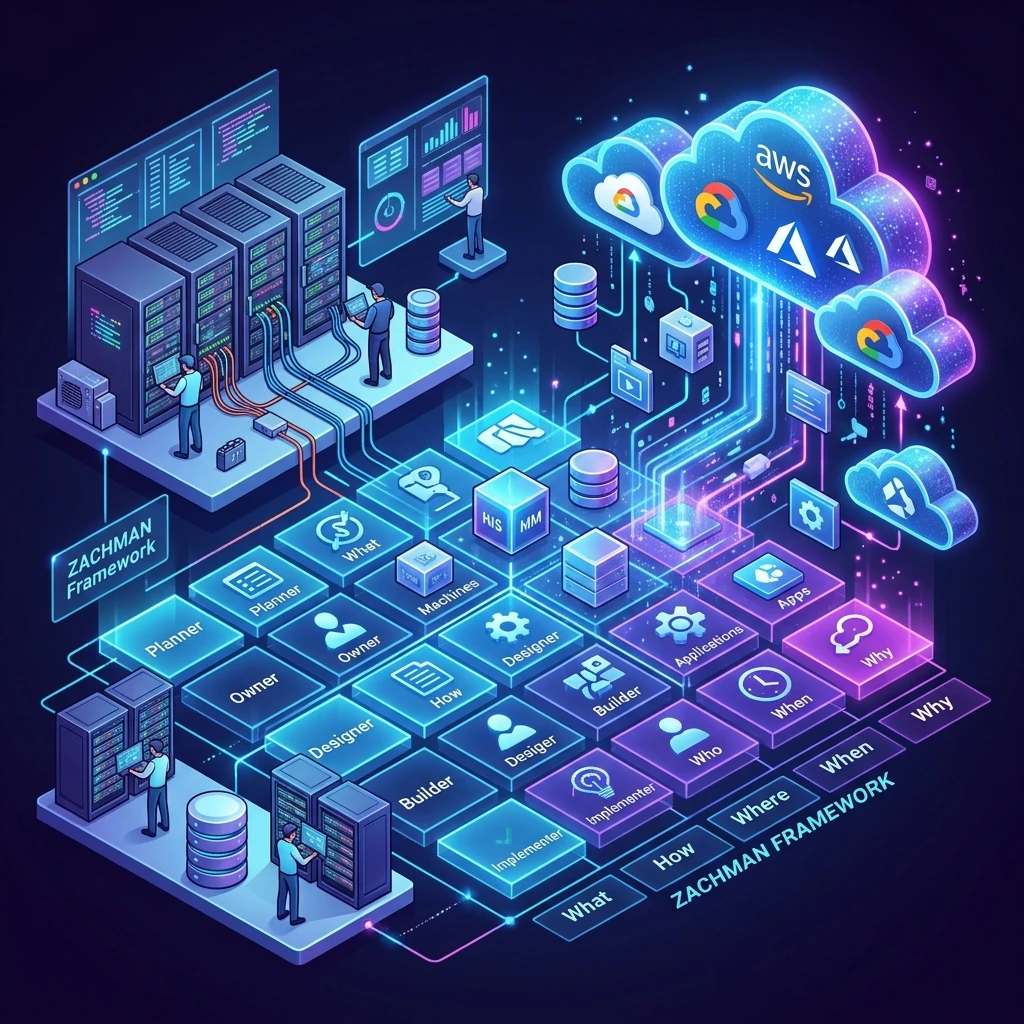
Cloud Migration Strategy Using Zachman Framework: Multi-Cloud Architecture
Cloud migration is the most significant infrastructure transformation many enterprises undertake. Yet 40-50% of migrations exceed budget or timeline. The Zachman Framework provides a systematic approach to planning, executing, and optimizing cloud migration without surprises.
This post shows how to use Zachman to architect a comprehensive, phased cloud migration strategy.
Why Zachman for Cloud Migration?
Cloud decisions impact every layer of enterprise architecture:
- Business: Cost model (CapEx → OpEx), scalability, global reach
- Technical: Infrastructure, data residency, security, disaster recovery
- Operational: Skills, processes, governance
Zachman ensures all layers align.
Case Study: Legacy Bank's Cloud Migration
Starting State
- 200+ applications across 8 datacenters
- On-premises: $120M annual infrastructure cost
- Mainframe + Unix + Windows (50-year-old systems)
- Complex dependencies (hard to disentangle)
Target State
- 60% cloud (AWS, Azure), 40% on-premises (colocated)
- Cost: $80M annually (33% reduction)
- Timeline: 3 years
- Outcomes: Faster time-to-market, global reach, 99.99% uptime
Zachman Cloud Migration Approach
Row 1: Strategic Intent (Weeks 1-4)
Column 1 (What): Scope
- In-scope: 150 of 200 apps (cloud-ready)
- Out-of-scope: 50 apps (regulatory constraints, mainframe dependencies)
Column 2 (Why): Strategic objectives
- Reduce cost: $120M → $80M
- Accelerate innovation: 6-month release cycle (vs. current 12-month)
- Enable geographic expansion: Support customers in 20+ countries
- Improve reliability: 99.99% uptime (vs. current 98%)
Row 2: Current State Assessment (Weeks 5-16)
Column 1 (What): Application inventory
200 Applications categorized:
  - Critical (50): Banking core, fraud, compliance
  - Important (80): Customer-facing, data processing
  - Supporting (70): Internal tools, legacy systems

Technology breakdown:
  - Mainframe: 15 apps (very hard to move)
  - Legacy Unix: 35 apps (moderate difficulty)
  - Windows: 80 apps (moderate difficulty)
  - Java/Linux: 70 apps (cloud-ready)

Data requirements:
  - 8 TB critical data (customer, regulatory)
  - 47 TB historical data (archive)
  - Residency: US (primary), EU (compliant copy)
Column 3 (Where): Current infrastructure
- 8 datacenters (US, Europe, APAC)
- Total capacity: 2,500 physical servers, 18 PB storage
- Utilization: 45% (overprovisioned for peaks)
Row 3: Target Architecture (Weeks 17-32)
Column 1 (What): Cloud data architecture
- Critical data: AWS RDS (Multi-AZ, encrypted)
- Big data: AWS S3 + Redshift (analytics)
- EU data: Azure (EU region, GDPR)
- Archive: AWS Glacier (cost-optimized cold storage)
Column 2 (How): Cloud operating model
AWS Primary (60% of apps):
  - Microservices (containerized)
  - Kubernetes (EKS) for orchestration
  - Serverless (Lambda) for event-driven

Azure (25% of apps):
  - Hybrid cloud (on-premises + Azure)
  - Virtual machines (for legacy apps)
  - App Services (PaaS for modern apps)

On-Premises (15% of apps):
  - Colocated (rented rack space)
  - Mainframe (if no alternative)
  - Hybrid: Connect to cloud via ExpressRoute/Direct Connect
Column 3 (Where): Multi-region strategy
AWS:
  - Primary: us-east-1 (US customers)
  - DR: us-west-2 (disaster recovery)
  - Global: CloudFront CDN (edge locations)

Azure:
  - Primary: eu-central-1 (EU customers, GDPR)
  - Secondary: eu-west-1 (redundancy)

On-Premises:
  - Colocated: 2 data centers (redundancy)
  - Connect to cloud: AWS Direct Connect + Azure ExpressRoute
Row 4: Technology Selection (Weeks 33-40)
Cloud Services Chosen:
For workload type:
- Lift & shift (rehost): AWS EC2, Azure VMs
- Replatform (minor optimization): AWS RDS, Azure SQL
- Refactor (cloud-native): Kubernetes, Serverless
- Repurchase (SaaS): Salesforce, ServiceNow, Workday
Platform choices:
- Primary: AWS (cost-effective, broad services)
- Secondary: Azure (hybrid benefits for Windows shops)
- Multi-cloud approach (avoid lock-in, best-of-breed services)
Row 5: Implementation & Deployment (Weeks 41-156)
Phased Migration Plan:
| Wave | Apps | Timeline | Strategy | Outcome |
|---|---|---|---|---|
| Wave 1 | 20 | Months 1-6 | Cloud-native, greenfield | Proof of concept, learn |
| Wave 2 | 40 | Months 7-18 | Replatform, re-architect | Gain confidence |
| Wave 3 | 60 | Months 19-30 | Lift & shift, bulk migration | Scale and optimize |
| Wave 4 | 30 | Months 31-36 | Complex, dependencies | Final apps, on-premises only |
Wave 1 Example (20 cloud-ready apps):
- App modernization: Containerize (Docker)
- Infrastructure: Deploy to AWS EKS (Kubernetes)
- Database: Migrate to AWS RDS (managed database)
- Security: Enable encryption, VPC isolation
- Testing: Performance test, security scan
- Cutover: Parallel run 2 weeks, then DNS switch
Timeline:
- Weeks 1-2: Containerize apps
- Weeks 3-4: Deploy to AWS (dev environment)
- Weeks 5-6: QA testing, performance tuning
- Weeks 7-8: Production deployment, parallel run
- Weeks 9-12: Optimize, decommission on-premises
Row 6: Operational Metrics (Ongoing)
Application Metrics:
Wave 1 Apps (20 total):
  - Deployment status: 18 in production, 2 in testing
  - Performance: 89% meeting SLA (target: >95%)
  - Cost/month: $23K (vs. $35K on-premises)
  - Reliability: 99.94% (vs. 98% on-prem)

Staffing Requirements:
  - AWS: 4 engineers (platform)
  - Azure: 2 engineers (legacy apps)
  - DevOps: 6 engineers (automation)
  - Total: 12 engineers (vs. 25 on-premises)  -  50% reduction
Multi-Cloud Governance in Zachman
Row 3: Multi-Cloud Architecture Principles
Principle 1: Service mapping
AWS services → Azure equivalents → Keep options open

Compute: EC2 ↔ Virtual Machines (both VM-based)
       : Lambda ↔ Functions (both serverless)

Database: RDS ↔ SQL Database (both managed SQL)
        : DynamoDB ↔ Cosmos DB (both NoSQL)

Containers: ECS ↔ Container Instances (container management)
Principle 2: Data residency rules
US customers: AWS us-east-1 (US region)
EU customers: Azure eu-central (GDPR, data residency)
APAC customers: AWS ap-northeast (local residency)
Principle 3: Avoid lock-in
Don't use proprietary services:
  ❌ AWS proprietary: Lambda (too specific)
  ✓ Standard: Kubernetes (portable across clouds)

  ❌ Azure-only: Cosmos DB (too specific)
  ✓ Standard: PostgreSQL (standard database)
Row 5: Multi-Cloud Implementation
Container-based portability (reduces lock-in):
# Dockerfile: Works on AWS, Azure, any cloud
FROM openjdk:11
COPY app.jar /app.jar
ENTRYPOINT ["java", "-jar", "/app.jar"]

# Kubernetes manifest: Deploy on AWS EKS, Azure AKS, any K8s
apiVersion: apps/v1
kind: Deployment
metadata:
  name: myapp
spec:
  replicas: 3
  template:
    spec:
      containers:
      - name: myapp
        image: myregistry.azurecr.io/myapp:1.0.0
        # Runs identically on AWS EKS, Azure AKS, or on-prem K8s
Data synchronization (for multi-region):
# Sync US (AWS) → EU (Azure) respecting GDPR
def sync_regional_data():
    us_data = get_data_from_aws_s3()  # US customer data

    # Filter PII, anonymize where needed
    eu_data = apply_gdpr_transformations(us_data)

    # Sync only non-PII or aggregated data to EU
    push_to_azure_storage(eu_data)
Migration Risk Mitigation
| Risk | Mitigation | Owner |
|---|---|---|
| Performance degradation | Benchmark before/after, tune infrastructure | Cloud architect |
| Security breach | Security review, penetration testing pre-cutover | CISO |
| Regulatory non-compliance | Compliance review per region (GDPR, HIPAA, etc.) | Compliance officer |
| Vendor lock-in | Use portable technologies (containers, K8s) | Enterprise architect |
| Cost overruns | Set spending limits, monitor daily | Finance |
| Timeline slips | Wave-based approach, buffer time | Program manager |
| Skills gap | Training, hiring, external consulting | HR + CTO |
Cost Analysis: On-Premises vs. Cloud
On-Premises ($120M annually):
- Hardware: $35M (50 PB storage, 2,500 servers)
- Staffing: $45M (25 engineers, 8 datacenters)
- Real estate: $15M (space, power, cooling)
- Networking: $8M (WAN connections)
- Software licenses: $12M (OS, databases)
- Other: $5M (maintenance, tools)
Cloud ($80M annually):
- Compute (EC2, containers): $28M
- Storage & database: $18M
- Networking: $6M
- Staffing (reduced): $22M (12 engineers)
- Software/SaaS: $4M
- Other: $2M
Net savings: $40M annually (33% reduction)
Key Takeaways
-
Zachman forces completeness: All perspectives (business, technical, operational) considered.
-
Multi-cloud is about options: Use different clouds where each excels; avoid unnecessary lock-in.
-
Phased approach reduces risk: Wave 1 teaches lessons for Wave 2-3.
-
Operational metrics prove value: Track cost, performance, reliability post-migration.
-
Cloud is not "rip and replace": Hybrid cloud (cloud + on-premises) is common for 3-5 year transition.
Next Steps
- Assess current application portfolio (which apps are cloud-ready?)
- Define target cloud strategy (AWS, Azure, multi-cloud, hybrid?)
- Create phased migration roadmap (waves, timeline, teams)
Cloud migration is complex, but with Zachman's systematic approach, it's manageable.
Meta Keywords: Cloud migration, Zachman Framework, multi-cloud strategy, AWS, Azure, hybrid cloud.