
TOGAF Phase B Business Architecture: Business Service Models
Explore TOGAF Phase B business service models, actor and role definitions, and business functions, and how services connect capabilities to information.
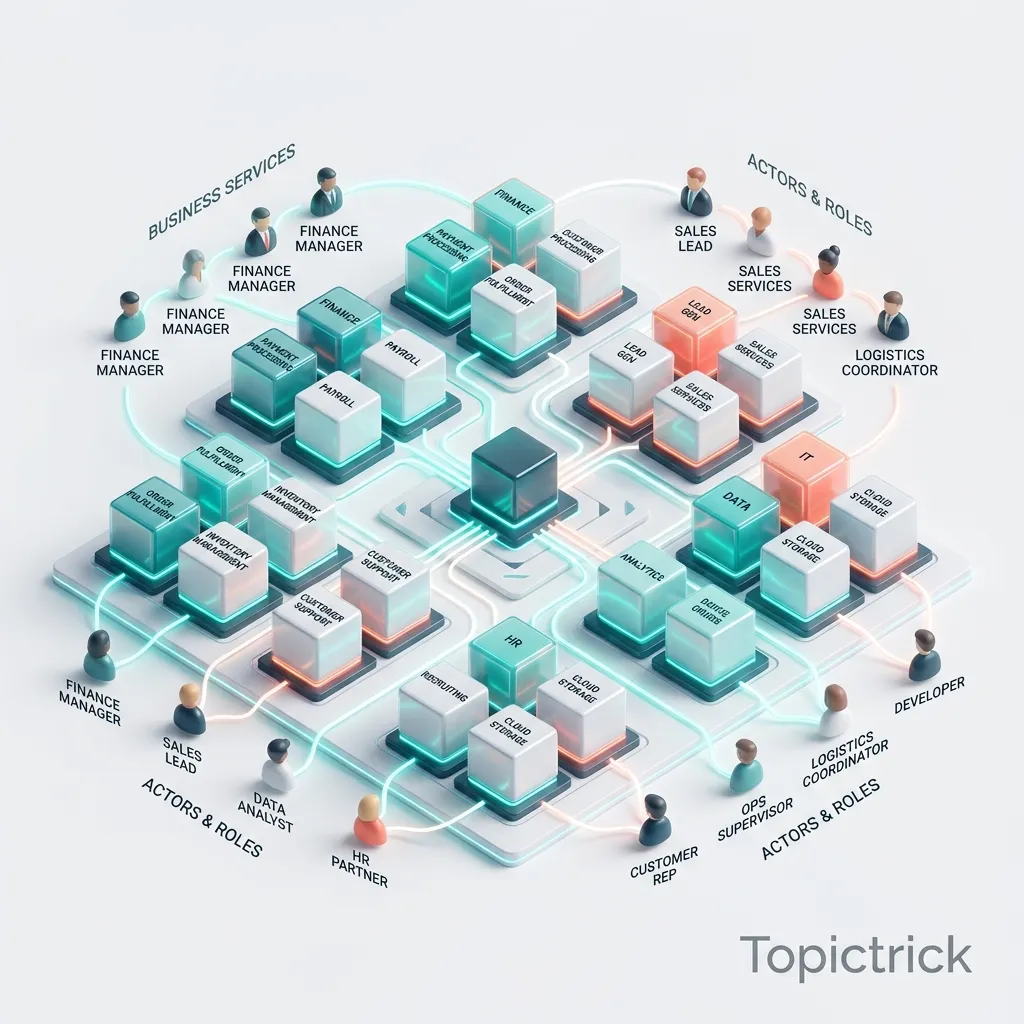
What Are Business Services in TOGAF?
In TOGAF Phase B, a business service is a defined unit of business functionality exposed to internal or external consumers. Business services are the connection point between the Business Architecture (Phase B) and the Information Systems Architecture (Phase C): every application component in Phase C must trace back to a business service it supports. Defining services clearly in Phase B prevents expensive rework when Phase C applications are designed against unclear requirements.
In the first part of Phase B, we established the Business Capability Model and mapped the key processes that deliver those capabilities. This second part goes deeper into how the business is actually structured to deliver its work, through business services, functions, actors, and roles.
Understanding these elements is what separates a surface-level Business Architecture from one that truly illuminates organizational complexity. It is also where the link between Phase B and Phase C (Information Systems Architecture) becomes visible: business services define what information systems must support.
Recap: Where We Are in Phase B
To briefly set context: Phase B develops the Business Architecture. In Part 1, we defined business capabilities, built the capability map, modeled business processes and performed a gap analysis between the baseline and target.
This post continues from that foundation and covers:
- Business functions and how they differ from capabilities and processes
- Business services: the externally observable outcomes the business delivers
- Actors and roles: who delivers those services
- Business interaction models: how organizational units collaborate
- Information needs from the business perspective, which feeds directly into Phase C
Business Functions
A business function is a unit of business capability that groups related activities together. Functions are often aligned with organizational departments or specialist teams.
The distinction between a function and a capability can seem subtle, but it is important:
- A capability is what the organization can do (independent of who does it)
- A function is how a specific part of the organization is organized to perform related tasks
For example, an organization might have a "Credit Risk Assessment" capability. The function that delivers this is the "Credit Risk Team", which performs related activities like reviewing applications, running credit bureau queries, applying credit policy rules, and escalating borderline cases for senior review.
Functions are useful in Business Architecture because they connect capabilities to the organizational structures that deliver them. When an organization restructures, functions change. When capabilities need to improve, architects know which function to focus on.
Business Functions in the Baseline
Documenting baseline business functions reveals misalignments that are often invisible until they are drawn out:
- Functions that are duplicated across organizational units
- Capabilities that have no clear ownership (performed informally across multiple teams)
- Functions whose boundaries cut across business capabilities in ways that create process inefficiencies
Business Services
A business service represents a defined unit of business functionality that is exposed to and consumed by other parts of the organization or by external parties. Business services are the externally visible outputs of a business function.
This concept is important for two reasons. First, it creates a stable contract between different parts of the organization. Regardless of how Service A internally reorganizes or automates its work, the service it exposes to Service B remains consistent.
Second, business services are what information systems must eventually support. When Phase C designs the Application Architecture, the applications must be capable of delivering the identified business services. This creates a direct traceability chain from business need to technology solution.
Characteristics of a Well-Defined Business Service
- Defined name: Clear, business-language name such as "Customer Credit Check Service" or "Account Opening Service"
- Consumer: Who uses this service (internal teams, external customers, partner organizations)
- Provider: Which function or organizational unit delivers this service
- Inputs: What information or triggers are required for the service to begin
- Outputs: What the consumer receives when the service completes
- Service levels: Expected response times, availability, and quality standards
- Supported capabilities: Which capabilities this service delivers
Business Services Enable SOA Alignment
Business Services in TOGAF closely align with the concept of services in Service-Oriented Architecture (SOA). Organizations that define business services clearly in Phase B produce much better-aligned Application Architectures in Phase C, because application services can be designed to map directly to business services.
Actors and Roles
Actors and roles describe the human and organizational participants in business processes and service delivery.
Actor
An actor is an individual person, system, or organization that initiates or interacts with activities in the architecture. Actors are real-world entities that trigger processes or consume services.
Examples of actors:
- A customer applying for a mortgage (external actor)
- A branch manager approving a transaction limit override (internal actor)
- A regulatory body submitting a data request (external actor)
- An automated batch processing system submitting nightly reports (system actor)
Role
A role is a defined set of responsibilities associated with participation in a business process or the delivery of a service. Roles are more useful than named individuals in architecture, because they remain stable as people change.
Documenting roles in Phase B helps with:
- Identifying skills gaps when the target architecture requires new responsibilities
- Understanding accountability for specific capabilities
- Establishing who has decision authority at each step of key processes
- Planning organizational change management alongside technology change
RACI Matrices
A RACI (Responsible, Accountable, Consulted, Informed) matrix is a common tool for documenting role relationships in Business Architecture. It maps each business activity or service to the roles that must be involved and in what capacity.
Business Interaction Models
Business Interaction Models show how different organizational units collaborate within and across business functions. They go beyond simple process flow diagrams to capture:
- Which units are providers and which are consumers of specific services
- The nature of interactions (automated data exchange, human collaboration, formal reporting)
- Latency and frequency characteristics of key interactions
- Dependencies between units that create risk if one unit's performance degrades
Interaction models are particularly valuable in large organizations where the Business Architecture spans multiple divisions or legal entities. They make visible the organizational seams where coordination failures commonly occur.
Organizational Structure in Phase B
Phase B also documents the organizational structure and how it aligns with the capability model and service delivery framework.
Organizational structure artifacts in Phase B include:
- Organization charts: Line relationships, reporting structures, and spans of control
- Capability-to-team mapping: Which organizational units are responsible for which capabilities
- Location models: Where functions and services are performed geographically (relevant for globally distributed organizations or regulatory constraints on data location)
This organizational context feeds into the Target Architecture planning. If the target state requires a new capability or shifts the ownership of an existing one, Phase B gives explicit visibility of the organizational change implications.
Connecting Phase B to Phase C
One of the most important roles of Phase B's service and function models is to set clear requirements for Phase C's Information Systems Architecture.
The connection works in three steps:
- Phase B defines the business services the organization must deliver
- Each business service has defined information inputs and outputs
- Phase C designs the data and application architecture to store, process, and expose exactly that information in a way that enables each service
Without well-defined business services from Phase B, Phase C architects are forced to guess what the business actually needs. This guesswork is where expensive rework originates.
Document Business Services Before Designing Applications
Architects who define business services in Phase B and then use them as requirements for Phase C application design consistently produce more coherent, lower-rework architectures than those who design applications based on technical assumptions alone.
The Phase B Catalogue, Matrix, and Diagram Outputs
TOGAF's Architecture Content Framework specifies what Phase B should produce in formal terms. The main categories of output are:
Catalogs
- Organization/Actor Catalog: All actors and roles
- Business Service/Function Catalog: All services and functions with their properties
- Location Catalog: Where functions and services operate geographically
Matrices
- Actor/Role Matrix: Mapping actors to the roles they play
- Business Interaction Matrix: Mapping which units interact with which
Diagrams
- Business Footprint Diagram: High-level view of drivers, goals, and functions
- Business Service/Information Diagram: Services and the information they consume and produce
- Functional Decomposition Diagram: Hierarchical breakdown of functions
- Goal/Objective/Service Diagram: Tracing services back to business objectives
- Business Use-Case Diagram: Key interactions between actors and business services
Real-World Example: Government Benefits Agency
A government benefits agency undertaking a digital service transformation has the following Phase B service model work:
- Business services identified: Benefits Eligibility Assessment, Payment Processing, Appeals Handling, Correspondence Management, and Fraud Detection
- Actors: Citizens (external), Caseworkers, Team Managers, the Appeals Tribunal (external), and Audit Teams
- Interaction model finding: Correspondence Management currently requires manual handoffs from four different teams with no shared record. This creates delays and duplicate communications
- Target service model: A unified Citizen Communication Service exposed to all internal teams via a shared application, with automated tracking and a single citizen interaction history
- Phase C implication: The Application Architecture must include a Case Management platform and a Customer Communications Hub with API integration to all caseworker-facing applications
Summary
Phase B Part 2 completes the Business Architecture by adding:
- Business functions: How organizational units group related activities
- Business services: The defined outcomes the organization delivers internally and externally
- Actors and roles: Who participates in delivering those services
- Interaction models: How different parts of the organization collaborate
Together with Part 1's capability and process models, this gives a complete picture of the business that Phase C can translate directly into information systems requirements.
In the next post, we move into Phase C, starting with Phase C: Application Architecture - designing the portfolio of applications that will enable the business services identified in Phase B.
For the full series context, visit What is TOGAF 9.2?. The TOGAF standard provides the complete Phase B catalog, matrix, and diagram specifications. See also our post on TOGAF Phase B Business Architecture for the capability and process modeling context that precedes service definition.
Frequently Asked Questions
Q: What is a business service in the context of TOGAF Phase B?
A business service in TOGAF is an explicitly defined unit of business functionality that is provided by an organisational unit and consumed by other units or external parties. Business services are the building blocks of Business Architecture - they represent what the business does, independent of how it does it technologically. Defining services precisely allows architects to identify duplication (two units providing the same service), gaps (required capabilities with no service defined), and integration points (where services depend on each other).
Q: What are the key deliverables produced in Phase B?
Phase B produces the Business Architecture document, which typically includes: an Organisation Map showing organisational units and their roles; a Business Service/Function Catalogue; a Business Interaction Matrix showing which units consume which services; Business Use Cases describing key processes; and Role Catalogues mapping functions to organisational roles. These artifacts collectively provide the business context that drives requirements for data, application, and technology architecture in subsequent phases.
Q: How does TOGAF Phase B relate to business process modelling?
Phase B produces the high-level Business Architecture - the services, capabilities, and organisational relationships that the enterprise needs. Business process modelling (using notations like BPMN) goes one level deeper, describing exactly how a specific business service is executed step by step. TOGAF Phase B is not the place for detailed process modelling - that level of detail belongs in business process design work that is fed by, but separate from, the Architecture. The Phase B Business Process/Function Catalogue identifies processes; detailed modelling happens in separate workstreams.
Part of the TOGAF 9.2 Masterclass.