
TOGAF Phase B: Business Architecture Outputs & Exam Traps
How to model business capabilities, map services to processes, and produce the Business Architecture Document - with baseline vs target gap analysis.
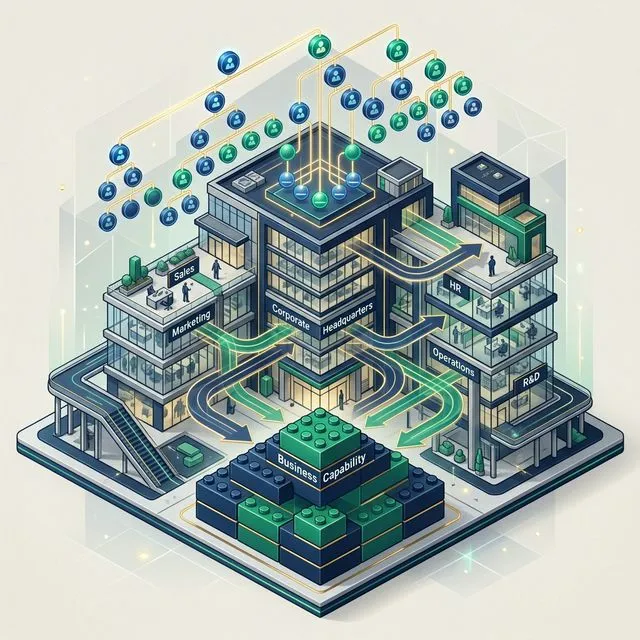
What is TOGAF Phase B Business Architecture?
TOGAF Phase B Business Architecture develops the baseline and target business capability models, maps key business processes, and performs a gap analysis to identify what must change. It is the first domain-specific phase after the Architecture Vision and produces the business foundation that drives all subsequent Data, Application, and Technology architecture decisions in Phases C and D.
Business Architecture is where enterprise architecture becomes tangible for business leaders. After the high-level visioning work of Phase A, Phase B takes the Architecture Vision and turns it into a detailed picture of how the business operates today and how it needs to operate in the future.
For many architects, Phase B is where the real collaboration with business stakeholders begins. This is not a phase you can complete alone in a server room. It requires deep engagement with business process owners, department heads, and strategy teams. The better that engagement is, the stronger the resulting architecture will be.
This post covers the first half of Phase B, focusing on business capabilities and business processes - the two most fundamental elements of any Business Architecture.
What Is Business Architecture?
Business Architecture describes the strategy, governance, organization, and key processes of an enterprise. It is the architectural domain that connects business goals to everything that follows: the data that supports those processes, the applications that run them, and the technology infrastructure beneath it all.
Without a solid Business Architecture, technology decisions float free of business context. Systems get built that are technically impressive but solve the wrong problems. Data gets structured around application needs rather than business needs. Cloud migrations happen without clarity on which capabilities are being migrated and why.
Phase B prevents all of this by establishing a clear picture of the business before any technology design begins.
The Objectives of Phase B
TOGAF defines the core objectives of Phase B as:
- Develop a Baseline Business Architecture that describes the current state of the business
- Develop a Target Business Architecture that describes the future state
- Perform a Gap Analysis between the baseline and target
- Define candidate roadmap components and architecture requirements that will close the identified gaps
All four objectives matter equally. Organizations often rush to define the target without honestly documenting the baseline. This leads to blind spots about what actually needs to change and how complex the transition will be.
Business Capability Modeling
The most powerful tool in Business Architecture is the Business Capability Model. A business capability describes something the organization must be able to do, expressed as a noun phrase rather than a verb-based process.
Examples of business capabilities:
- Customer Onboarding
- Credit Risk Assessment
- Claims Processing
- Product Catalogue Management
- Regulatory Reporting
- Employee Performance Management
Capabilities are deliberately abstract. They say what needs to happen without specifying who does it, what system supports it, or how it works in detail. This abstraction is what makes capability models so useful: they remain stable even when processes, systems, and teams change around them.
Building a Business Capability Map
A Business Capability Map organizes all the capabilities of an enterprise into a logical structure, typically arranged in a heat map format. Each capability is assessed against the current level of performance and the strategic importance to the organization.
This creates a prioritization tool. Capabilities that are strategically important but currently performing poorly become the highest-priority targets for the Target Architecture.
A typical capability map has three levels:
- Level 1: High-level capability domains, such as "Customer Management", "Operations", "Finance and Risk"
- Level 2: Specific capabilities within each domain, such as "Customer Acquisition" and "Customer Retention" within "Customer Management"
- Level 3: Detailed sub-capabilities required for exam or in-depth architecture work
Most Phase B engagements define Level 1 and Level 2 in full, with Level 3 detail only where strategic priorities demand it.
Capabilities vs Processes
A capability is WHAT the business does. A process is HOW it does it. Capabilities are stable over years; processes change whenever the business redesigns how work gets done. Good Business Architecture models both, with capabilities providing the stable organizing framework.
Mapping Capabilities to Strategic Goals
One of the critical activities in Phase B is connecting business capabilities to the strategic goals identified in Phase A's Architecture Vision.
This is done through a capability assessment, which evaluates each capability against two dimensions:
- Strategic importance: How critical is this capability to achieving the organization's stated goals?
- Current performance: How well does the organization currently perform this capability?
Capabilities that score high on strategic importance but low on current performance represent the most urgent architectural priorities. These become the driving force behind the Target Architecture and set the agenda for Phases C and D.
Business Process Modeling
Once capabilities are defined and assessed, Phase B moves deeper to map the key business processes that deliver those capabilities.
A business process is a sequence of related activities performed by people and systems to achieve a defined business outcome. Unlike capabilities, processes are rich with operational detail: who does what, in what sequence, what decisions are made, and what information flows through each step.
What Business Process Models Show
A good business process model captures:
- Activities: The discrete steps performed in the process
- Actors: The roles or systems responsible for each activity
- Decisions: Points in the process where different paths are taken based on conditions
- Information flows: The data and documents that move between activities
- Events: The triggers that start, modify, or end the process
- Outcomes: What the process produces when it completes successfully
Common Process Modeling Notation
The most widely used notation for business process modeling in enterprise architecture is BPMN (Business Process Model and Notation). It is internationally standardized and widely supported by modeling tools. TOGAF does not mandate BPMN specifically but it is the recommended choice for most practitioners.
Baseline Business Architecture
The Baseline Business Architecture documents the current state of the business. It is a description of how things actually work today, not how they are supposed to work on paper.
This distinction matters. Organizations often discover a gap between their documented processes and their actual practice during Phase B. What the procedure manual says happens and what real employees actually do are frequently different. The baseline must capture reality, not aspiration.
The Baseline Business Architecture typically includes:
- The current Business Capability Map with performance assessments
- Current business process models for key processes
- The current organizational structure
- Current governance and decision-making structures
- Known pain points, inefficiencies, and constraints
Do Not Skip the Baseline
Organizations frequently want to skip documenting the baseline and jump straight to the target. Resisting this pressure is important. Without a clear baseline, you cannot perform a meaningful gap analysis, and without a gap analysis, you cannot build a credible implementation roadmap.
The Gap Analysis
With both the Baseline and Target Business Architectures defined, Phase B performs a Gap Analysis. This compares the two states systematically and identifies what needs to change.
Gaps fall into several categories:
- Capability gaps: Capabilities required in the target that do not exist in the baseline
- Performance gaps: Capabilities that exist but need significant improvement
- Process gaps: Processes that need to be redesigned, automated, or eliminated
- Organizational gaps: Roles, skills, or structures the target requires that do not exist today
- Governance gaps: Decision rights or accountability structures that need to change
Each gap is documented with a severity rating and a candidate approach to closing it. These documented gaps feed directly into Phase E (Opportunities and Solutions) and Phase F (Migration Planning) later in the ADM cycle.
Key Phase B Deliverables
When Phase B is complete, the architecture team has produced:
- Refined principles, goals, and drivers specific to the business domain
- Baseline Business Architecture description
- Target Business Architecture description
- Gap Analysis results
- Updated candidate architecture requirements
- Updated Architecture Roadmap components specific to the business domain
- Updated Statement of Architecture Work (if scope changes were required)
Real-World Example: Retail Bank Customer Onboarding
A retail bank's Phase B work on their customer onboarding capability reveals the following:
- Baseline: Customer onboarding currently takes 5 business days, involves 8 manual handoffs, requires the customer to visit a branch in person, and has a 23% error rate requiring rework
- Target: Customer onboarding should be completable digitally in under 10 minutes for straightforward cases, with automated identity verification and no manual handoffs for standard products
- Gaps identified: No digital identity verification capability exists. The CRM system does not support digital application forms. Four of the eight handoffs are unnecessary duplications. Staff roles need redefining for a digital-first model.
- Candidate solutions: Procure a digital identity verification platform (SBB), implement a customer portal (new application capability), redesign the process map to eliminate four steps, retrain customer-facing staff
This structured analysis gives the architecture team and business sponsors a clear, evidence-based case for the changes the Target Architecture requires.
Summary
Phase B Business Architecture develops the current and future pictures of the business, organized around capabilities, processes, and organizational structures.
The key activities are:
- Building the Business Capability Map and assessing each capability against strategic importance and current performance
- Mapping key business processes in the baseline state
- Defining the target business capability and process models
- Performing the Gap Analysis to identify what must change
In the next post, we cover the second part of Phase B: Business Service Models - how organizations structure the services they deliver, both internally and to external customers, and how these service models become a bridge between business capabilities and the information systems that support them.
Return to Phase A: Architecture Vision if you missed how the project leading to Phase B was defined and scoped. If you are at the start of your TOGAF journey, begin with What is TOGAF 9.2?.
The TOGAF 9.2 standard provides the full list of Phase B inputs, outputs, and steps. For exam preparation, our TOGAF Foundation Study Guide covers Phase B's exam weighting and the most commonly tested outputs.
Continue Learning
Phase B also covers the service model - how business capabilities are exposed as services to other parts of the organisation. The companion guide TOGAF Phase B: Business Service Models explores service catalogues, service contracts, and how business services map to application components in Phase C.
Part of the TOGAF 9.2 Masterclass.