
Zachman Framework's 6 Rows: Which Stakeholder Owns Each Architecture View
Planner, Owner, Designer, Builder, Subcontractor — each row belongs to a different audience with a different question to answer. The most common mistake is assigning artefacts to the wrong row. Here's who owns what, and what breaks when you get it wrong.
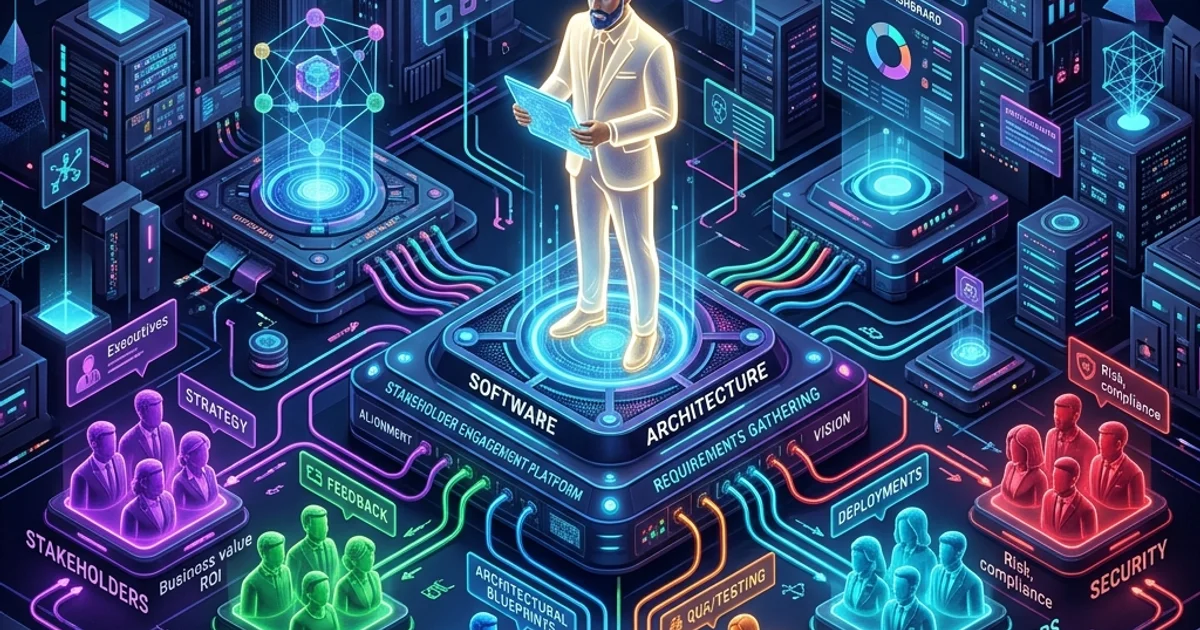
The Six Perspectives of Zachman: Stakeholder Rows Explained
If the six interrogatives (What, How, Where, Who, When, Why) form the columns of the Zachman Framework, the six perspectives form the rows. Each row represents a different stakeholder's view of the enterprise, at a different level of abstraction.
The six perspectives are sometimes called the "six levels" or "six layers" of the Zachman matrix. They range from the broadest, most abstract view (the executive planner's scope) down to the most detailed, most concrete view (the actual functioning enterprise).
Introduction: The Six Perspectives
The six perspectives reflect the insight that a complete architecture must be described at multiple levels of abstraction:
- Row 1: The executive/planner's view - scope and context
- Row 2: The business owner's view - conceptual model
- Row 3: The architect/designer's view - logical design
- Row 4: The engineer/builder's view - physical implementation
- Row 5: The specialist/technician's view - detailed components
- Row 6: The actual working system - the enterprise itself
This mirrors classical architecture (buildings). An architect describes a building at multiple levels:
- Site plan and location (scope)
- Functional layout (owner's view)
- Construction drawings (designer's view)
- Material specifications (builder's view)
- Installation details (specialist's view)
- The actual constructed building (working system)
The Zachman Framework applies the same logic to enterprise architecture.
The Six Perspectives Explained
Row 1: Contextual - The Planner's Scope
Stakeholder: Executive, Chief Executive Officer, Business Planner
Perspective: "What is the scope and context of the enterprise? What is our business environment?"
Level of abstraction: Highest - most abstract
What this row addresses:
- Business scope and boundaries
- Market context and environment
- High-level goals and strategy
- Entity types (nouns the business cares about)
- High-level process areas
- Geographic scope
- Organisational units
- Key business rules
- Strategic drivers
Characteristics:
- Uses business language, not technical jargon
- Focuses on "what" and "why," not "how"
- Typically one-to-two pages (executive summary level)
- Resistant to change (reflects stable business strategy)
Manifestations across interrogatives:
- What: Entity list (customers, orders, products, accounts)
- How: Process list (order management, billing, support)
- Where: Site/geography list (headquarters, regional offices)
- Who: Organisational units (sales, operations, finance)
- When: Event list (quarter-end close, annual planning)
- Why: Goal list (growth, profitability, customer satisfaction)
Example: "Our bank has customer accounts across five geographic regions. Customers deposit, withdraw, and transfer funds. We operate 200 branch locations."
Row 2: Conceptual - The Owner's Business Model
Stakeholder: Business owner, product manager, business analyst, process owner
Perspective: "How does the business actually work? What are the business processes and relationships?"
Level of abstraction: Business level - logical from a business viewpoint
What this row addresses:
- Detailed business processes and value chain
- Business entity-relationship models
- Business rules and policies
- Customer journeys and workflows
- Organisational responsibilities (RACI)
- Information flows between departments
- Key decision points
- Performance metrics
Characteristics:
- Uses business terminology
- Describes "how the business operates"
- May span 10-50 pages depending on complexity
- Moderately resistant to change (reflects business model, which evolves slowly)
- Does not prescribe how technology will be used
Manifestations across interrogatives:
- What: Entity-relationship diagram (customers have accounts, accounts have transactions)
- How: Detailed business process flowchart (order receives → stock check → payment → fulfillment)
- Where: Business network map (which regions handle which functions)
- Who: Organisational chart and RACI matrix (who approves orders, who handles billing)
- When: Business event model (when orders arrive, when invoices go out)
- Why: Business rules (customers in Europe pay in Euros, orders must ship within 48 hours)
Example: "When a customer places an order, the sales team enters it. Inventory is checked. If in stock, payment is processed. Warehouse is notified and picks the order. Shipping prepares the package."
Row 3: Logical - The Designer's System Model
Stakeholder: Enterprise architect, solutions architect, systems designer
Perspective: "What is the system's logical architecture, independent of specific technology choices?"
Level of abstraction: System level - logical (technology-independent)
What this row addresses:
- Logical data model (entities and relationships without database specificity)
- System functions and capabilities
- System interfaces and interactions
- Information flows between systems
- Logical network architecture
- Access control requirements
- System constraints and performance requirements
- Alternative solutions
Characteristics:
- Uses technical but technology-neutral language
- Describes "what the system must do" without "how" (technology)
- Spans 20-100 pages depending on complexity
- Moderately volatile (evolves as requirements are refined)
- Can be implemented using multiple technology stacks
Manifestations across interrogatives:
- What: Logical data model (Order entity with attributes and relationships, independent of database choice)
- How: Logical system workflow (Validate Order → Check Inventory → Process Payment → Create Fulfillment Task)
- Where: Logical network model (Customer Tier, Business Logic Tier, Data Tier)
- Who: System access model and role definitions (Customer role, Staff role, Admin role)
- When: Processing sequence and timing requirements (Order must be fulfilled within 24 hours)
- Why: System constraints (must support 10,000 concurrent users, 99.99% uptime, < second response time)
Example: "The system accepts orders via a web service. It validates the order against business rules. It queries the inventory system for availability. It calls the payment processor. Upon success, it creates a fulfillment task."
Row 4: Physical - The Builder's Technology Model
Stakeholder: Technical architect, solutions engineer, application architect, DBA
Perspective: "What specific technologies, tools, and platforms will we use to implement the system?"
Level of abstraction: Technology level - physical implementation choices
What this row addresses:
- Specific technology stack choices (Java vs Python, Oracle vs PostgreSQL, AWS vs Azure)
- Application architecture (monolith vs microservices, REST vs message queue)
- Database design (schemas, indexes, partitioning)
- Network infrastructure (load balancers, firewalls, CDNs)
- Security implementation (encryption, authentication, authorization)
- Performance and scalability implementation (caching, replication)
- Third-party integrations
- Deployment architecture
Characteristics:
- Uses specific technology terminology
- Describes "how to implement" using specific tech
- Spans 30-150 pages depending on complexity
- Volatile (evolves as technologies change and new options emerge)
- Binding - commits the organisation to specific technology choices
Manifestations across interrogatives:
- What: Physical database schema (Order table with specific columns, types, constraints in Oracle)
- How: Application design (Spring Boot microservices, each handling specific functions)
- Where: Infrastructure topology (Java app servers in us-east-1, database in us-west-2, CDN for static content)
- Who: Security design (OAuth 2.0 authentication, Role-Based Access Control in Spring Security)
- When: Scheduling design (Quartz jobs for batch processing, Kafka for event streaming)
- Why: Technology choices justified (We chose AWS for elasticity, PostgreSQL for open source, Kafka for scalable event handling)
Example: "We will implement using Java Spring Boot microservices running on AWS ECS. The database is PostgreSQL with multi-region replication. Authentication is OAuth 2.0 via AWS Cognito."
Row 5: Detailed - The Sub-Contractor's Component View
Stakeholder: Developer, DBA, security engineer, system administrator
Perspective: "What are the specific components, code, configuration, and deployment details?"
Level of abstraction: Component level - detailed implementation
What this row addresses:
- Source code and algorithms
- Database DDL (Data Definition Language)
- Configuration files
- Deployment scripts
- Security policies and access controls
- Specific third-party library versions
- Build and release procedures
- Operational runbooks
Characteristics:
- Uses programming language and tool-specific terminology
- Describes "how to build and deploy" in specific terms
- Span from hundreds to thousands of pages (one source file can be 100+ pages)
- Highly volatile (changes continuously as code is written)
- Out-of-context - difficult to understand without deep technical knowledge
Manifestations across interrogatives:
- What: DDL (CREATE TABLE Order statements with specific columns and types)
- How: Source code (Java classes for OrderService, OrderValidator, PaymentProcessor)
- Where: Deployment configuration (Docker containers, Kubernetes manifests, network policies)
- Who: Access control lists (IAM roles, database user permissions, SSH key management)
- When: Cron jobs and schedulers (Spring @Scheduled tasks, database job schedules)
- Why: Implementation rules (validation logic, business rule enforcement in code, SLA compliance code)
Example: "The OrderService class handles order receipt. It calls OrderValidator to ensure business rules. PaymentProcessor handles payment. Upon success, FulfillmentService creates a task. All code is available in GitHub repo..."
Row 6: Functional - The Enterprise (Working System)
Stakeholder: End users, operations team, customers
Perspective: "This is the actual working system - the implemented enterprise architecture in operation."
Level of abstraction: Lowest - most concrete - actual reality
What this row addresses:
- Live running systems
- Actual operational data
- Real users and sessions
- Current performance metrics
- Actual uptime and reliability
- Real customer experience
Characteristics:
- The actual, working enterprise
- Not a model or design - this is reality
- Constantly changing (data, performance, user base)
- Measured through monitoring and observability
- The source of truth for "what is actually happening"
Manifestations across interrogatives:
- What: Live database contents (actual customer accounts and orders)
- How: Running processes (real-time order processing, customers currently shopping)
- Where: Deployed infrastructure (live servers, running data centres)
- Who: Actual users and sessions (John logged in from New York, Jane logged in from London)
- When: Real events occurring (orders arriving every second, daily batch jobs running)
- Why: Real-world constraints being enforced (business rules actually preventing invalid transactions)
Example: "Right now, 2,350 customers are shopping. 47 orders are being processed. The system is responding in 890ms average. Database contains 145 million live customer records."
The Six Perspectives as Abstraction Levels
Think of the six perspectives as a bridge from abstract (Row 1) to concrete (Row 6):
Row 1 (Planner)       ← Most abstract
Row 2 (Owner)
Row 3 (Designer)
Row 4 (Builder)
Row 5 (Sub-Contractor)
Row 6 (Enterprise)     ← Most concrete
Each row adds detail and specificity. A manager can understand Row 1 (scope). An architect can design Row 3 (logical). A developer implements Row 5 (components). All describe the same enterprise, but at different levels of detail.
How the Six Perspectives Work Together
The power comes from the combination:
- Row 1 ensures scope alignment: Everyone agrees on the business boundaries and goals.
- Row 2 ensures business understanding: Business and IT agree on how the business works.
- Row 3 ensures architectural soundness: Architects ensure the logical design meets requirements.
- Row 4 ensures technical feasibility: Builders ensure technologies can implement the design.
- Row 5 ensures implementation quality: Developers implement according to specifications.
- Row 6 validates everything: The actual system works (or reveals where models were wrong).
Perspective Traceability: From Business to Implementation
A key use of the six perspectives is traceability - ensuring that a requirement from Row 1 flows through all rows and is actually implemented in Row 6.
Example traceability: "Orders must ship within 24 hours"
- Row 1 (Planner): Business goal - "Ship orders within 24 hours to stay competitive"
- Row 2 (Owner): Business process - "When order is received, warehouse must pick and ship within 20 hours (buffer)"
- Row 3 (Designer): System requirement - "Fulfillment task must be created within 5 minutes of order receipt; warehouse management system must notify shipping within 20 hours"
- Row 4 (Builder): Technology decision - "Use message queue to immediately notify warehouse; use job scheduler to auto-escalate unfulfilled orders after 18 hours"
- Row 5 (Sub-Contractor): Code - "Implement logic to create FulfillmentTask within 5 minutes; Quartz job to escalate unshipped orders after 18 hours"
- Row 6 (Enterprise): Reality - "Track actual order-to-ship times; 99.2% of orders ship within 24 hours; 0.8% escalated"
Pitfall: Jumping Rows
A common architectural mistake is skipping rows. For example:
- Skipping Row 2 (Conceptual): Going directly from scope (Row 1) to logical design (Row 3). Result: Requirements are incomplete or misunderstood.
- Skipping Row 3 (Logical): Going directly from business process (Row 2) to physical technology (Row 4). Result: Architecture is technology-biased and not future-proof.
- Skipping Row 4 (Physical): Going directly from logical design (Row 3) to code (Row 5). Result: Implementation misses scalability or performance requirements.
Each row is necessary. Each provides distinct value and catches different types of errors.
Practical Application: Using the Six Perspectives
When architecting a system:
- Define Row 1: Stakeholders agree on scope and business goals.
- Define Row 2: Business owner defines how the business operates.
- Define Row 3: Architect designs the logical system, independent of technology.
- Get approval before proceeding: Stakeholders and business agree to Row 3 design.
- Define Row 4: Architect chooses specific technologies based on Row 3 requirements.
- Define Row 5: Development team implements Row 4 design.
- Validate Row 6: Monitor actual system against all rows - do they match? Do requirements flow through?
Key Takeaways
-
The six perspectives represent abstraction levels: From planner (abstract) to enterprise (concrete).
-
Each perspective has distinct stakeholders: Different people own and understand different rows.
-
All six rows are necessary: Each provides unique architectural value.
-
Traceability from Row 1 to Row 6 is critical: Requirements should flow from business goals through implementation to actual system.
-
Skipping rows causes architectural problems: Each row catches different types of errors.