
Zachman Framework vs TOGAF: Which Framework Should You Use?
Detailed side-by-side comparison of the Zachman Framework and TOGAF - scope, purpose, methodology, strengths, weaknesses, and when to use each in enterprise architecture.
Zachman Framework vs TOGAF: Which Framework Should You Use?
One of the most common questions in enterprise architecture is: "Should we adopt Zachman or TOGAF?" The answer surprises many: the question is based on a false dichotomy. Zachman and TOGAF are not competitors - they are complementary tools designed to answer different questions.
This guide will explain the fundamental differences between them, their respective strengths and weaknesses, and most importantly, how to use them together effectively.
The Core Difference: Ontology vs Methodology
To understand the relationship between Zachman and TOGAF, we must first clarify their fundamental natures.
Zachman: An Ontology
The Zachman Framework is an ontology - a classification schema. It answers: "What are all the things that must be described to have a complete enterprise architecture?"
Zachman is descriptive and prescriptive in scope (not process). It says: "These are the 36 types of architectural artefacts you need to consider. It does not say how to create them or in what order.
TOGAF: A Methodology
TOGAF is a methodology - a process framework. It answers: "What steps should I follow to develop an enterprise architecture?"
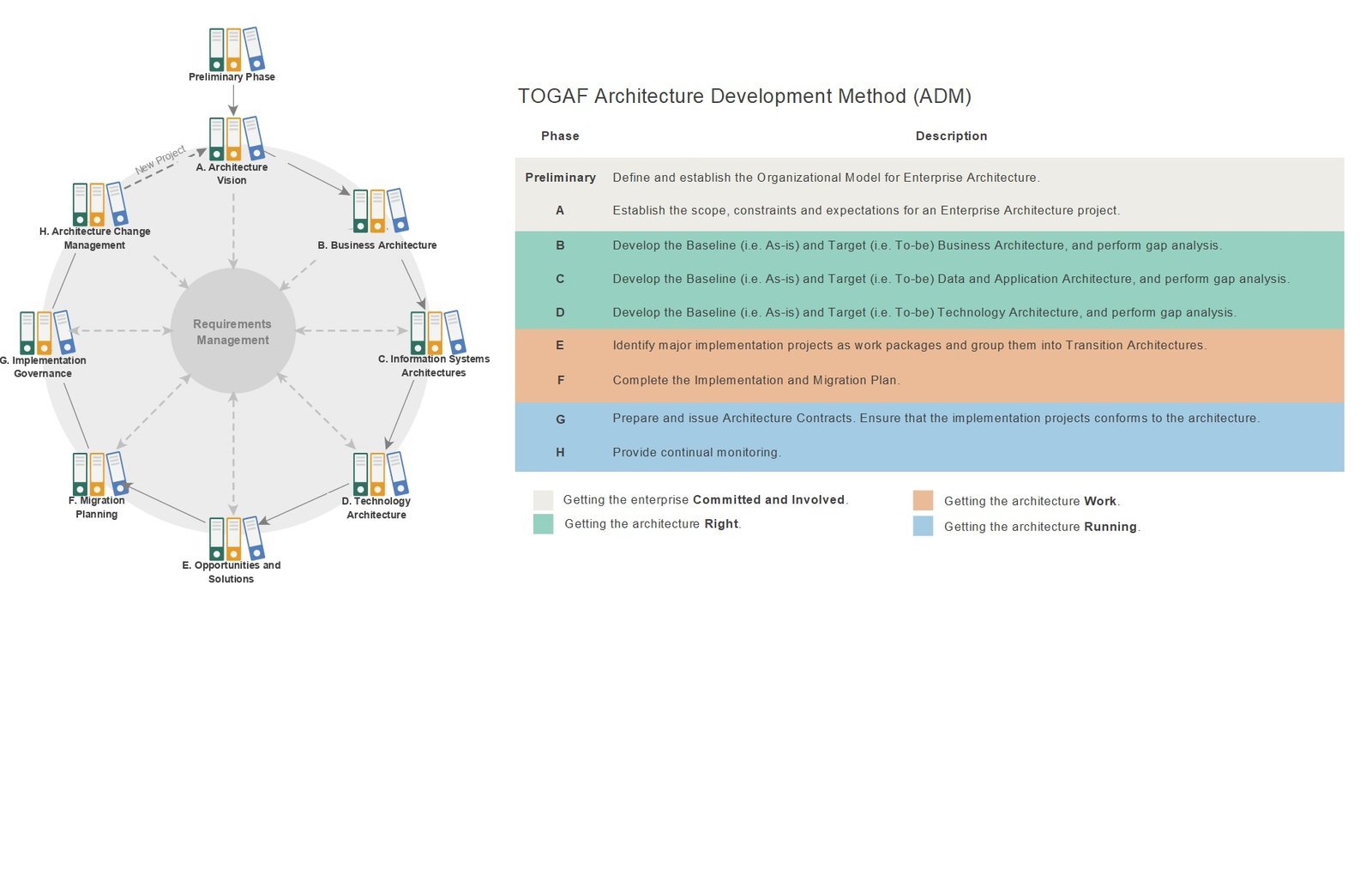
TOGAF is prescriptive in process. It defines phases (the ADM - Architecture Development Method), roles, stakeholders, governance, and a structured path from architecture planning through implementation and change management.
Comparison Table: Zachman vs TOGAF
| Aspect | Zachman | TOGAF |
|---|---|---|
| Type | Ontology / Classification | Methodology / Process Framework |
| Focus | What to describe (scope of architecture) | How to develop it (process and governance) |
| Primary Question | "What's in a complete enterprise architecture?" | "What steps should we follow to develop architecture?" |
| Prescriptiveness | Defines what, not how | Defines both what and how (especially how) |
| Structure | 6x6 matrix of 36 cells | 10-phase ADM cycle + supporting frameworks |
| Stakeholder Focus | All stakeholders across abstraction levels | All stakeholders via defined roles and phases |
| Timeframe | Timeless ontology (same since 1987) | Evolving methodology (currently v10.1) |
| Flexibility | Highly flexible; compatible with any process | Flexible but structured; prescribes some process |
| Technology Agnostic | Yes - interrogatives apply to any tech | Mostly yes, though has some tech assumptions |
| Learning Curve | Moderate - conceptual matrix is straightforward | Steep - lots of content, many concepts |
| Implementation Time | Medium (building repository) | Long (defining processes, governance) |
| Tool Support | Enterprise architecture tools (EA, Ardoq, etc.) | Enterprise architecture tools, plus TOGAF-specific guidance |
| Certification | ZCEA (Zachman Certified Enterprise Architect) | TOGAF Foundation, TOGAF Certified, TOGAF 10 credentials |
| Industry Adoption | Government, defence, large finance | Consulting, mid-market, large enterprises |
Strengths and Weaknesses: Detailed Analysis
Zachman Strengths
-
Universality: The 6x6 matrix applies across all industries, technologies, and organisation types. You will use the same framework for a bank, a retailer, and a government agency.
-
Completeness Checking: The matrix is a natural checklist. Before declaring your architecture "complete," you can verify that you have addressed all 36 cells (or at least all relevant ones). This prevents blind spots.
-
Stakeholder Communication: Different cells are owned by different audiences. This allows stakeholders with different concerns to focus on relevant cells without being overwhelmed by the full architecture.
-
Methodology Agnostic: Use Zachman with Agile, Waterfall, TOGAF, or any other approach. It is a lens, not a process.
-
Longevity: 39 years unchanged (since 1987) validates its fundamental soundness. Investing time in learning Zachman is a safe career bet.
Zachman Weaknesses
-
Lacks Governance Structure: Zachman does not define roles, responsibilities, decision-making authority, or governance processes. If you need clear governance, you must layer something else on top.
-
No Prescribed Process: While flexibility is a strength, organisations new to enterprise architecture sometimes struggle without a step-by-step roadmap. Zachman does not provide one.
-
Ontology Overload: The 6x6 matrix can feel intimidating at first. New practitioners sometimes struggle to understand what should go into each cell.
-
Limited on Implementation: Zachman focuses on "what to describe" but says little about how to implement changes or transition from current to target state.
-
Requires Cultural Adoption: Zachman requires buy-in from all stakeholder levels. In organisations with weak governance, adoption can be difficult.
TOGAF Strengths
-
Comprehensive Guidance: TOGAF provides detailed, step-by-step guidance across the entire architecture lifecycle - from planning through implementation to change management.
-
Clear Governance Model: TOGAF defines roles (Chief Architect, Architecture Board, etc.), decision-making processes, and governance structures.
-
Maturity Model: TOGAF includes ACMM (Architecture Capability Maturity Model) to assess and improve an organisation's architecture capabilities over time.
-
Well-Documented: The TOGAF specification is comprehensive and widely available. Training is readily available.
-
Industry Consensus: TOGAF is the most widely recognised EA methodology in the market. Many organisations explicitly require TOGAF experience.
-
Tools and Templates: Many enterprise architecture tools provide TOGAF-aligned templates, accelerating implementation.
TOGAF Weaknesses
-
Complexity and Length: The TOGAF specification is over 1,000 pages. The learning curve is steep. Many practitioners learn "just enough" rather than mastering it.
-
Waterfall Bias: While TOGAF 10 added agile guidance, the original ADM (Architecture Development Method) has a sequential, waterfall-like feel. Some argue it does not fit naturally with iterative development.
-
Scope Creep: Because TOGAF attempts to cover governance, standards, implementation, and change management, it can become bloated. Organisations sometimes implement more of TOGAF than they actually need.
-
Heavy Documentation Expectations: TOGAF encourages extensive documentation. In agile environments with limited formal documentation, this can feel at odds with culture.
-
Less Universally Applicable: While TOGAF works across industries, it has more assumptions than Zachman. Some argue it is slightly biased toward large enterprises and government.
When to Use Each Framework
Use Zachman When:
- You need a universal reference model for what a complete architecture consists of.
- You want to communicate architecture across diverse stakeholder groups with different levels of abstraction.
- You need flexibility in how you develop architecture (Agile, Waterfall, or hybrid).
- You are building or maintaining a comprehensive architectural repository.
- You are in a regulated industry and need to demonstrate that you have addressed all necessary dimensions.
- You want to integrate with multiple methodologies (Agile, TOGAF, etc.) without being locked into one.
Use TOGAF When:
- You need a step-by-step process framework for developing enterprise architecture.
- Your organisation needs clear governance, roles, and decision-making structures.
- You want to assess and mature your architecture capability over time (using ACMM).
- You are in a consulting or systems integration context where TOGAF is industry standard.
- You need comprehensive guidance covering governance, standards, and implementation.
- Your industry or organisation has specifically mandated TOGAF adoption.
The Ideal Answer: Use Both Together
The most sophisticated organisations use Zachman + TOGAF as a complementary pair:
-
Use Zachman as the Ontology: Define what your enterprise architecture will address. Populate a Zachman matrix with your architectural artefacts. Use the matrix as your repository structure and completeness checklist.
-
Use TOGAF as the Methodology: Follow the TOGAF ADM (Architecture Development Method) as your process. Use TOGAF's governance model, roles, and phases to structure your architecture engagements.
The combination provides:
- What to describe (Zachman) + How to describe it (TOGAF) = Complete Architecture Practice
- Universal applicability (Zachman) + Clear governance (TOGAF) = Structured Flexibility
- Communication framework (Zachman) + Maturity model (TOGAF) = Continuous Improvement
This synthesis is so powerful and widely adopted that it has become the de facto standard in enterprise architecture. Most large enterprises, consulting firms, and government agencies use Zachman + TOGAF together.
Case Studies: Zachman-Only vs TOGAF-Only vs Combined
Case 1: Large Bank (Zachman + TOGAF)
A Global Tier-1 bank adopted Zachman for its architectural repository and Zachman 3.0 ontology as its reference model. The bank maintains a comprehensive EA repository with the matrix structure. For governance and process, the bank uses TOGAF ADM to drive annual architecture planning cycles. Result: Complete and structured, with clear governance and universal reference.
Case 2: Federal Agency (Zachman-Heavy, Minimal TOGAF)
A US federal agency mandates FEAF (which is based on Zachman) and adopts Zachman heavily. They use a simplified, Zachman-based process rather than full TOGAF ADM. Result: Lighter process overhead, but less formal governance. Suits government's unique constraints.
Case 3: Consulting Firm (TOGAF-Heavy, Zachman as Reference)
A consulting firm bills hours for architecture work and uses TOGAF ADM as the "standard engagement model." They reference Zachman cells when defining deliverables, but do not maintain a formal Zachman repository. Result: Repeatable engagement methodology, faster billability, but less institutional architectural knowledge capture.
Case 4: Startup (Neither - Ad Hoc)
A fast-growing tech startup avoids both frameworks, preferring agile, emergent architecture. Result: Faster decisions, but potential architectural incoherence as the company scales. Often regrets this as complexity increases.
Migration Path: If You Know One, Can You Switch?
If You Know Zachman, Learning TOGAF is:
Medium difficulty. You already understand the "what" - the architectural concerns and artefacts. Learning TOGAF is learning the "how" - the phases and governance. TOGAF is more process-oriented, but your Zachman knowledge gives you a head start on understanding what each TOGAF phase is trying to produce.
If You Know TOGAF, Learning Zachman is:
Easier. You understand phases, governance, and process. Zachman is simply a way to organise the deliverables and artefacts from those phases into a coherent matrix. Practitioners often say, "Zachman just gave me a way to see what TOGAF was trying to achieve."
Making Your Choice: A Decision Framework
Do you need a step-by-step process framework for your organisation?
- Yes → TOGAF (or Zachman + TOGAF)
- No → Zachman (or neither, if you prefer emergent architecture)
Do you need a universal reference model that transcends specific methodologies?
- Yes → Zachman (or Zachman + TOGAF)
- No → TOGAF or ad-hoc approach
Is your industry or organisation specifically mandating a framework?
- Zachman/FEAF mandated → Zachman
- TOGAF mandated → TOGAF
- No mandate → Choose based on above criteria
Do you want certification?
- Yes, Zachman → ZCEA
- Yes, TOGAF → TOGAF Foundation and Certified
- Yes, both → Both certifications (many practitioners have both)
The Future: Convergence or Divergence?
As of 2026, Zachman and TOGAF remain complementary rather than converging or diverging. Recent versions of both (Zachman 3.0 and TOGAF 10) have actually strengthened alignment:
- TOGAF 10 explicitly acknowledges Zachman concepts and recommends using Zachman as a reference model.
- Zachman International publishes guidance on applying Zachman with agile and TOGAF.
The trend suggests deeper integration, not separation. Expect future versions to deepen the synthesis.
Key Takeaways
-
They are not competitors: Zachman answers "what," TOGAF answers "how."
-
Most sophisticated organisations use both: Zachman as ontology + TOGAF as methodology.
-
Know your context: If you need governance and process, lean TOGAF. If you need universality and flexibility, lean Zachman.
-
Certification in both is valuable: ZCEA and TOGAF Certified demonstrate comprehensive EA expertise.
-
The choice is not binary: You can adopt elements of each, mix them with other frameworks, or create a hybrid approach suited to your organisation.
Next Steps
- Explore the Six Interrogatives and Six Perspectives to understand Zachman's ontological structure more deeply.
- Read guides on Practical Application to see how other organisations use these frameworks.
- If you have TOGAF experience, jump to TOGAF + Zachman Integration for guidance on synthesis.
- If certification interests you, start with ZCEA Certification Guide or TOGAF Foundation resources.
The reality is that nearly every enterprise architect in 2026 should understand both Zachman and TOGAF. Rather than choosing one, the best practitioners master both and use them in concert.
Frequently Asked Questions
Q: What is the Zachman Framework and how does it differ from TOGAF?
The Zachman Framework is a two-dimensional ontology — a classification scheme for enterprise architecture artefacts organised by perspective (Planner, Owner, Designer, Builder, Implementer, Worker) and abstraction (What, How, Where, Who, When, Why). It tells you what artefacts should exist but provides no method for creating them. TOGAF, by contrast, is a method — its ADM tells you how to develop, govern, and maintain architecture. Zachman is a taxonomy; TOGAF is a process. Many organisations use Zachman as a completeness checklist to verify that their TOGAF-produced architecture covers all the necessary perspectives.
Q: Which framework should an organisation adopt — Zachman or TOGAF?
For most organisations, TOGAF is the more practical starting point because it provides a method, governance model, and set of deliverables — not just a classification scheme. The Zachman Framework is most valuable as a complementary tool: use it to assess whether your TOGAF-produced architecture is comprehensive (does it address all six perspectives and all six abstraction dimensions?). Organisations with a strong research or academic bent may find Zachman's rigour appealing, but implementing it as a primary framework requires significant methodology development that TOGAF provides out of the box.
Q: Can Zachman and TOGAF be used together effectively?
Yes, and this is a common enterprise architecture approach. TOGAF's ADM drives the architecture development process, producing deliverables that are then classified and stored in the Architecture Repository. The Zachman Framework is applied as a lens to ensure completeness — checking whether the Architecture Vision, Business Architecture, and other TOGAF deliverables have addressed all relevant perspectives (Executive, Business Management, Architect, Engineer, Technician, and User) and all abstraction types (data, function, network, people, time, motivation). The combination provides both rigorous method and rigorous taxonomy.
Meta Keywords: Zachman vs TOGAF, enterprise architecture framework comparison, TOGAF vs Zachman, EA methodology, architecture frameworks, EA ontology, FEAF, architecture best practices, Zachman Certified, TOGAF Certified.