
What is the Zachman Framework? A Complete Guide for Enterprise Architects
Learn what the Zachman Framework is, its 6x6 matrix structure, the six interrogatives and perspectives, and why it remains the gold standard ontology for enterprise architecture.
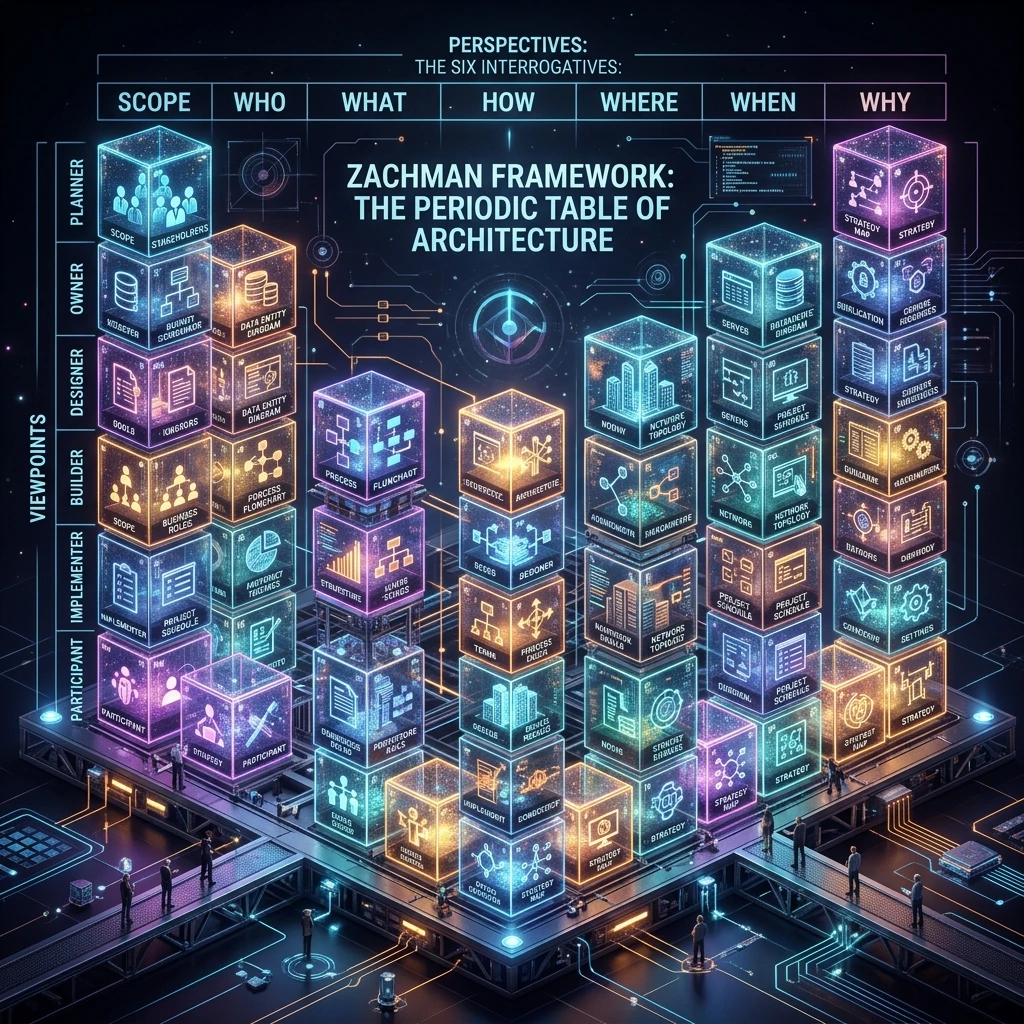
What is the Zachman Framework?
The Zachman Framework is a two-dimensional classification schema - an ontology - that organises and structures enterprise architectural knowledge. Created by John Zachman in 1987 and published in the IBM Systems Journal, it provides a universal reference model for enterprise architects to describe what a complete enterprise architecture comprises, regardless of industry, technology, or organisation size.
At its core, the Zachman Framework is represented by a 6x6 matrix containing 36 cells. Each cell is defined by the intersection of two dimensions: six interrogatives (What, How, Where, Who, When, Why) and six perspectives (Planner, Owner, Designer, Builder, Sub-Contractor, and Enterprise). This fundamental structure makes it a powerful communication tool across all stakeholder levels in an organisation.
The Core Difference: Ontology vs Methodology
Before diving into the matrix, it is critical to understand a fundamental distinction: the Zachman Framework is an ontology, not a methodology.
An ontology is a classification system. It answers the question: "What are all the things that must be described to have a complete understanding of the enterprise?" It does not tell you how to build architectures or in what order to create artefacts.
In contrast, methodologies like TOGAF (The Open Group Architecture Framework) are prescriptive. TOGAF defines step-by-step processes, roles, and phases for developing an architecture. It tells you not only what to describe, but how and when to describe it.
This distinction is why the Zachman Framework is often described as timeless and universal. A complete Zachman matrix exists whether you are designing a mainframe system built in the 1990s, a cloud-native SaaS application in 2026, or an AI-powered enterprise system in the future. The framework itself never changes, because the fundamental questions an enterprise must answer never change.
The 6x6 Matrix: Interrogatives and Perspectives
The Zachman Framework organises enterprise knowledge along two axes:
The Six Interrogatives (Columns)
These are the classic "journalist questions" applied to enterprise architecture. They represent the six distinct ways of describing any complex object:
- What - Data, Inventory, Entities, Information Objects. "What does the enterprise consist of?"
- How - Function, Process, Activities, Workflows. "How does the enterprise operate?"
- Where - Network, Location, Logistics, Distribution. "Where are the enterprise's operations physically located?"
- Who - People, Organisation, Roles, Responsibilities. "Who performs the work?"
- When - Time, Schedule, Events, Sequences. "When do events and processes occur?"
- Why - Motivation, Strategy, Goals, Business Rules. "Why does the enterprise exist and operate as it does?"
The Six Perspectives (Rows)
These represent six distinct stakeholder viewpoints, each describing the enterprise at a different level of abstraction:
- Row 1 - Contextual (Planner): The scope context as perceived by a planner. This is the broadest, most abstract view - the business environment and enterprise boundaries.
- Row 2 - Conceptual (Owner): The owner's mental model of the enterprise. Business processes, entities, and relationships as the business owner understands them.
- Row 3 - Logical (Designer): The system designer's logical architecture. System-independent specifications and requirements.
- Row 4 - Physical (Builder): The builder's technology model. Specific platform choices, software, and infrastructure.
- Row 5 - Detailed (Sub-Contractor): The sub-contractor's component view. Detailed specifications and code implementations.
- Row 6 - Functional (Enterprise): The actual working enterprise. The system as it is deployed and operational.
Each cell in the 6x6 matrix represents the intersection of one interrogative and one perspective. For example:
- Row 1, What Column: The scope - all the entities and data types the enterprise cares about.
- Row 3, How Column: The logical process model - how the system will function, independent of specific technology.
- Row 4, Why Column: The technology-specific constraints and business rules governing the physical system.
Why the Zachman Framework Matters
In a world with dozens of competing enterprise architecture frameworks and methodologies, why does the Zachman Framework remain relevant - even dominant - across industries?
1. Completeness
The Zachman Framework forces architects to think holistically. By requiring descriptions across all six interrogatives and six perspectives, it prevents blind spots. An architect cannot ignore the "Who" or "Where" dimensions. The matrix is a checklist ensuring nothing is forgotten.
2. Language Neutrality
The Zachman Framework does not dictate a specific notation or language. Cell descriptions can be expressed in natural language, structured text, UML diagrams, ArchiMate models, or any other notation. This makes it compatible with any tools, methodologies, or notations an organisation might adopt. You can use Zachman + TOGAF, Zachman + ArchiMate, Zachman + Agile - the framework is flexible.
3. Universal Applicability
Whether you are designing the architecture for a financial services firm, a government agency, a healthcare system, or a retail chain, the same six interrogatives and six perspectives apply. The specific content differs, but the structure is constant.
4. Stakeholder Communication
Different audiences care about different parts of the matrix. Executives focus on Row 1 (scope) and the Why column (strategy). Business owners focus on Rows 1-2 and the What/How columns. Designers focus on Rows 3-4. Developers focus on Rows 4-5. The matrix provides a common vocabulary to bridge these groups, even when they are describing different levels of abstraction.
5. Longevity
Since 1987, the core structure of the Zachman Framework has remained unchanged. Technology has evolved dramatically, but the framework has not become obsolete. This is because it is an ontology of business and organisational concerns, not a reflection of current technology trends.
A Brief History: From IBM Systems Journal to Global Standard
The Origin (1987)
John Zachman published his seminal article "A Framework for Information Systems Architecture" in the IBM Systems Journal in February 1987. At the time, he was working as an information systems architect at IBM and observed that architects lacked a common vocabulary and structure for describing enterprise systems. Different projects used different terminology, created different types of models, and had no coherent way to store and retrieve architectural knowledge.
Zachman's insight was to borrow from classical disciplines. In classical architecture (buildings), architects describe a structure across multiple dimensions: plans, elevations, sections, details. Similarly, Zachman proposed that enterprise architects should describe an information system across multiple dimensions - multiple interrogatives and multiple perspectives.
The Framework Evolves (1992-2003)
Through the 1990s and early 2000s, the Zachman Framework was refined through industry application and academic research. Zachman International (founded by John Zachman) published expanded versions, added the "Enterprise Continuum" concept, and developed training and certification programmes. By 2003, the framework had become the de facto standard in government, defence, and large enterprises.
TOGAF Emerges as a Complement (2009-Present)
When TOGAF 9 was released in 2009, many in the community initially saw it as competing with Zachman. However, practitioners quickly realised the two could work together: Zachman as the ontology (the "what to describe"), and TOGAF as the methodology (the "how to develop it"). This complementary relationship has proven durable and is now widely adopted.
Modern Variants and Extensions (2015-Present)
Today, the Zachman Framework has inspired variants and extensions, including the Zachman for Security (SABSA integration) and Zachman for specific industries (government, healthcare, finance). The core 6x6 matrix remains unchanged, validating its fundamental soundness.
The 36 Cells Explained
To make the matrix concrete, here is a summary of what each cell typically contains:
| Interrogative | Planner | Owner | Designer | Builder | Sub-Contractor | Enterprise |
|---|---|---|---|---|---|---|
| What | Entity list, scope | Business entity model | Logical data model | Physical data model, DB schema | DDL, SQL scripts | Live database |
| How | Process list, value chain | Business process model | System logic, workflows | Application design, interfaces | Code, algorithms | Running applications |
| Where | Site list, geography | Logistics network | System distribution | Infrastructure layout | Component locations | Deployed infrastructure |
| Who | Organisation chart outline | Detailed org chart, roles | System access model | Security architecture | User access controls | Live authentication |
| When | Event list, timeline | Business event model | Processing sequences | System scheduling | Execution schedule | Operational timing |
| Why | Goal list, mission | Business rules, strategy | System constraints | Technology rules | Implementation rules | Operational constraints |
This table is a simplified view - each cell contains far richer detail in practice - but it illustrates how the matrix scales from abstract scope (Row 1) down to concrete implementation (Rows 5-6).
Who Uses the Zachman Framework?
The Zachman Framework is adopted across sectors:
- Financial Services: Banks and insurance companies use it to manage architectural complexity across regulatory, data, and technology domains.
- Government & Defence: Federal agencies (DoD, VA, SSA) mandate Zachman-aligned architectures for systems of record.
- Healthcare: Health systems use it to align clinical processes with IT infrastructure and regulatory compliance.
- Telecommunications: Telcos use it to manage multi-layered network and service architectures.
- Consulting Firms: Major consulting firms (Deloitte, Accenture, McKinsey) incorporate Zachman concepts into their methodology offerings.
- Enterprise Vendors: Software and consulting companies (Sparx EA, Ardoq, Mulesoft) embed Zachman thinking into their tools and frameworks.
Over 50,000 professionals hold some form of Zachman-related certification, with certifications offered through Zachman International (ZCEA - Zachman Certified Enterprise Architect) and academic institutions.
Zachman vs Other Frameworks: A Quick Comparison
| Framework | Primary Focus | Scope | Type |
|---|---|---|---|
| Zachman | What to describe (ontology) | Enterprise-wide, all dimensions | Ontology / Classification |
| TOGAF | How to develop (methodology) | Enterprise-wide, structured process | Methodology / Process |
| FEAF | US Federal systems | Federal agencies, compliance-driven | Adapted framework (Zachman-based) |
| DoDAF | US Defence systems | Defence, security focus | Adapted framework (Zachman-based) |
| ArchiMate | How to model (notation) | Visual representation of architecture | Language / Notation |
This table shows that Zachman is often used as the foundation for other frameworks (FEAF, DoDAF are directly derived from Zachman) and alongside methodologies like TOGAF and languages like ArchiMate.
Key Takeaways: Why This Matters for Your Architecture Career
-
Completeness: The Zachman Framework ensures you describe the enterprise across all necessary dimensions - preventing gaps and oversights.
-
Communication: The matrix is a powerful tool for aligning stakeholders with different concerns and expertise levels.
-
Longevity: Its 39-year history (and counting) proves its fundamental soundness. Learning Zachman is an investment that will remain relevant throughout your career.
-
Flexibility: Use it alongside TOGAF, ArchiMate, Agile, or any other approach. Zachman is a lens, not a religion.
-
Certification Value: Zachman knowledge and ZCEA certification are respected credentials that differentiate architects in the job market, particularly in regulated industries and large enterprises.
Next Steps
Now that you understand what the Zachman Framework is, explore the next level:
- Dive into the Six Interrogatives to understand how the columns classify different types of architectural knowledge.
- Explore the Six Perspectives to understand how different stakeholders view the enterprise.
- Read the Zachman vs TOGAF guide to see how the two work together.
- Jump to Practical Application to see how real organisations use the framework.
- If you are interested in certification, start with the ZCEA Certification Guide.
The Zachman Framework is not complex - it is simply a well-structured way of thinking about enterprise architecture. Once you internalise the 6x6 matrix, it becomes an invaluable tool for organising your own thinking and communicating with others.
Meta Keywords: Zachman Framework, enterprise architecture, 6x6 matrix, EA ontology, information systems architecture, Zachman International, enterprise architecture basics, system architecture planning.