
TOGAF Exam Questions: 50 Free Practice + Answers (2026)
Test yourself with 50 free TOGAF Foundation questions: ADM, governance, Building Blocks. Detailed answers for every question. Pass first time. 2026.
What These TOGAF Exam Questions Cover
These 10 TOGAF Foundation exam questions cover architecture principles, governance dispensation, the Standards Information Base, the Enterprise Continuum, re-architecture change, Phase C, business models, scope dimensions, and the four core domains. Each question matches the style and difficulty of the real Part 1 exam, with detailed answer explanations for every option. Use them to identify knowledge gaps before your exam date.
Introduction to TOGAF Certification
The Open Group is a vendor-neutral and technology-neutral consortium intent on creating open standards and global interoperability to enable access to integrated information within and between enterprises.
One of their premier certification programs, based on The Open Group Architecture Forum (TOGAF), provides an opportunity for service providers and tool vendors to demonstrate their products and services are able to securely support the enterprise.
TOGAF is an industry-standard architecture framework used to develop information systems architecture within an enterprise using the TOGAF Architecture Development Method (ADM).
TOGAF Architecture Development Cycle
The TOGAF Architecture Development Method (ADM) provides a tested and repeatable process for developing architectures, functioning as the core method of the framework.
Learn More About the ADM
Want a deep dive into the ADM phases? Check out our complete guide on the [TOGAF Architecture Development Cycle](https://topictrick.com/togaf-9-architecture-development-adm-cycle/).
TOGAF Certification Exam Overview
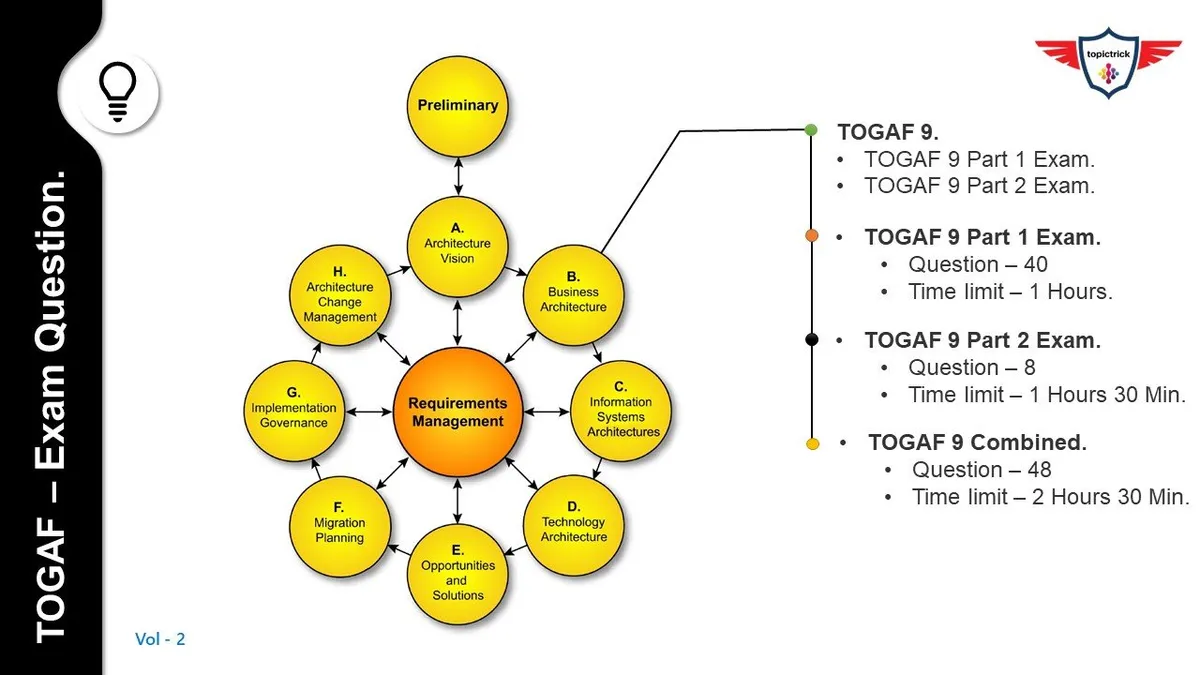
The TOGAF 9 Certification has two different exam levels:
- The TOGAF 9 Foundation (TOGAF Part 1)
- The TOGAF 9 Certified (TOGAF Part 2)
You can take the TOGAF 9 Certification exam individually or combined:
- TOGAF Part 1 Exam: 40 multiple-choice questions with a time limit of 1 hour.
- TOGAF Part 2 Exam: 8 complex scenario questions with a time limit of 1 hour 30 minutes.
- TOGAF 9 Combined Exam: 48 questions with a time limit of 2 hours 30 minutes.
TOGAF Certification Cost
The TOGAF certification costs around $360 USD for each individual exam. However, the cost of the TOGAF 9 combined exam offers a slight discount at $550 USD.
Free TOGAF Exam Questions
These free TOGAF exam questions are carefully designed to help participants clear the TOGAF Foundation (Part 1) Exam. Each practice question comes with a detailed explanation of the correct answer.
Let's test your knowledge!
Question 1
Which of the following characteristics is NOT a distinction of a good architecture principle?
A. Meaningful
B. Consistent
C. Understandable
D. Stable
Answer
A. Meaningful. According to TOGAF, a good set of architecture principles are distinguishable by four specific criteria: they must be Understandable, Robust, Complete, and Stable. 'Meaningful' is not one of the official four criteria.
Question 2
Which Architecture Governance Process is used when a Compliance Assessment is rejected to ensure service and operational levels in the environment are still met?
A. Dispensation
B. Environment Management
C. Monitoring and Reporting
D. Compliance
Answer
A. Dispensation. In TOGAF governance, a dispensation provides a period of time where specific service and operational levels can be met or deviations allowed after a formal compliance assessment has been rejected.
Question 3
The ability of a standard to be applied to any company equally is a function of what criteria for inclusion in the Standards Information Base (SIB)?
A. Freedom to Build
B. Non-discriminatory Patents
C. Non-discriminatory Implementations
D. Availability of Implementations
Answer
C. Non-discriminatory Implementations. According to TOGAF, non-discriminatory implementation speaks to the ability to apply or implement a specific specification within any company without any inherent prejudice or restriction.
Question 4
Enterprise Architecture is the most relevant to the IT customer for what reason?
A. It provides the guidelines for creating a complete, robust computing environment.
B. It provides the technology standard for implementing the architecture in the environment.
C. It provides industry-specific data and process models to be incorporated into the enterprise.
D. It reflects the requirements and defines the building blocks specific to an enterprise.
Answer
B. Enterprise Architecture provides the technology standard for implementing the architecture in the environment. The relevancy to an IT customer is derived from how it applies to their specific enterprise. Though the customer may require compliance with industry standards, it is ultimately how the architecture standardly meets those requirements that matters most to them.
Question 5
Several departments within the enterprise have come together to discuss the architecture needs of the organization. Which TOGAF element will have the greatest impact on the discussion by providing a consistent and common language?
A. Architecture Capability Framework
B. Enterprise Continuum
C. Architecture Development Framework
D. Statement of Architecture Work
Answer
B. Enterprise Continuum. The Enterprise Continuum is considered the ultimate aid to communication and understanding of possible architectures within an enterprise by providing a snapshot and common classification of all architectural assets.
Question 6
Running the entire existing architecture through the architecture development cycle again is a form of what type of change?
A. Simplification change
B. Development change
C. Incremental change
D. Re-architecture change
Answer
D. Re-architecture change. In TOGAF's Architecture Change Management phase, when the entire architecture is evaluated and put through the ADM cycle to form a new baseline, it is classified as a re-architecture change.
Question 7
Which phase of the ADM is used to define the logical groups of capabilities that manage data objects as necessary to support the business?
A. Phase C - Information Systems Architectures
B. Phase B - Business Architecture
C. Phase A - Architecture Vision
D. Requirements Management
Answer
A. Phase C - Information Systems Architectures. In TOGAF, applications are defined as logical groups of capabilities that manage data objects. In Phase C (specifically the Application Architecture section), you develop the Baseline and Target Application Architecture and analyze the gaps.
Question 8
Business Models are used to represent how an organization works and can take on several forms. Which type of business model describes the static information used within an organization as well as how that information affects the operations of the business?
A. Activity Models
B. Class Models
C. Use-case Models
D. Business Process Models
Answer
B. Class Models. In TOGAF Business Architecture, Class Models are similar to logical data models. They focus specifically on the static business information (entities/attributes) and its characteristics within the Enterprise Architecture.
Question 9
What are the four dimensions used for defining the scope of architecture activity?
A. Focus, Need, Details, and Strategy
B. Business, Data, Application, and Technology
C. Enterprise, Architecture, Vertical, and Time
D. Vision, Requirement, Strategy, and Architecture
Answer
C. Enterprise, Architecture, Vertical, and Time. The scope of an architecture activity is precisely defined by four dimensions: the extent of the enterprise covered (Enterprise scope), the specific architecture domains considered (Architecture scope), the level of detail allowed (Vertical scope), and the time period covered (Time scope).
Question 10
Which core architecture domains does TOGAF primarily handle?
A. Business, Data, Application, and Technology
B. Architecture Types
C. Process, Knowledge, Application, and Technology
D. Strategic, Tactical, Operational, and Improvement
Answer
A. Business, Data, Application, and Technology (BDAT). TOGAF basically focuses on and handles these four core domain architectures to describe the enterprise.
Question 11
Which TOGAF document formally defines the scope, approach, schedule, and resources for an architecture project?
A. Architecture Definition Document
B. Statement of Architecture Work
C. Architecture Vision
D. Architecture Roadmap
Answer
B. Statement of Architecture Work. The Statement of Architecture Work defines the scope and approach that will be used to complete an architecture development cycle. It is produced in Phase A and must be agreed and signed off by sponsoring organisations.
Question 12
What is the purpose of the Architecture Repository in TOGAF?
A. To store all software assets used by the enterprise
B. To hold the results of ongoing architecture work
C. To record governance decisions only
D. To document the Technology Architecture exclusively
Answer
B. The Architecture Repository holds the results of ongoing architecture work. It is organized into six classes of architectural information: Architecture Metamodel, Architecture Capability, Architecture Landscape, Standards Information Base, Reference Library, and Governance Log.
Question 13
In TOGAF, what distinguishes a Building Block from a Solution Building Block?
A. Building Blocks define what to do; Solution Building Blocks are vendor-specific implementations
B. Building Blocks are defined in Phase D only; Solution Building Blocks appear in Phase B
C. Building Blocks are physical; Solution Building Blocks are logical
D. There is no distinction — the terms are interchangeable
Answer
A. Architecture Building Blocks (ABBs) capture architecture requirements and direct the development of Solution Building Blocks (SBBs). SBBs represent components that will be used to implement the required capability, and they may be vendor-specific products or custom-built components.
Question 14
Which phase of the ADM produces the Architecture Roadmap?
A. Phase A
B. Phase E
C. Phase F
D. Phase H
Answer
B. Phase E — Opportunities and Solutions. Phase E is the first phase to directly address delivery and implementation planning. It produces the initial Architecture Roadmap, identifying the major work packages and their sequencing.
Question 15
What is the primary role of the Architecture Board in TOGAF governance?
A. Approving budgets for architecture projects
B. Providing oversight of the implementation of the governance strategy
C. Writing the Architecture Definition Documents
D. Managing the procurement of architecture tools
Answer
B. The Architecture Board is responsible for the oversight and providing a cross-organizational view of the implementation of the IT governance strategy. It ensures the capability and commitment of the enterprise to the architecture work.
Question 16
Which of the following correctly describes the TOGAF Content Metamodel?
A. A tool for creating UML diagrams of technology infrastructure
B. A formal description of all the types of building blocks used in architecture work and their relationships
C. The governance policy for managing architecture artefacts
D. A list of approved vendors for the Standards Information Base
Answer
B. The TOGAF Content Metamodel provides a formal description of all the types of building blocks used in architecture work, and defines their relationships and inter-dependencies. It enables a consistent definition of the content of architecture work across an enterprise.
Question 17
In TOGAF, what does the term 'Architecture Landscape' describe?
A. A visual map of the physical data centres of an enterprise
B. A representation of the Strategic, Segment, and Capability architecture levels
C. The organisational structure of the Architecture Capability
D. A description of the IT standards applicable to the enterprise
Answer
B. The Architecture Landscape describes the Strategic, Segment, and Capability architecture levels. The Strategic Architecture provides a summary view of the enterprise; Segment Architecture provides detailed views of specific segments; Capability Architecture addresses a specific solution or capability.
Question 18
Which ADM phase focuses specifically on ensuring that the implementation project conforms to the defined architecture?
A. Phase F
B. Phase G
C. Phase H
D. Phase E
Answer
B. Phase G — Implementation Governance. Phase G ensures that each implementation project conforms to the architecture. It provides architectural oversight for implementation, manages the Architecture Contract, and produces an Architecture Compliance Assessment.
Question 19
What is the function of the Solutions Continuum in TOGAF?
A. Providing a classification for reusable solution components corresponding to the Architecture Continuum
B. Documenting the gap analysis between Baseline and Target Architecture
C. Recording the organisation's preferred technology vendors
D. Describing the migration steps in Phase F
Answer
A. The Solutions Continuum represents a population of reusable solution components corresponding to the definitions contained in the Architecture Continuum. It spans from Foundation Solutions through Common Systems Solutions to Industry Solutions and Organisation-Specific Solutions.
Question 20
Which TOGAF deliverable describes the gap between the Baseline Architecture and the Target Architecture?
A. Architecture Vision
B. Architecture Contract
C. Gap Analysis Results
D. Implementation and Migration Plan
Answer
C. Gap Analysis Results. Gap Analysis is performed within the ADM to identify the differences between the Baseline Architecture and the Target Architecture. The results are used to identify the work packages needed to close the gaps.
Question 21
What is the primary input to Phase A — Architecture Vision?
A. The Request for Architecture Work
B. The Architecture Definition Document
C. The Implementation and Migration Plan
D. The Architecture Compliance Assessment
Answer
A. The Request for Architecture Work is the primary input to Phase A. It is a document that formally requests the initiation of an architecture development cycle and is issued by the sponsoring organisation to the architecture organisation.
Question 22
Which of the following is NOT one of the six parts of the Architecture Capability Framework?
A. Architecture Board
B. Architecture Skills Framework
C. Architecture Patterns Library
D. Architecture Governance
Answer
C. Architecture Patterns Library. The six components of the Architecture Capability Framework are: Architecture Board, Architecture Compliance, Architecture Contracts, Architecture Governance, Architecture Maturity Models, and Architecture Skills Framework. There is no 'Patterns Library' component.
Question 23
In TOGAF ADM Phase B, which of the following is a key output?
A. Technology Architecture Document
B. Baseline Business Architecture
C. Implementation Governance Model
D. Architecture Contract
Answer
B. Baseline Business Architecture. Phase B — Business Architecture — produces both the Baseline Business Architecture (a description of the existing state) and the Target Business Architecture (a description of the desired future state), along with the gap analysis between them.
Question 24
Which TOGAF concept describes the documented instruction from the Architecture Board to an organisation permitting a deviation from the established architecture?
A. Waiver
B. Dispensation
C. Variance
D. Exception
Answer
B. Dispensation. A dispensation is a documented decision by the Architecture Board that acknowledges a specific deviation from the agreed architecture is acceptable for a defined period of time, while the project works toward full compliance.
Question 25
What is the purpose of the Preliminary Phase in the TOGAF ADM?
A. To define the scope of the next architecture project
B. To define the enterprise architecture capability and governance framework
C. To produce the Architecture Vision for executive approval
D. To document the Baseline Architecture
Answer
B. The Preliminary Phase defines the enterprise architecture capability and governance framework. It establishes the tailored architecture framework, the Architecture Principles, and the organisational context in which future ADM cycles will operate.
Question 26
According to TOGAF, what does the term 'stakeholder' mean in the context of architecture?
A. Only the executive sponsors who fund the architecture project
B. Any individual, team, organisation, or class of individuals with an interest in the outcome of the architecture
C. Only the IT department personnel who implement the architecture
D. The vendors and suppliers contracted to deliver solutions
Answer
B. In TOGAF, a stakeholder is any individual, team, organisation, or class of individuals who have an interest in, or are concerned about, the outcome of the architecture work. This definition is deliberately broad and includes sponsors, implementers, users, and regulators.
Question 27
Which phase of the TOGAF ADM is the only phase that does not have a defined set of steps?
A. Preliminary Phase
B. Phase A
C. Requirements Management
D. Phase H
Answer
C. Requirements Management. The Requirements Management phase is a continuous process that operates throughout all ADM phases. Unlike other phases, it does not have discrete sequential steps — it manages and prioritises requirements that are fed into and out of ADM phases dynamically.
Question 28
In TOGAF, what is a 'Concern' in the context of architecture viewpoints?
A. A documented risk register entry
B. An interest that a stakeholder has in the system
C. A non-functional requirement
D. A type of Architecture Principle
Answer
B. A Concern is an interest that pertains to a system's development, its operation, or any other aspect that is critical or otherwise important to one or more stakeholders. An Architecture Viewpoint addresses one or more concerns of stakeholders.
Question 29
Which ADM phase produces the Architecture Contract between the developing organisation and its sponsors?
A. Phase A
B. Phase E
C. Phase F
D. Phase G
Answer
D. Phase G — Implementation Governance. The Architecture Contract is a joint agreement between development partners and sponsors on the deliverables, quality, and fitness-for-purpose of the architecture. It is formally managed in Phase G during implementation.
Question 30
What is the correct definition of 'Architecture Vision' in TOGAF?
A. The strategic long-term plan for technology investment
B. A high-level, aspirational view of the Target Architecture that is approved before the detailed architecture work begins
C. The baseline documentation of the current state architecture
D. The executive summary section of the Architecture Definition Document
Answer
B. The Architecture Vision is a high-level, aspirational view of the Target Architecture. It is produced in Phase A and approved by stakeholders before detailed architecture work begins. It provides the 'end state' destination to guide all subsequent architecture development work.
Question 31
According to TOGAF, what is the difference between a 'deliverable' and an 'artefact'?
A. Deliverables are produced externally; artefacts are produced internally
B. A deliverable is a contractually specified work product; an artefact is an architectural work product that describes an aspect of the architecture
C. There is no difference — the terms are synonymous in TOGAF
D. Artefacts are produced in Phase A only; deliverables are produced throughout the ADM
Answer
B. In TOGAF, a deliverable is a work product that is contractually specified and formally reviewed, agreed, and signed off by the stakeholders. An artefact is an architectural work product describing an aspect of the architecture. Artefacts may be components of deliverables.
Question 32
Which of the following TOGAF principles states that the enterprise architecture is managed as a resource and investment?
A. Continuity of Knowledge
B. Technology Independence
C. Data Trustee
D. Common Use Applications
Answer
A. Continuity of Knowledge. This principle states that individuals responsible for the use of information must know what information is available, where it is, and how to access it. Architecture knowledge itself must be managed as a long-term enterprise resource.
Question 33
In TOGAF Phase C, which sub-phase must be completed first according to best practice?
A. Application Architecture
B. Data Architecture
C. Either can be completed first depending on enterprise context
D. Technology Architecture
Answer
B. Data Architecture. TOGAF recommends that, within Phase C, the Data Architecture sub-phase is typically addressed before Application Architecture, since applications exist to create, manage, and present data. However, TOGAF also acknowledges that the order can depend on enterprise context.
Question 34
What is the purpose of the Implementation and Migration Plan produced in Phase F?
A. To define the governance processes for implementation projects
B. To provide a prioritised list of projects and transition architectures to realise the Target Architecture
C. To document the Architecture Compliance Assessment for each project
D. To record all deviations from the architecture approved by the Architecture Board
Answer
B. The Implementation and Migration Plan provides a co-ordinated set of work packages, projects, and transition architectures, prioritised and scheduled to realise the Target Architecture. It is produced in Phase F — Migration Planning.
Question 35
Which TOGAF term describes the highest level of architecture within the Architecture Landscape?
A. Segment Architecture
B. Capability Architecture
C. Strategic Architecture
D. Enterprise Architecture
Answer
C. Strategic Architecture. The Architecture Landscape has three levels: Strategic Architecture (highest level, overview of the enterprise used for direction-setting), Segment Architecture (detailed view of specific business segments), and Capability Architecture (addresses specific solutions).
Question 36
Which of the following correctly describes a 'Transition Architecture' in TOGAF?
A. An interim state that the enterprise must pass through to reach the Target Architecture
B. The current Baseline Architecture before modernisation
C. The approved Target Architecture after the ADM cycle completes
D. A description of the enterprise architecture during Phase A only
Answer
A. A Transition Architecture is a formal description of an intermediate state of the architecture being developed — a step between the Baseline and the Target Architecture. Multiple Transition Architectures may exist, each representing a deliverable interim state.
Question 37
According to TOGAF, which phase is specifically concerned with change management after the architecture has been implemented?
A. Phase G
B. Phase F
C. Phase H
D. Phase E
Answer
C. Phase H — Architecture Change Management. Phase H establishes procedures for managing change to the new architecture, monitoring the business and technology environment for changes, and determining whether a formal architecture refresh cycle should be triggered.
Question 38
What does TOGAF define as the 'Enterprise Continuum'?
A. The timeline for migrating legacy systems to modern architecture
B. A view of the Architecture Repository providing methods for classifying architecture assets from generic to specific
C. The documented technology standards applicable to the enterprise
D. A model of the enterprise spanning from business vision to infrastructure
Answer
B. The Enterprise Continuum provides a view of the Architecture Repository and offers methods for classifying architecture and solution artefacts, both internal and external, from generic (Foundation Architectures) to specific (Organisation-Specific Architectures). It comprises both the Architecture Continuum and the Solutions Continuum.
Question 39
What is the purpose of conducting a 'Business Transformation Readiness Assessment' in TOGAF?
A. To assess the financial cost of the architecture transformation
B. To evaluate an organisation's readiness and ability to undergo change required by the Target Architecture
C. To document the technical risks in the proposed Target Architecture
D. To produce the Architecture Compliance Assessment
Answer
B. A Business Transformation Readiness Assessment evaluates and quantifies an organisation's readiness to undergo business transformation. It identifies factors such as vision, desire, need, business case, funding, sponsorship, and capacity for change.
Question 40
Which TOGAF phase produces the first version of the Architecture Roadmap?
A. Phase D
B. Phase E
C. Phase F
D. Phase G
Answer
B. Phase E — Opportunities and Solutions. Phase E produces the initial Architecture Roadmap, which is developed further in Phase F (Migration Planning). The roadmap identifies the sequence of transition architectures and implementation projects needed to reach the Target Architecture.
Question 41
In TOGAF, what is an 'Architecture Pattern'?
A. A recurring best-practice solution to a common architecture problem
B. A mandatory template for producing Architecture Definition Documents
C. A UML diagram mandated in Phase D
D. A governance checklist for Phase G compliance reviews
Answer
A. An Architecture Pattern is a named, recurring solution to a common architecture problem. Patterns capture the essence of proven solutions that can be reused across different architecture contexts. They form part of the Reference Library in the Architecture Repository.
Question 42
What is the primary purpose of the 'Capability-Based Planning' technique in TOGAF?
A. Mapping IT systems to business unit budgets
B. Focusing planning on business outcomes by identifying the capabilities needed to deliver them
C. Defining the technical skills required by the architecture team
D. Producing the Capability Architecture level of the Architecture Landscape
Answer
B. Capability-Based Planning focuses on the planning, engineering, and delivery of strategic business capabilities. Rather than planning around projects or technology, it identifies the end-state capabilities the enterprise needs and works backward to the architecture required to deliver them.
Question 43
According to TOGAF, which of the following is a characteristic of a well-defined Architecture Principle?
A. It must be measurable with a quantified KPI
B. It must be derived from the TOGAF standard documentation
C. It must be understandable, robust, complete, and stable
D. It must change with each ADM iteration
Answer
C. According to TOGAF, good architecture principles share four characteristics: Understandable (clearly expressed without ambiguity), Robust (covers a range of scenarios), Complete (all relevant areas are covered), and Stable (enduring, with a process for change).
Question 44
What does TOGAF mean by the term 'logical' when applied to architecture?
A. The architecture is mathematically provable
B. Implementation-independent — describing what is needed without specifying how it is implemented
C. The architecture has been formally approved by the Architecture Board
D. The architecture uses only open-source components
Answer
B. In TOGAF, 'logical' means implementation-independent. A logical architecture describes what capability is required without defining how it will be implemented. It is contrasted with 'physical' architecture, which describes a specific, vendor-specific implementation.
Question 45
Which ADM phase is primarily concerned with identifying the business requirements that the architecture must address?
A. Preliminary Phase
B. Phase A
C. Requirements Management
D. Phase B
Answer
C. Requirements Management. Although requirements appear throughout the ADM, the Requirements Management phase is specifically concerned with the ongoing process of managing, storing, and prioritising architecture requirements across all phases. It feeds requirements into and receives updated requirements from each ADM phase.
Question 46
In TOGAF, what are 'Architecture Principles' used for?
A. Defining the technology standards for the Standards Information Base
B. Guiding the selection, design, and implementation of architecture across the enterprise
C. Documenting the compliance assessment results in Phase G
D. Specifying the deliverables required in each ADM phase
Answer
B. Architecture Principles guide how the enterprise fulfils its mission. They inform how it makes decisions and are the basis for design constraints placed on the architecture. They underpin the selection, design, and implementation of architecture components.
Question 47
Which of the following best describes 'interoperability' as used in TOGAF?
A. The ability of systems to use the same database
B. The ability of a system or product to work with other systems or products without special effort on the part of the customer
C. The compliance of systems with the enterprise's security standards
D. The reusability of architecture components across multiple business units
Answer
B. TOGAF defines interoperability as the ability of systems or products to work with other systems or products without special effort from the customer. Architecture work must explicitly plan for interoperability to avoid integration costs in later phases.
Question 48
What is the key difference between Phase E and Phase F in the TOGAF ADM?
A. Phase E focuses on the Business Architecture; Phase F focuses on Technology Architecture
B. Phase E identifies what implementation options exist; Phase F produces the detailed migration plan and schedule
C. Phase E is only run once; Phase F repeats for each work package
D. Phase E produces the Architecture Contract; Phase F produces the Architecture Roadmap
Answer
B. Phase E — Opportunities and Solutions identifies implementation options and creates the initial Architecture Roadmap. Phase F — Migration Planning takes those options and creates a detailed, prioritised Implementation and Migration Plan with schedules, resource requirements, and transition architectures.
Question 49
Which TOGAF concept provides a formal mechanism for an organisation to demonstrate that its systems comply with the Target Architecture?
A. Architecture Contract
B. Architecture Compliance Review
C. Compliance Assessment
D. Architecture Dispensation
Answer
C. Compliance Assessment. In TOGAF Phase G, a Compliance Assessment is a formal mechanism for determining the extent to which an implementation project conforms to the defined architecture. Results can be: Conformant, Non-Conformant, or Dispensation-required.
Question 50
According to TOGAF, what triggers a new Architecture Development Cycle (re-entry to Phase A)?
A. A scheduled annual review regardless of business conditions
B. A significant change in the business or technology environment that invalidates the current architecture
C. The completion of a single implementation work package in Phase G
D. A request from the Architecture Board to update the Standards Information Base
Answer
B. A new Architecture Development Cycle is triggered when a significant change in the business or technology environment is identified — for example, a major regulatory change, a merger, or a disruptive technology — that materially invalidates or requires significant revision to the existing Target Architecture.
Summary
In today's TOGAF tutorial, you learned what TOGAF stands for, the cost of the TOGAF exams, and tested your knowledge with essential practice questions.
These TOGAF Foundation exam questions will significantly help you prepare for the TOGAF 9 Foundation Certification (TOGAF Part 1 Exam). The questions cover different topics of the framework, such as the ADM phases, the Enterprise Continuum, and architecture governance.
For even more practice, work through the 10 Best TOGAF Exam Questions with Answers and our full TOGAF Foundation Mock Exam — 20 questions in closed-book exam format. Before your exam, review the TOGAF Foundation Study Guide to ensure you have covered all 11 syllabus areas.
How to Use These Practice Questions Effectively
Simulate exam conditions Set a 60-minute timer, put away your notes, and attempt all questions in one sitting before checking the answers. Foundation exam conditions are closed book with 60 minutes for 40 questions — approximately 90 seconds per question. Candidates who only review questions casually without time pressure often find the actual exam much harder than expected.
Track your weak areas systematically Note which ADM phases and framework sections your wrong answers cluster around. The Foundation exam draws from all ADM phases, the Architecture Content Framework, the Architecture Capability Framework, and key concepts (Building Blocks, Architecture Repository, Governance). Targeted revision on weak clusters is more efficient than re-reading the entire standard.
External preparation resources:
- Official TOGAF certification sample questions — The Open Group
- TOGAF Standard full text — The Open Group
Frequently Asked Questions
How are TOGAF Foundation exam questions structured? Each Foundation question presents a scenario or definition and offers four multiple-choice options. Exactly one option is correct. Distractors are typically plausible terms from adjacent ADM phases or framework sections. Questions test recall of specific TOGAF terminology, understanding of phase objectives and outputs, and the ability to classify architecture artefacts correctly. The Open Group exam syllabus lists all tested topics with their weightings.
What is the best order to revise TOGAF topics for the Foundation exam? Start with the ADM phase overview — understand the sequence and the objective of each phase before learning the detailed outputs. Then study the Architecture Content Framework (catalogs, matrices, diagrams, deliverables). Then cover the Architecture Capability Framework (Architecture Board, governance, compliance). Finally, review key terminology (Building Blocks, Architecture Repository, SIB, Solutions Continuum). This order mirrors the exam's conceptual difficulty curve and ensures foundational concepts are solid before tackling detailed deliverable names.
Should I buy an official TOGAF study guide or can I use free resources? Free resources (including this site's TOGAF guides and The Open Group's publicly accessible standard overview) can get most candidates to Foundation pass level. The official TOGAF standard text is available through The Open Group website — members have full access, and a free registration-based version is available to non-members. Official study guides from accredited training providers add structured learning paths and additional practice questions for candidates who prefer guided study.
Part of the TOGAF 9.2 Masterclass.