
TOGAF 9.2 Foundation Mock Exam: 20 Practice Questions (2026)
Test your knowledge with a full-length 20-question TOGAF 9.2 Foundation mock exam. Interactive questions with instant plain-English explanations. Start.
What This Mock Exam Covers
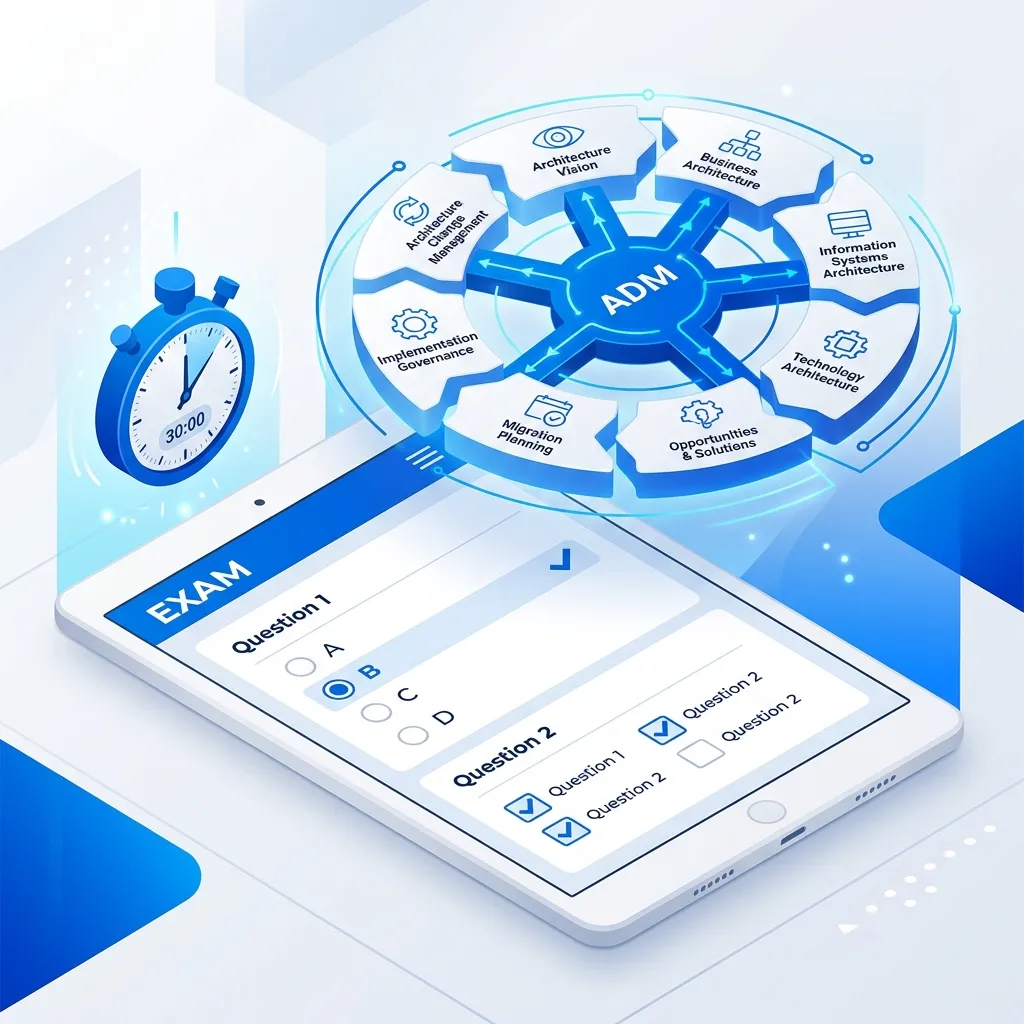
This 20-question TOGAF 9.2 Foundation mock exam covers Core Concepts, ADM Phases, ADM Techniques, the Content Framework, the Enterprise Continuum, and Architecture Governance - the exact six areas with the highest question weighting on the real exam. Work through it without notes, aiming to complete all 20 questions within 30 minutes (90 seconds per question). A score of 15 or more puts you solidly on track for the real exam's 60% passing mark.
Are you ready to take the TOGAF 9.2 Foundation exam? One of the best ways to prepare is by practicing with realistic questions that mimic the style, difficulty, and syllabus weighting of the actual exam.
Remember: For the Foundation level, you need to answer 11 out of 20 questions correctly (55%) in this practice set to stay on track for the real 60% passing mark. This is a closed-book exam, so try to answer these without looking at the manual!
Section 1: Core Concepts & ADM Phases
1. Which of the following describes the 'Enterprise Continuum' in TOGAF?
2. In the TOGAF ADM, which phase is responsible for creating the Architecture Vision and obtaining approval to proceed?
3. What is the primary purpose of the Preliminary Phase in the ADM?
4. Which ADM phase is focused on defining the Technical Architecture?
5. What does the term 'SMART' refer to in the context of Architecture Principles?
6. Which document is the primary output of the Preliminary Phase?
Section 2: Artifacts, Building Blocks & Techniques
7. Which of the following is an example of an 'Architecture Building Block' (ABB)?
8. What is the primary purpose of a 'Gap Analysis' in the ADM?
9. Which part of the TOGAF standard describes the 'objects that can be stored in the Architecture Repository'?
10. Which technique is used to manage and categorize architecture assets in the repository?
Section 3: Governance, Constraints & Readiness
11. What is the main objective of an 'Architecture Compliance Review'?
12. Which document defines the formal agreement between the development team and the architecture team?
13. What is 'Interoperability' according to the TOGAF Standard?
14. In which ADM phase is 'Business Transformation Readiness' initially assessed?
15. Which of the following is responsible for resolving conflicts between stakeholders regarding architecture designs?
Section 4: Advanced Concepts & Reference Models
16. What does the 'Technical Reference Model' (TRM) represent?
17. Which axis of the 'Stakeholder Power/Interest Matrix' measures a stakeholder's ability to influence the outcome of the project?
18. What is 'Transition Architecture'?
19. Which phase of the ADM is responsible for the selection of specific technological products (SBBs)?
20. What is the primary focus of the 'Architecture Governance' process in Phase H?
Summary
The Foundation exam is a test of precision and terminology. If you answered at least 15 out of 20 correctly, you are in a very strong position! If not, we recommend revisiting the ADM Phases and Building Blocks sections of the course.
Ready for the big leagues? Let’s tackle the scenarios: Interactive Mock Exam: TOGAF 9.2 Certified.
This post is part of the TOGAF 9.2 Masterclass series. Don’t forget to check out our previous post on Part 1 (Foundation) Study Guide & Exam Strategy.
For official exam registration and syllabus information, visit the Open Group TOGAF Certification page. Additional practice questions are available in our TOGAF Exam Questions and TOGAF 9 Practice Questions and Answers posts.
Frequently Asked Questions
Q: How is the TOGAF Foundation mock exam structured and how should I use it?
TOGAF Foundation mock exams mirror the real exam: 40 single-answer multiple-choice questions, 60-minute time limit, 55% pass mark. Use mock exams diagnostically - identify which ADM phases, TOGAF components, or terminology areas you score weakest on, then return to study material for those specific areas before sitting another mock. Do not memorise question-answer pairs; understand why each answer is correct. The real exam draws from a large item bank, so pattern memorisation is not a reliable strategy.
Q: What score should I aim for on mock exams before sitting the real Foundation exam?
Aim for consistently scoring 70% or above (28+ out of 40) on multiple different mock papers before booking the real exam. A 70% mock average provides a comfortable buffer above the 55% pass threshold and accounts for the variation between mock and real exam difficulty. If you are scoring 60-65%, continue targeted study on your weak areas. Avoid booking the exam after passing only a single mock paper - consistent performance across three or more different mocks is a stronger confidence indicator.
Q: Which TOGAF topics carry the most weight in the Foundation exam?
ADM phases and their primary inputs and outputs, the Architecture Content Framework (artifacts, deliverables, building blocks), the Enterprise Continuum, and the Architecture Repository are the highest-yield areas for Foundation. TOGAF terminology - particularly the precise definitions of key terms like "Architecture Vision," "Architecture Contract," and "Building Block" - is tested extensively. The TOGAF standard document Part II (ADM) and Part III (ADM Guidelines and Techniques) are the primary source material for Foundation-level questions.
Part of the TOGAF 9.2 Masterclass.