
TOGAF Certification, Framework & ADM Explained (2026)
What TOGAF actually is, how The Open Group runs it, why enterprise architecture needs a framework, and how the ADM and certification path connect. 2026.
Introduction to TOGAF
Hello and welcome to the TOGAF® 9 Certification. The TOGAF 9 Certification for People Program is an industry-accepted and market-driven certification program to support TOGAF 9 standards defined by The Open Group.
TOGAF in One Paragraph (Quick Answer)
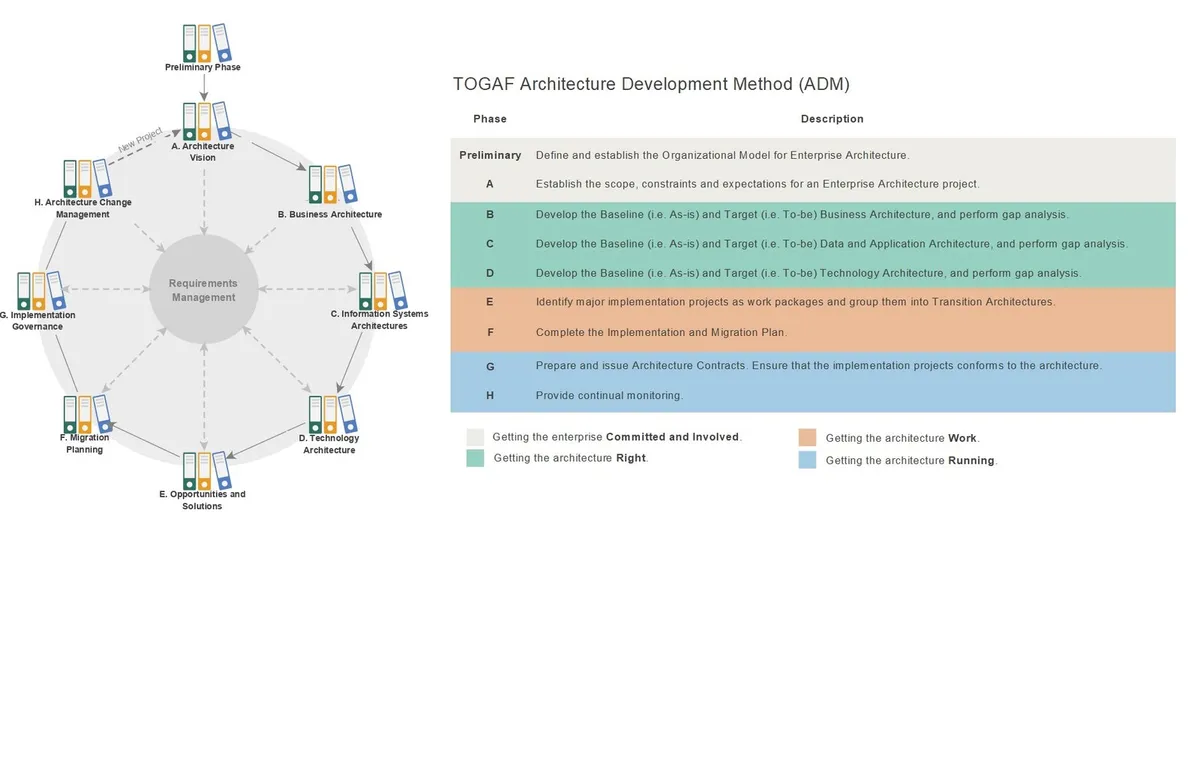
TOGAF is the world's leading Enterprise Architecture framework, maintained by The Open Group - a vendor-neutral consortium with over 425 member organizations. It provides the ADM (Architecture Development Method), a step-by-step process for developing enterprise architecture, along with governance structures, content frameworks, and reference models. TOGAF certification validates that professionals can understand and apply this framework to align IT with business strategy.
TOGAF is the de facto global standard for Enterprise Architecture. The aim of this lesson is to provide an introduction to The Open Group, Enterprise Architecture, and TOGAF as the architecture framework.
This lesson provides the management overview of TOGAF 9.1, answering crucial questions such as:
- What is The Open Group?
- What is Enterprise Architecture (EA)?
- Why do I need Enterprise Architecture?
- Why do I need TOGAF as a framework for Enterprise Architecture?
By the end of this lesson, you will be able to:
- Provide a management overview of TOGAF, an Open Group Standard.
- Describe The Open Group and its mission.
- Explain the reasons why Enterprise Architecture is required.
- Discuss why a formal framework is needed.
- Explain the evolution of TOGAF 9.1 and describe the TOGAF 9 Certification.
The Open Group
The Open Group is an international vendor- and technology-neutral consortium upon which organizations rely to lead the development of IT standards and certifications, and to provide them with access to key industry peers, suppliers, and best practices. It provides guidance and an open environment to ensure interoperability and vendor-neutrality.
With more than 425 member organizations and 40,000 member representatives around the globe, The Open Group has a diverse membership that spans all sectors of the IT community, including:
- Customers
- Systems and solutions suppliers
- Tool vendors
- Integrators and consultants
- Academics and researchers
The Open Group’s membership is open to all enterprises in the world, irrespective of whether they are small, medium, or large.
Vision: Boundaryless Information Flow™
The Open Group’s vision is Boundaryless Information Flow™, achieved through global interoperability in a secure, reliable, and timely manner.
Understanding Boundaries
Boundaryless does not mean that there are no boundaries at all. Instead, it indicates that boundaries are permeable to enable business operations across different units and organizations smoothly.
Boundaryless Information Flow™ is a shorthand representation of "access to integrated information to support business process improvements." It represents the desired state of an enterprise’s infrastructure, tailored specifically to the business needs of the organization.
An infrastructure that provides Boundaryless Information Flow™ utilizes open standard components to:
- Combine multiple sources of information.
- Securely deliver the information whenever and wherever it is needed.
- Present it in the right context for the people or systems using that information.
Mission of The Open Group
The mission of The Open Group is to drive the creation of Boundaryless Information Flow™ by:
- Working with customers to capture, understand, and address current and emerging requirements, establish policies, and share best practices.
- Working with suppliers, consortia, and standard bodies to develop consensus, facilitate interoperability, and integrate open-source technologies.
- Offering a comprehensive set of services to enhance the operational efficiency of consortia.
- Developing and operating the industry's premier certification service and encouraging the procurement of certified products.
Tackling Boundaryless Information Flow
To address problems related to Boundaryless Information Flow, The Open Group works on several subject areas, most notably Enterprise Architecture and cloud computing. For these areas, they provide services such as white papers, standards, product/service certification, and professional certifications.
TOGAF is The Open Group’s flagship Enterprise Architecture standard. TOGAF certification falls under the professional certification category for the Enterprise Architecture subject area.
Forums and Work Areas of The Open Group
The Open Group forums and workgroups provide members with an open, vendor-neutral environment where they can meet, gain knowledge, and lead the development of IT standards that address the evolving challenges of today’s enterprises.
These forums act as meeting points for suppliers and buyers in the following ways:
- Each forum is effectively an autonomous consortium operating within The Open Group.
- The direction for each workgroup is determined by the members themselves.
- The outputs of the workgroups and forums are approved directly by members.
- Forums initiate new areas of work, often leading to new industry standards and certification programs.
Why Customers Join
Customers gain significant advantages by joining these forums:
- Building relationships and sharing knowledge with peers across industries.
- Talking to suppliers in a non-selling, collaborative environment.
- Influencing the priorities being addressed by the broader IT industry.
- Gaining early access to solutions developed to address urgent issues.
Customers vs. Suppliers
In the context of IT services, a banking firm, manufacturing firm, or insurance firm acts as a customer. Meanwhile, IT consulting firms such as IBM or HP act as the suppliers.
Architecture Forum: Mission and Stakeholders
The mission of The Open Group Architecture Forum is to advance the vision of Boundaryless Information Flow™ through programs that focus on all architectural aspects, including:
- Providing broad and deep leadership to the EA community.
- Validating, publishing, fostering, and maintaining best practices for EA.
- Initiating and managing programs and projects to support these activities.
Stakeholders and Values
The Forum provides an active, vendor-neutral environment for users and vendors to learn and develop EA standards aligned with business objectives. Stakeholders derive specific values:
- Customer Architects: Reduced time, cost, and risk.
- Tools Vendors: A bigger market and increased market share.
- IT Solution Vendors & Integrators: Greater cost-efficiency and better service delivery.
- Academic/Research Organizations: Opportunities for funding and support.
Understanding the Enterprise and Architecture
What is an Enterprise?
TOGAF defines an enterprise as any collection of organizations that have a common set of goals. An enterprise could be a single department, a government agency, a whole corporation, or a chain of geographically distant organizations linked by common ownership. Today, an "extended enterprise" also includes external partners, suppliers, and customers.
What is Architecture?
Architecture is the fundamental organization of a system, embodied in:
- Its components.
- Their relationships to each other and the environment.
- The principles governing its design and evolution.
What is Enterprise Architecture?
Enterprise Architecture (EA) is the organizing logic for business processes and IT infrastructure, reflecting the integration and standardization requirements of the firm’s operating model. It is a conceptual blueprint that defines the structure and operation of an organization, determining how it can most effectively achieve its current and future objectives.
When discussing Enterprise Architecture, we are looking at departments, executives, business functions, IT systems, and how they relate under governing principles. EA always considers the baseline (current state) and the target (future state).
Architecture Domains
There are four architecture types (or domains) that are commonly accepted as subsets of Enterprise Architecture, all of which TOGAF supports:
- Business Architecture: Defines the business strategy, governance, organization, and key business processes.
- Data Architecture: Describes the structure of an organization's logical and physical data assets and data management resources.
- Application Architecture: Provides a blueprint for individual applications, their interactions, and relationships to core business processes.
- Technology Architecture: Describes the hardware, software, and IT infrastructure necessary to support the deployment of business, data, and application services.
Why Do You Need Enterprise Architecture?
Effective management and exploitation of information through IT is critical for business success and competitive advantage. Previously, many organizations developed short-term IT systems, leading to fragmented, duplicated, and unmanageable environments.
Enterprise Architecture addresses this by optimizing fragmented processes into an integrated, responsive environment.
Core Reasons for EA:
- Survival and Success: EA is critical for long-term business survival, providing a competitive advantage through managed IT.
- Managed Innovation: EA helps achieve the right balance between IT efficiency and business innovation, allowing individual units to innovate safely without breaking overarching IT integration.
Business Benefits of EA
- Strategic Alignment: Helps an organization execute its business strategy effectively.
- Faster Time to Market: New technologies and capabilities can be deployed rapidly against competitive pressures.
- Consistent Processes: Unifies information silos across business units for more consistent decision-making.
- Improved Reliability and Security: Provides clear traceability between business processes, data, user roles, and infrastructure, reducing risk.
The Importance of Governance
An Enterprise Architecture is only as effective as the decision-making framework established around it. This is called the Governance Framework. It ensures the successful development, implementation, and sustainment of the architecture.
The governance framework depends on a clear authority structure and the right participants. The Architecture Board acts as the approving and controlling authority, ensuring:
- Consistency between sub-architectures.
- Identification of re-usable components.
- Enforcement of Architecture Compliance.
- Support for out-of-bounds escalations and decision-making.
What Governance Means
Governance provides the rules, procedures, and clear authorizations for making architectural decisions. It dictates who is involved, who is responsible, and who is accountable.
What is an Architecture Framework?
An architecture framework is a conceptual, foundational structure used to develop, implement, and sustain Enterprise Architecture.
It provides:
- A method for designing the target state using a set of building blocks.
- A common vocabulary and standard tools.
- A list of recommended standards and compliant products.
The Value of a Framework
- Provides a practical, "codified common sense" starting point.
- Prevents initial panic regarding the scale of the task.
- Captures real-world, proven methodologies.
- Contains a baseline set of reusable resources.
TOGAF 9 Core Components and Scope
TOGAF is a vendor-, tool-, and technology-neutral open standard. It encourages reuse and focuses heavily on aligning business with IT. TOGAF is meant to work in conjunction with other frameworks (like ITIL, COBIT, or PRINCE2®), not necessarily replace them.
The TOGAF framework consists of several major components:
- Architecture Development Method (ADM): The core of TOGAF. A step-by-step approach to developing and using Enterprise Architecture.
- ADM Guidelines and Techniques: Directions on how to apply the ADM in practice (e.g., iterating architecture) and specific task techniques (e.g., stakeholder management).
- Architecture Content Framework: A structural model allowing major architectural work products to be consistently defined, structured, and presented.
- Enterprise Continuum: A view of the Architecture Repository showing the evolution of architectures from generic/logical to specific/physical.
- TOGAF Reference Models: Abstract frameworks (like the TRM) providing common semantics for consistent standards across implementations.
- Architecture Capability Framework: Reference materials on how to establish and operate an organizational architecture function.
Understanding these core concepts is your first major step toward passing the TOGAF 9 Certification and successfully applying Enterprise Architecture principles in the real world.
What to Study Next
Now that you have the management overview, the recommended learning path is:
- TOGAF ADM Cycle Explained - dive into all 10 ADM phases in detail.
- TOGAF Architecture Principles and Governance - understand how principles are structured and enforced.
- TOGAF Certification Levels - decide whether to pursue Foundation, Certified, or Combined.
- TOGAF 9 Practice Questions - test your knowledge before the exam.
For the official TOGAF standard, certification programme details, and accredited training partners, visit The Open Group TOGAF page. TOGAF is used by organizations worldwide - you can find its adoption data on the Open Group's success stories page.
Frequently Asked Questions
Q: What is the difference between TOGAF Foundation and TOGAF Certified?
TOGAF Foundation (Level 1) validates that you understand TOGAF terminology, structure, and the purpose of each ADM phase. TOGAF Certified (Level 2) validates that you can apply TOGAF in practice - it tests scenario-based judgment, not just recall. Foundation is a closed-book multiple-choice exam; Certified is an open-book scenario exam. Most employers in enterprise architecture roles expect Certified level. Foundation alone is suitable for stakeholders who need to understand and collaborate with architects without practising architecture themselves.
Q: Is the TOGAF certification recognised globally?
Yes. TOGAF is the most widely adopted enterprise architecture framework globally, with over 100,000 certified practitioners across more than 165 countries. It is recognised by major employers in banking, government, defence, telecommunications, and consulting. The certification is vendor-neutral and does not expire, though the Open Group periodically releases new versions of TOGAF (9.2 is current; TOGAF 10 was released in 2022) and certified practitioners may choose to update their credential.
Q: How long does it take to prepare for TOGAF certification?
For TOGAF Foundation, most candidates with an IT background need 40-60 hours of study - typically two to four weeks of part-time preparation. For TOGAF Certified, add another 30-50 hours focused on scenario practice using the Open Group's official sample questions. A combined study approach using an accredited training course (typically 3-5 days classroom or equivalent online) plus independent practice with sample exams is the most reliable preparation path.
Part of the TOGAF 9.2 Masterclass.