
Zachman Framework in 2026: Modern Relevance, Cloud-Native Challenges, Digital Transformation
How Zachman Framework remains relevant in 2026 - addressing cloud-native architectures, AI/ML systems, rapid change, and modern enterprise challenges.
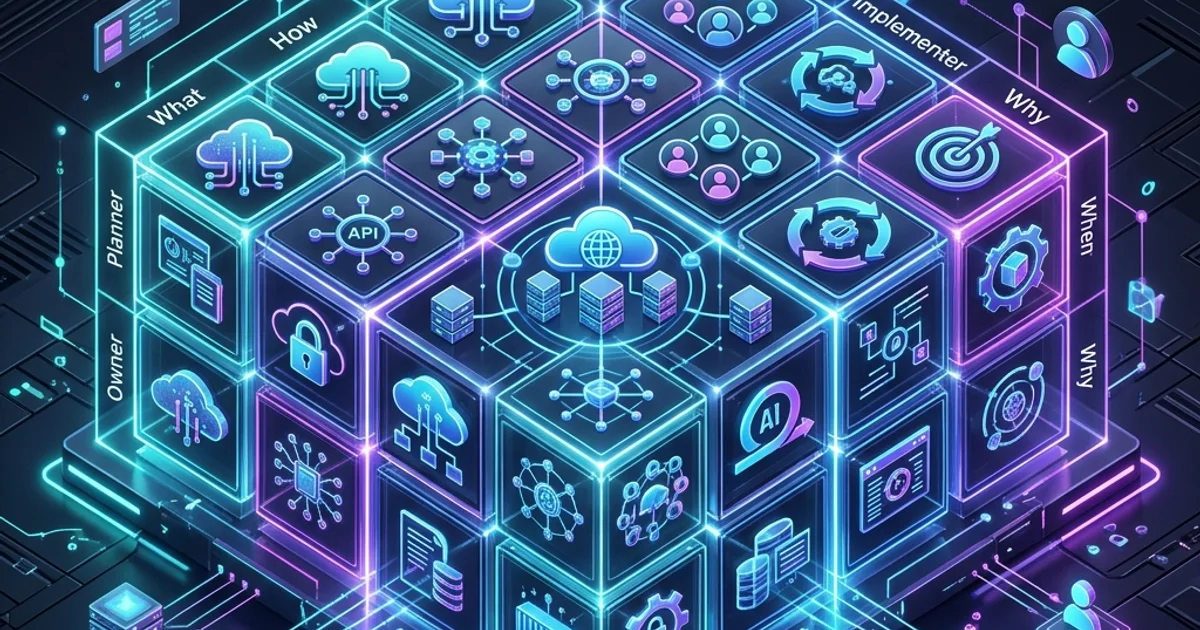
Zachman Framework in 2026: Modern Relevance, Cloud-Native Challenges, Digital Transformation
Zachman was introduced in 1987. It's 2026 (39 years later). Is Zachman still relevant? Or is it "legacy architecture thinking"?
Answer: More relevant than ever. But its application has evolved to address modern challenges: cloud-native architectures, AI/ML systems, rapid change, hybrid work, and the pace of digital transformation.
Why Zachman Is Still Relevant in 2026
1. Complexity Hasn't Decreased - It's Increased
1987: Mainframes, COBOL, centralized data, relatively stable
2026:
- Microservices (100+ services instead of monoliths)
- Cloud (AWS, Azure, GCP, hybrid, multi-cloud)
- AI/ML systems (black-box decision making)
- Distributed systems (data spread across continents)
- Real-time requirements (sub-100ms latencies)
- Security threats (zero-trust, cyber warfare)
- Regulatory complexity (GDPR, HIPAA, CCPA, sector-specific)
Result: Systems are 100x more complex. Need for Zachman's systematic, complete approach is greater than ever.
2. Speed of Change Is Extreme
1987: 3-5 year product cycles, architecture stable for years
2026:
- 2-week release cycles
- Customers expect features weekly
- Technology shifts (React → new framework every 2 years)
- AI disrupts industries overnight (ChatGPT impact on search, content creation)
Zachman benefit: Provides structure that scales with change. Row 3 (target design) can absorb changes. Rows 5-6 (implementation) can pivot without breaking Row 1-3 intent.
3. Business Model Disruption
1987: Enterprise business model: Build product once, sell for years
2026:
- Subscription models (continuous updates)
- Freemium (monetize engagement, not upfront)
- Platform models (ecosystems, not monoliths)
- AI-driven personalization (individual experiences)
- Real-time analytics (data is competitive advantage)
Zachman adaptation: Extend Row 6 (enterprise metrics) to include business model metrics (ARR, churn, LTV, engagement).
Cloud-Native Challenges & Zachman Solutions
Challenge 1: Service Mesh Complexity
Problem: Kubernetes + microservices = hundreds of services, complex networking, deployment hell.
Zachman Response:
Row 3 (Target design): Define service boundaries
  - What does each service own? (What column)
  - How do services communicate? (How column)
  - Where are services deployed? (Where column)

Row 4 (Technology spec): Specify Kubernetes, service mesh (Istio)
  - Resource limits, health checks
  - Network policies, traffic management

Row 5 (Implementation): Helm charts, deployment automation
  - Infrastructure-as-code (reproducible)

Row 6 (Operations): Metrics (latency, error rates, service health)
  - Alerting on service dependencies
Without Zachman: Teams fight about service boundaries, duplicate responsibilities, fail to coordinate. With Zachman: Clear architecture, minimal friction.
Challenge 2: Data Distributed Across Clouds
Problem: Customer data in AWS, vendor data in Azure, analytics in GCP. How to maintain consistency? Comply with GDPR (EU data in EU)?
Zachman Response:
Row 3 (Target design): Data residency and consistency strategy
  - Which data in which region?
  - How to ensure consistency (eventual vs. real-time)?
  - Data ownership (who's responsible for freshness)?

Row 4 (Technology spec): Multi-cloud data architecture
  - AWS (customer data)
  - Azure (enterprise customers, hybrid)
  - GCP (analytics)
  - Data sync strategy (Kafka, CDC, API)

Row 5-6 (Implementation + ops): Automated data pipelines
  - Monitor sync latency
  - Alert on divergence
Challenge 3: AI/ML Model Governance
Problem: ML models are non-deterministic ("black box" decisions). How to ensure fairness, compliance, auditability?
Zachman Response:
Row 3 (Target design): ML governance framework
  - What decisions should ML make? (vs. rule-based?)
  - How to validate fairness? (test for bias)
  - Why this model over another? (business justification)

Row 4 (Technology spec): ML infrastructure
  - Model registry (track versions)
  - Feature store (reproducible features)
  - Monitoring (model drift detection)

Row 5 (Implementation): Model versioning in git
  - Model code, training data, test results
  - Reproducible builds (same data = same model)

Row 6 (Operations): Model metrics
  - Prediction accuracy
  - Fairness metrics (error rate by demographic)
  - Drift detection (model performance degrading?)
Rapid Change & Zachman Adaptability
Old Way (Rigid Architecture)
Design (6 months) → Build (9 months) → Deploy (3 months) → Live (1 month)
Total: 19 months
Business requirements changed 10 times during design; architecture now obsolete
Zachman Way (Adaptive Architecture)
Row 1: Strategic intent (fixed, every 12 months)
Row 2: Current state (updated every 3 months)
Row 3: Target design (updated every 3 months as we learn)
Row 4-5: Implementation (continuous, every sprint)
Row 6: Operations (continuous, real-time)

Result: Architecture evolves with business
        Current state → Target adjusts → Implementation follows
        Business agility + technical discipline
Regulatory Complexity in 2026
2026 Regulatory Landscape:
- GDPR (EU, 2018+)
- CCPA (California, 2020+)
- HIPAA (Healthcare, ongoing)
- SOC 2 (Cloud services, 2022+)
- Sector-specific (Finance: PCI-DSS, Healthcare: HIPAA, Government: FedRAMP)
- Emerging: AI Act (EU, 2024+), Data Privacy Act proposals (US)
Zachman Solution:
Row 1 (Strategic): List compliance requirements
  - GDPR, CCPA, HIPAA, SOC 2, PCI-DSS

Row 3 (Target design): Design architecture to meet requirements
  - Data residency (where data lives)
  - Encryption (at rest, in transit)
  - Access controls (audit trails)
  - Retention policies (delete data when required)

Row 4 (Technology): Specify compliance tools
  - Data loss prevention (DLP)
  - Encryption engines (KMS)
  - Audit logging (immutable logs)
  - Compliance automation (detect violations)

Row 5 (Implementation): Compliance-as-code
  - Policy engine (enforce rules)
  - Automated testing (verify compliance)

Row 6 (Operations): Compliance metrics
  - Violations (0 target)
  - Audit findings (decreasing trend)
  - Time-to-remediate (SLA: < days)
Without Zachman: Compliance bolted on (expensive, causes rework). With Zachman: Compliance built in from Row 1.
Hybrid Work Architecture
2026 Challenge: Teams distributed globally, working asynchronously, on unstable networks.
Zachman Solution:
Row 2 (Current): Document work-from-anywhere reality
  - Network latency (unstable connections)
  - Time zones (no real-time sync possible)
  - Security requirements (VPN, zero-trust)

Row 3 (Target): Design resilient architecture
  - Assume networks fail; design for offline-first
  - Asynchronous communication (don't require real-time)
  - Strong consistency where needed, eventual consistency where possible

Row 4 (Technology): Offline-capable systems
  - Client-side caching (work offline)
  - Sync when online (eventual consistency)
  - Server architecture tolerates slow clients

Row 5-6: Monitoring latency, sync reliability
Modern Zachman Adaptations
Adaptation 1: Faster Rows
Traditional: Rows 1-2 take months, Rows 3-6 take years.
2026 approach:
- Row 1: 2 weeks (executive alignment on strategy)
- Row 2: 4 weeks (current state snapshot)
- Row 3: 2 weeks (target design high-level)
- Rows 4-6: 2-week sprints (design → build → operate in parallel)
Key difference: Instead of sequential, rows 3-6 happen in parallel, informed by rows 1-2.
Adaptation 2: Continuous Rows
Traditional: Rows are snapshots in time (Q1 planning, then frozen).
2026 approach: Rows are living documents
- Row 1: Updated annually (strategy)
- Row 2: Updated quarterly (current state evolves)
- Row 3: Updated continuously (learning from Row 5-6, adjusting design)
- Rows 5-6: Updated real-time (code, metrics)
Adaptation 3: Rows per Product Squad
Traditional: One enterprise Zachman for whole company (monolithic).
2026 approach:
- Enterprise Row 1 (shared strategy)
- Product squad Row 3 (target design for their product)
- Product squad Row 5-6 (their code, metrics)
- Shared Row 4 (platform/shared services)
Result: Autonomy + alignment.
Zachman + AI/ML in 2026
Row 1: AI Strategy
Question: Should we use AI/ML?
Examples:
- Fraud detection (yes, clear ROI)
- Customer service (maybe, uncertain ROI)
- Legal compliance review (no, too risky)
Row 3: ML System Design
What: Training data (customer transactions history)
How: ML pipeline (collect → label → train → evaluate → deploy)
Where: GPU cluster (expensive, so shared resource)
Who: Data scientists, ML engineers
When: Retraining schedule (daily? weekly?)
Why: Business value (reduce fraud by 15%)
Row 5: ML Code
Python code: model training, evaluation
Data pipelines: Airflow jobs to collect training data
Model registry: MLflow to track model versions
Deployment: KServe for serving predictions
Row 6: ML Operations
Metrics:
  - Model accuracy (96%)
  - Model drift (prediction distribution changing?)
  - Fairness (error rate by demographic, bias?)
  - Cost (GPU hours, inference latency)
2026 Zachman Best Practices
-
Start with Row 1: Always. Executive alignment is foundation.
-
Rows 3-6 in parallel: Instead of sequential, use sprints (2-week cycles for rows 3-6).
-
Living documents: Update Rows 2-3 every quarter (not one-time snapshots).
-
Metrics-driven: Row 6 metrics should drive Row 3 updates (reality informs design).
-
Squad-level Zachman: Enterprise Row 1, squad-level Rows 3-6.
-
Automation: Use Zachman to identify automation opportunities (compliance-as-code, deployment automation).
-
Asynchronous: In distributed teams, document architecture asynchronously (not requiring real-time meetings).
Predicted Evolution of Zachman (2026-2030)
AI-Augmented Architecture
2030 possibility: AI generates Row 4 from Row 3
  - "Design for microservices, cloud, real-time"
  - → AI suggests: Kubernetes, Kafka, PostgreSQL
  - → AI generates: Helm charts, Terraform configs
Real-Time Compliance
2030 possibility: Continuous compliance checking
  - Code committed → Compliance validator checks all regulations
  - Violations detected in minutes (not months)
  - Automatic remediation suggestions
Ecosystem Architecture
2030: Platform thinking (not just products)
  - Row 1: Ecosystem strategy (how to create network effects)
  - Row 3: Ecosystem design (which partner plays which role)
  - Row 5: API contracts (how partners integrate)
  - Row 6: Ecosystem health metrics (growth, engagement)
Key Takeaways: Zachman in 2026
-
Still relevant: Complexity, speed, regulation, distribution all increased. Zachman's systematic approach even more valuable.
-
Evolved approach: Faster rows, living documents, squad-level, continuous iteration.
-
Adaptations: Cloud-native, AI/ML, distributed work all addressable within Zachman framework.
-
Future-proof: Zachman's abstract framework can evolve with technology (unlike tech-specific approaches).
-
Competitive advantage: Enterprises using Zachman (well) have clearer architecture, faster execution, fewer surprises.
Next Steps
- Evaluate how Zachman could improve your architecture practice (what would be different?)
- Identify current pain points: complexity, change management, compliance → Zachman solutions?
- Plan Zachman adoption: Row 1 workshop, current state assessment, modern approach
Zachman Framework, 39 years later, is more relevant than ever. The pace of change, complexity of systems, and regulatory requirements make comprehensive architecture essential. Zachman provides the map.
Meta Keywords: Zachman Framework 2026, cloud-native, AI/ML, digital transformation, modern enterprise architecture.