
Why TOGAF Still Matters in 2026: Cloud, EA Careers & Digital
Discover why TOGAF matters — from its DoD origins to its role in digital transformation, cloud migration, and EA career advancement in 2026. Start here.
Why TOGAF Is More Important Than You Think
TOGAF is more important than most IT professionals realise because it is not just a certification or a diagramming methodology - it is the language that enterprise architects, CIOs, and technology vendors share globally. Organisations that apply TOGAF systematically consistently reduce technology duplication, accelerate digital transformation, and produce architectures that business leaders can understand and act on. In 2026, TOGAF-certified architects are among the highest-paid professionals in the IT industry.
Introduction to TOGAF
To understand why TOGAF® is more important than you think, it helps to understand The Open Group and the multiple components that make up the TOGAF framework.
The Open Group is a global consortium that enables the achievement of business objectives through IT standards. They have hundreds of member organizations which contribute to the consortium and their standards, specifically TOGAF.
Their primary vision is Boundaryless Information Flow.
Boundaryless Information Flow
Boundaryless Information Flow means having the ability to deliver required information in an understandable way to the correct people over integrated systems in a timely and secure manner.
A Brief History of TOGAF
TOGAF itself was first developed back in 1995 and was initially based on research done by the Department of Defense and the US government. After spending millions of dollars and years of research, the Department of Defense gave explicit permission to The Open Group to use the Technical Architecture Framework for Information Management (TAFIM) as a starting point for TOGAF.
Since then, The Open Group has been incredibly successful in furthering TOGAF, establishing The Open Group Architecture Forum as the place where changes to the standard are discussed and collaboratively revised by industry experts.
Core Components of TOGAF
Aside from introductory components, TOGAF is largely made up of the Architecture Development Method (ADM), alongside guidelines and techniques for using it.
Developing Architecture
The ADM describes how to actually produce the various architectural components required to build a functioning enterprise architecture. It is a true method in that there is a specific order to follow: architectural components should be developed iteratively in a specific sequence for the best results.
Guidelines and Techniques
The guidelines and techniques provide further information around the practical application of the ADM. These represent the refinements and suggestions from Architecture Forum members over decades of real-world enterprise architecture experience.
Architectural Content Framework
In addition, there is an Architectural Content Framework. This describes a standard structure for storing all architectural documents and other outputs from the ADM. Perhaps the most important outputs are the reusable architectural components (Building Blocks).
Enterprise Continuum and Tools
The Enterprise Continuum section describes the categorization and storage of architectural outputs, acting as a virtual repository from generic to highly specific architectures.
TOGAF Reference Models
TOGAF includes reference models such as the Foundation Architecture and the Integrated Information Infrastructure Reference Model (III-RM). Even if a specific organization doesn't use these exact models, reference models inevitably form part of the foundation for creating any mature enterprise architecture practice.
Architectural Capability Framework
Finally, there is the Architectural Capability Framework, which centers around building up and maintaining an enterprise architecture practice within a business. This includes information around the relevant skill sets, roles, and business processes required to operate effectively.
Apply TOGAF Holistically
TOGAF is a large framework. While it is possible to successfully use pieces of TOGAF separately, the full magic and value of TOGAF are only realized when the framework is applied holistically.
The 10 Phases of the Architecture Development Method (ADM)
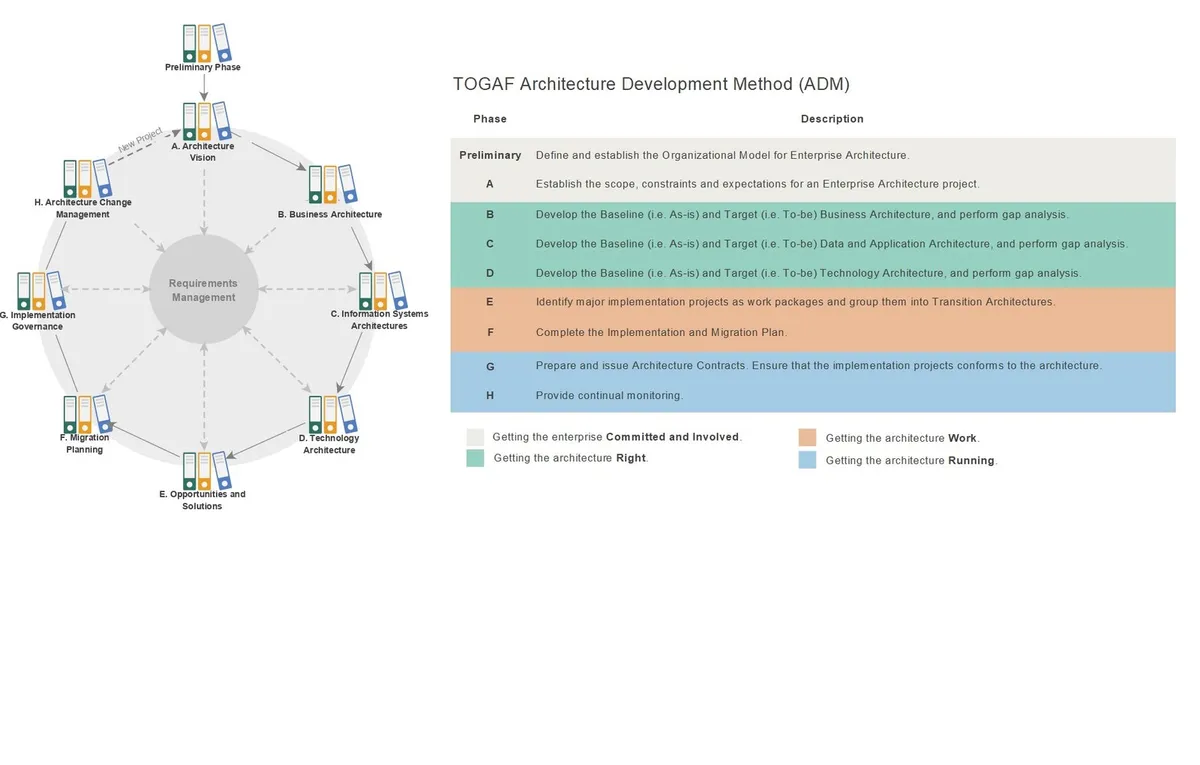
The ADM is the beating heart of TOGAF. All phases are performed iteratively in a cycle as enterprise architectures are defined and implemented. As the business continually changes, the architecture will need to change with it.
If a business strategy or vision statement changes, this should be a signal to re-evaluate the architecture. Even when the business strategy remains static, Application and Technology Architectures must be reviewed periodically to keep pace with new hardware/software releases and changing market conditions.
Here are the phases of the TOGAF ADM:
Preliminary Phase
The preliminary phase revolves around setting up the enterprise architecture practice and capability. You define the overarching principles (try to keep them under ten) and agree upon the scope. As the business changes over time, this foundational capability may need to be reviewed and altered.
Phase A: Architecture Vision
For each new architecture developed, it is treated like launching a project. A project management office (PMO) might be involved, stakeholders are identified, and scope is agreed upon. Similar to a project charter, an Architecture Vision is created and approved before proceeding with deep architectural work.
Phase B: Business Architecture
This is where the Business Architecture is developed based on the approved Architecture Vision.
Phase C: Information Systems Architectures
Here, the Information Systems Architecture is developed based on the vision and the completed Business Architecture. (Note: Phase C includes both the Data and Application architecture domains).
Phase D: Technology Architecture
The Technology Architecture is developed based on the vision and all previous architectures (Business, Data, and Application). This covers the hardware, networks, and infrastructure.
Phase E: Opportunities and Solutions
In this phase, opportunities and solutions are examined. This is essentially initial implementation planning, figuring out how to build what has been designed.
Phase F: Migration Planning
Here, the migration plan is developed. This is the detailed plan for how to safely move from the Current State Architecture to the Target State Architecture. It may involve intermediate architectures (Transition Architectures).
Phase G: Implementation Governance
This critical phase allows the architects to oversee the implementation projects, ensuring that the transition to the target architecture is actually proceeding according to what was designed and planned.
Phase H: Architecture Change Management
Change management for the new architecture is established here. This ensures the architecture lifecycle continues efficiently when new changes are inevitably required.
Requirements Management
Requirements Management is placed at the center of the ADM graphic because it's not a sequential phase-it is a continuous process performed alongside all other phases. As an architecture is developed, various requirements will present themselves and must be managed continuously to ensure the final result truly meets the business need.
Why TOGAF Matters in 2026
The question "is TOGAF still relevant?" comes up every few years. The answer in 2026 is an emphatic yes, for several reasons.
Digital Transformation Requires Architecture
Cloud migration, AI adoption, microservices transformation, and legacy modernisation are not technology projects - they are business transformation programmes. Each one requires the same things TOGAF is designed to deliver:
- A clear picture of the current state (Baseline Architecture)
- A well-defined target state aligned to business goals (Target Architecture)
- A realistic transition plan that manages risk (Migration Plan)
- Governance to ensure what gets built matches what was designed (Phase G)
Without this structure, digital transformation programmes routinely run over budget, miss their intended business outcomes, and produce technical debt that makes the next transformation harder.
TOGAF Certification Commands Premium Salaries
According to multiple industry surveys, TOGAF-certified enterprise architects earn an average of 20-35% more than non-certified architects in equivalent roles. The certification signals a level of structured thinking and framework fluency that employers - particularly in banking, government, consulting, and healthcare - actively pay for. This salary premium is one of the most tangible returns on the investment of passing the Foundation and Practitioner exams.
TOGAF Is the Common Language of Architecture
When an IT leader from a UK bank sits in a room with consultants from a global systems integrator and architects from a cloud provider, they need a shared vocabulary. TOGAF provides that vocabulary - ADM, ABBs, SBBs, Architecture Vision, Architecture Board, Compliance Review. These terms are understood by practitioners in over 180 countries. That shared language reduces the communication overhead that kills large transformation programmes.
TOGAF Integrates With Agile and DevOps
A common misconception is that TOGAF is incompatible with agile delivery. TOGAF 9.2 introduced specific guidance on integrating the ADM with agile methods. Architecture governance checkpoints can be built into sprint rhythms. Architecture principles can replace heavyweight governance gates. The ADM's iterative nature maps naturally to the incremental delivery model of agile programmes.
The Business Case for Learning TOGAF
Whether you are an individual IT professional or an organisation evaluating whether to adopt the framework, the business case for TOGAF is straightforward:
- For individual professionals: TOGAF certification is one of the most return-positive investments an IT professional can make. The cost of the exam is typically recovered within months through salary uplift
- For organisations: TOGAF provides a systematic methodology for managing technology complexity that is cheaper than the alternative - which is unmanaged complexity resulting in duplicated systems, failed transformation programmes, and technology that cannot support business growth
- For teams: A shared framework and vocabulary reduces the coordination overhead between architects, developers, business analysts, and business stakeholders
For a deeper introduction to the framework itself, start with our post on What is TOGAF 9.2?. For the certification path, see TOGAF Certification Levels: Foundation vs Practitioner. And for a real-world perspective on how TOGAF is applied, read our TOGAF Real-World Case Studies covering FinTech, healthcare, and retail transformations.
Frequently Asked Questions
Q: Why do organisations invest in TOGAF when most IT projects still fail?
TOGAF does not prevent project failure by itself - it provides the framework to make better architectural decisions and govern change. Organisations that implement TOGAF effectively report improvements in: alignment between IT investment and business strategy; reduction in duplicate systems; faster onboarding of new technology through reuse of existing architecture patterns; and clearer governance of complex cross-programme dependencies. The ROI is highest in large organisations where the cost of misalignment, duplication, and uncoordinated change is substantial.
Q: How does TOGAF support digital transformation?
Digital transformation requires coordinating change across business models, processes, data, applications, and technology simultaneously - exactly what enterprise architecture is designed to manage. TOGAF provides the structured method to define where the organisation needs to go (Target Architecture), assess the current state (Baseline), identify the gaps, and sequence the transformation into governable steps (Transition Architectures and Migration Plan). Without this structured approach, digital transformation initiatives frequently run into integration failures, data quality problems, and competing technology standards across business units.
Q: Is TOGAF becoming less relevant as cloud and agile become dominant?
No - if anything, cloud and agile increase the need for enterprise architecture governance. Cloud makes it easy to spin up new capabilities quickly, which without architectural governance leads to "shadow IT," data sovereignty violations, security gaps, and spiralling costs from duplicated services. Agile delivers change rapidly, but without architectural guardrails, rapid delivery can embed technical debt at scale. TOGAF's ADM has been updated to support iterative delivery, and many organisations combine TOGAF governance with SAFe delivery practices to get the benefits of both speed and architectural coherence.
Part of the TOGAF 9.2 Masterclass.