
TOGAF Foundation vs Practitioner: Which for 2026?
TOGAF Foundation vs Practitioner — exam format, curriculum differences, and which level you actually need for EA roles in 2026. Includes a decision guide.
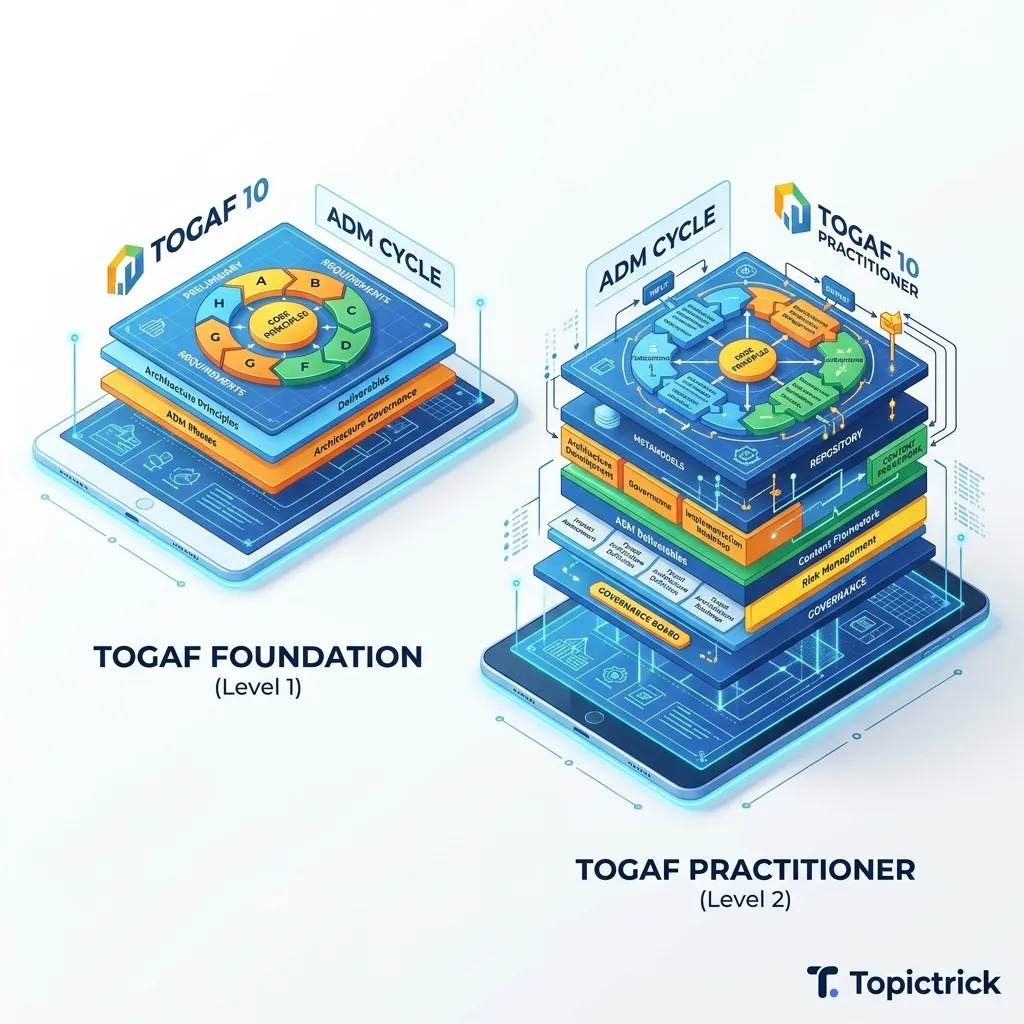
TOGAF 10 Foundation vs Practitioner
Choosing between TOGAF® 10 Foundation (Level 1) and Practitioner (Level 2) is a critical decision for any aspiring Enterprise Architect. While both certifications are based on the latest TOGAF Standard, 10th Edition, they serve distinct purposes and target different levels of professional maturity.
In this guide, we break down the curriculum, the intensity of the exams, and the real-world value of each level to help you map your certification strategy for 2026.
Comparison Overview
The primary difference lies in the Bloom's Taxonomy of learning. Foundation focuses on knowledge and comprehension, while Practitioner focuses on application and analysis.
| Task / Feature | TOGAF 10 Foundation (Level 1) | TOGAF 10 Practitioner (Level 2) |
|---|---|---|
| No comparison data available | ||
Level 1: Foundation – The Fundamentals
The Foundation exam tests your understanding of the "language" of TOGAF. It tests your ability to identify the various phases of the Architecture Development Method (ADM), the content of the Architecture Content Framework, and the role of the Architecture Repository.
Who is it for?
- Project Managers who need to work with architects.
- Junior Developers looking to understand high-level strategy.
- IT Managers overseeing digital transformation.
Level 2: Practitioner – The Application
The Practitioner level is where the "real" architecture happens. Instead of asking you to define "Phase A," the exam provides a 2-page business scenario and asks you which architectural action is most appropriate given the constraints (budget, time, stakeholder resistance).
The Scenario Challenge
Practitioner questions are notoriously difficult because they often have multiple "good" answers. You must choose the "best" answer based on the rigorous application of the TOGAF Standard.
Who is it for?
- Aspiring Enterprise Architects.
- Solution Architects moving into strategic roles.
- Consultants leading organizational change.
The 2026 "Combined" Path
Most professionals today take the Combined Exam (Part 1 + Part 2). This allows you to earn both certifications in a single sitting.
[!IMPORTANT] If you take the Combined Exam and fail Part 2 but pass Part 1, you still earn the Foundation certification. However, if you fail Part 1, you cannot earn either, even if you pass Part 2. Most candidates spend 70% of their prep time on Part 2 scenarios.
What the Exams Actually Test
Understanding the exam format prevents the most common preparation mistake: studying Foundation material for a Practitioner exam, or vice versa.
Foundation questions test recall and recognition. A typical question:
"Which phase of the TOGAF ADM produces the Statement of Architecture Work?" A) Preliminary Phase B) Phase A C) Phase B D) Phase E
There is one correct answer. Knowing the ADM phases, key deliverables, and TOGAF terminology is sufficient to pass.
Practitioner questions test judgement. A typical question presents a 200-word scenario describing an organisation's context — budget constraints, stakeholder conflicts, time pressures — and then asks:
"Given the constraints described, which action is most appropriate for the architecture team to take?"
Each of the 8 questions has five answer options scored on a gradient: 5 points (best answer), 3 points (acceptable), 1 point (possible but suboptimal), 0 points (wrong). You do not need a perfect score — you need 24 out of 40 points. But choosing the wrong "best" answer repeatedly loses points fast.
The TOGAF Standard Guide is provided during the Practitioner exam, but reading it during the exam wastes time. Practitioners who pass have already studied it thoroughly — the open-book allowance is for referencing specific clauses, not learning the content during the exam.
How Long Does Preparation Take?
Realistic preparation times vary by background:
| Background | Foundation Prep | Practitioner Prep |
|---|---|---|
| No prior EA experience | 40–60 hours | 60–80 hours |
| IT project management background | 20–30 hours | 40–60 hours |
| Working enterprise architect | 10–15 hours | 25–40 hours |
The Foundation exam rewards structured memorisation — the ADM phase names and outputs, key deliverables, framework components. Flashcards and practice questions are the most effective preparation method.
The Practitioner exam rewards pattern recognition from scenarios. The best preparation is working through annotated sample scenarios, understanding why the top-scoring answer is correct, and practising the reasoning process rather than memorising answers.
Career Impact: Roles and Salary
In 2026, the Practitioner credential is the standard requirement for senior EA roles. Most enterprise architect job descriptions list TOGAF Certified as a requirement, not a preference.
| Certification Level | Estimated Salary Premium | Typical Role |
|---|---|---|
| Foundation Only | +5–10% | Business analyst, project manager, IT manager |
| Practitioner / Certified | +20–30% | Enterprise architect, solutions architect, EA lead |
Foundation alone is valued in roles where you collaborate with architects but do not produce architecture deliverables yourself. If you plan to run ADM cycles, chair Architecture Boards, or own the Enterprise Architecture practice, Practitioner is the target.
Salary premiums vary significantly by region and industry. Financial services and government sectors in the UK, US, and Australia show the strongest TOGAF premium. Technology-first companies often treat it as one credential among many; regulated industries treat it as a baseline requirement.
Common Mistakes When Choosing
Taking Foundation when you need Practitioner. Foundation takes 2–3 weeks to prepare; Practitioner takes 6–10 weeks. Some candidates take Foundation first as a confidence-builder, then sit Practitioner separately. This is a valid strategy — but it costs more and takes longer than the combined exam.
Sitting the combined exam underprepared for Part 2. In a combined sitting, failing Part 1 means you get no credential at all, even if your Part 2 performance was strong. Most combined candidates spend roughly 70% of their preparation time on Practitioner scenarios, since Foundation knowledge is the prerequisite for the scenario reasoning anyway.
Studying the wrong version. TOGAF 10 replaced TOGAF 9.2 as the examined version in 2022. Some study materials online still reference 9.2 structure. Verify that your practice questions and study guides reference TOGAF 10.
Underestimating the open-book allowance. Practitioner candidates who assume the open-book format makes the exam easy consistently underperform. The Standard Guide contains hundreds of pages. Finding a specific clause under time pressure is slow — and the exam tests application, not lookup. Candidates who need to read the Standard during the exam typically run out of time.
Which Should You Choose?
Choose Foundation if: You are new to enterprise architecture, your role involves working alongside architects rather than leading architecture work, or you want to verify your knowledge before committing to Practitioner preparation.
Choose Practitioner (or combined) if: Your role involves producing architecture deliverables, leading ADM phases, or participating in Architecture Boards. This is also the right path if you are targeting senior EA roles within 12 months.
For most people building an EA career, the combined exam is the most efficient route — one sitting, both credentials, and the full TOGAF Certified designation that employers are looking for.
Continue your TOGAF preparation:
- TOGAF ADM phases explained — what each phase produces, which the exam tests most heavily
- TOGAF ADM full cycle guide — the process behind both exams
- TOGAF exam practice questions — Foundation and Practitioner practice with explanations
Frequently Asked Questions
Q: Can I take TOGAF Certified (Part 2) without first passing TOGAF Foundation (Part 1)?
No. TOGAF Certified is a prerequisite-based credential — you must hold TOGAF Foundation (or pass both parts in a single combined exam sitting) before being awarded the TOGAF Certified designation. The combined exam allows you to sit both Part 1 and Part 2 on the same day, and passing both in that sitting awards the full Certified designation directly. If you fail Part 2 but pass Part 1 in a combined sitting, you retain the Foundation credential and can resit Part 2 separately.
Q: Which level do employers typically require — Foundation or Certified?
For practising enterprise architects, TOGAF Certified (Level 2) is the standard expectation in most job descriptions. Foundation alone is generally considered sufficient for project managers, business analysts, or technology managers who work with architects and need to understand the framework without producing architecture work themselves. If your role involves creating architecture deliverables, leading ADM cycles, or participating in Architecture Boards, Certified is the appropriate target.
Q: How long does the TOGAF Certified credential last?
TOGAF credentials do not expire. Once you pass the exam, the certification is yours permanently. The Open Group releases updated versions of TOGAF — TOGAF 9.2 (2018) and TOGAF Standard Version 10 (2022) being the most recent. Certified practitioners who want their credential to reflect the latest version can sit a delta or upgrade exam. Many employers accept TOGAF 9 certification without requiring an upgrade, but candidates entering the job market may wish to confirm which version their target employers expect.
*Part of the TOGAF 9.2 Masterclass.*r Architecture Boards, or own the Enterprise Architecture practice, Practitioner is the target.
Salary premiums vary significantly by region and industry. Financial services and government sectors in the UK, US, and Australia show the strongest TOGAF premium. Technology-first companies often treat it as one credential among many; regulated industries treat it as a baseline requirement.
Common Mistakes When Choosing
Taking Foundation when you need Practitioner. Foundation takes 2–3 weeks to prepare; Practitioner takes 6–10 weeks. Some candidates take Foundation first as a confidence-builder, then sit Practitioner separately. This is a valid strategy — but it costs more and takes longer than the combined exam.
Sitting the combined exam underprepared for Part 2. In a combined sitting, failing Part 1 means you get no credential at all, even if your Part 2 performance was strong. Most combined candidates spend roughly 70% of their preparation time on Practitioner scenarios, since Foundation knowledge is the prerequisite for the scenario reasoning anyway.
Studying the wrong version. TOGAF 10 replaced TOGAF 9.2 as the examined version in 2022. Some study materials online still reference 9.2 structure. Verify that your practice questions and study guides reference TOGAF 10.
Which Should You Choose?
Choose Foundation if: You are new to enterprise architecture, your role involves working alongside architects rather than leading architecture work, or you want to verify your knowledge before committing to Practitioner preparation.
Choose Practitioner (or combined) if: Your role involves producing architecture deliverables, leading ADM phases, or participating in Architecture Boards. This is also the right path if you are targeting senior EA roles within 12 months.
For most people building an EA career, the combined exam is the most efficient route — one sitting, both credentials.
Next steps:
- TOGAF ADM phases explained — what you need to know for both exams
- TOGAF ADM cycle deep-dive — the process behind the certification
- TOGAF exam questions with answers — practice for Foundation and Practitioner
Frequently Asked Questions
Q: Can I take TOGAF Certified (Part 2) without first passing TOGAF Foundation (Part 1)?
No. TOGAF Certified is a prerequisite-based credential — you must hold TOGAF Foundation (or pass both parts in a single combined exam sitting) before being awarded the TOGAF Certified designation. The combined exam allows you to sit both Part 1 and Part 2 on the same day, and passing both in that sitting awards the full Certified designation directly. If you fail Part 2 but pass Part 1 in a combined sitting, you retain the Foundation credential and can resit Part 2 separately.
Q: Which level do employers typically require — Foundation or Certified?
For practising enterprise architects, TOGAF Certified (Level 2) is the standard expectation in most job descriptions. Foundation alone is generally considered sufficient for project managers, business analysts, or technology managers who work with architects and need to understand the framework without producing architecture work themselves. If your role involves creating architecture deliverables, leading ADM cycles, or participating in Architecture Boards, Certified is the appropriate target.
Q: How long does the TOGAF Certified credential last?
TOGAF credentials do not expire. Once you pass the exam, the certification is yours permanently. However, The Open Group releases updated versions of TOGAF — TOGAF 9.2 (2018) and TOGAF Standard Version 10 (2022) being the most recent. Certified practitioners who want their credential to reflect the latest version can sit a delta exam or upgrade exam. Many employers accept TOGAF 9 certification without requiring an upgrade, but candidates entering the job market may wish to confirm which version their target employers expect.
Part of the TOGAF 9.2 Masterclass. ���������������������������������������