
Zachman Framework and TOGAF Integration: Complementary Architecture Approaches
Understand how Zachman Framework and TOGAF complement each other - combined approach, governance, when to use each framework in enterprise architecture.
Zachman Framework and TOGAF Integration: Complementary Architecture Approaches
Organizations often ask: "Should we use Zachman or TOGAF?" The answer: both. They're complementary, not competing. Zachman provides the complete matrix (ensures nothing is overlooked). TOGAF provides the methodology (how to change, govern, manage architecture).
Quick Comparison: Zachman vs. TOGAF
| Aspect | Zachman | TOGAF |
|---|---|---|
| Purpose | Complete matrix (what to document) | Methodology (how to change) |
| Focus | Ensures no gaps | Defines process & governance |
| Structure | 6x6 matrix (36 cells) | ADM (Architecture Development Methodology) |
| Usage | Architecture planning/design | Transformation initiatives |
| Strength | Comprehensive | Pragmatic, practical |
| Weakness | Doesn't say "how to do it" | Doesn't guarantee completeness |
Best practice: Use Zachman for structure (what to document), TOGAF for methodology (how to implement).
How Zachman and TOGAF Complement Each Other
Zachman Provides: The What (Complete Matrix)
Zachman ensures you capture all perspectives:
- Row 1 (Planner): Strategic objectives
- Row 2 (Owner): Current state
- Row 3 (Designer): Target architecture
- Row 4 (Builder): Technology implementation
- Row 5 (Sub-Contractor): Executable code
- Row 6 (Enterprise): Live metrics
And all interrogatives:
- Column 1 (What): Entities, data
- Column 2 (How): Processes, functions
- Column 3 (Where): Location, infrastructure
- Column 4 (Who): People, roles
- Column 5 (When): Timing, events
- Column 6 (Why): Motivation, strategy
TOGAF Provides: The How (Methodology)
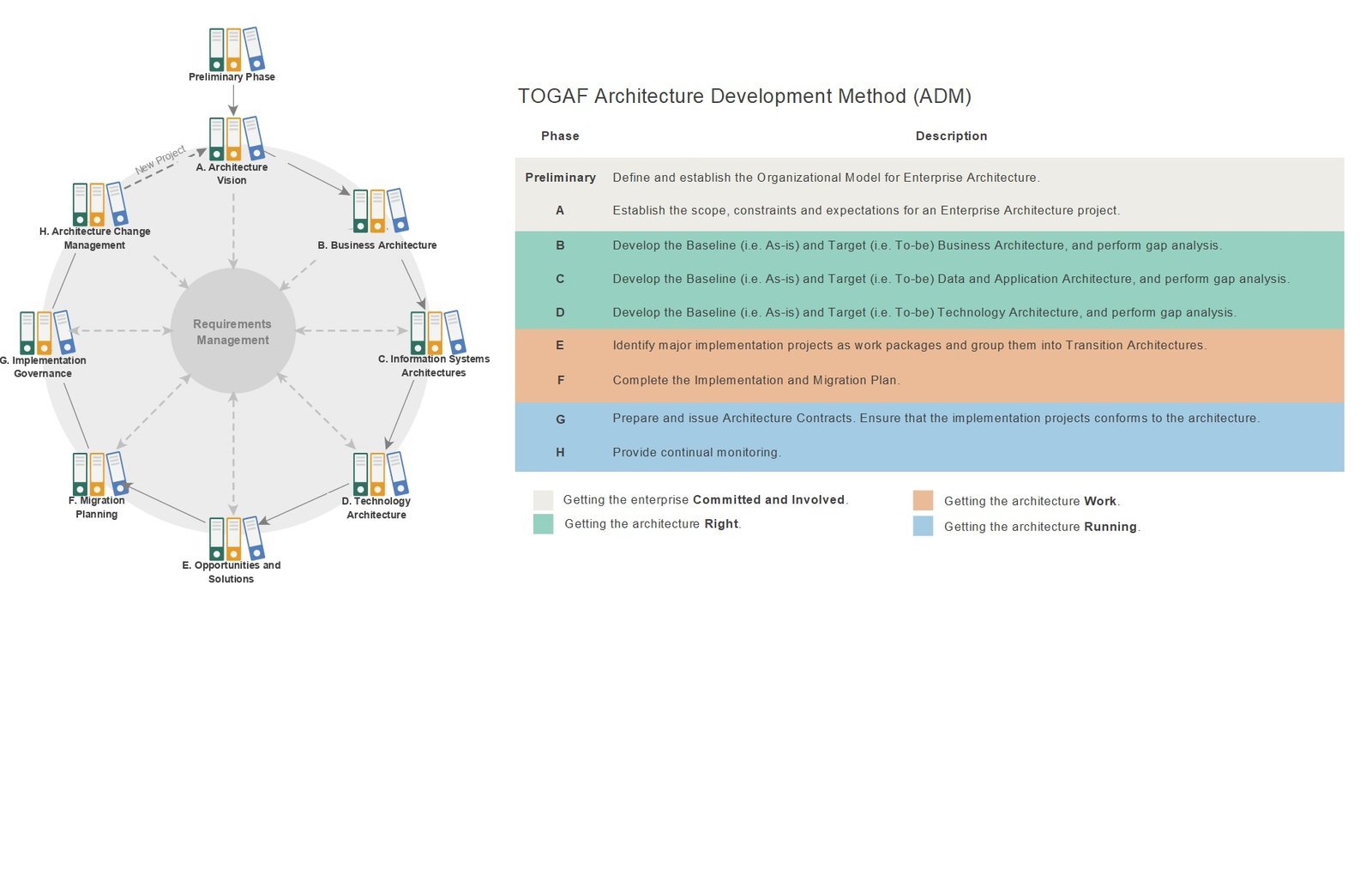
TOGAF defines the process for implementing architecture change:
ADM Phase A: Architecture Vision
- Define what architecture initiative is about
- Get stakeholder buy-in
ADM Phase B: Business Architecture
- Current state business processes
- Target state business processes
ADM Phase C: Information Systems Architecture
- Data architecture (current, target)
- Application architecture (current, target)
ADM Phase D: Technology Architecture
- Infrastructure (current, target)
- Technology stack choices
ADM Phase E: Opportunities and Solutions
- Roadmap (what to build when)
- Business cases (ROI)
ADM Phase F: Migration Planning
- Detailed implementation plan
- Dependencies
ADM Phase G: Implementation Governance
- Controls, risks, approvals
- Quality gates
ADM Phase H: Architecture Change Management
- Feedback, lessons learned
- Continuous improvement
Combined Approach: Zachman + TOGAF
Phase 1: Vision (TOGAF Phase A) + Row 1 (Zachman)
TOGAF: Define architecture vision, get executive buy-in Zachman Row 1: Document strategic intent (what, how, where, who, when, why) at strategic level
Deliverables:
- Architecture vision statement
- Business case
- Stakeholder analysis
Phase 2: Current State (TOGAF Phase B-C-D) + Row 2 (Zachman)
TOGAF: Assess current business, data, applications, technology Zachman Row 2: Document current state (what data do we have, how do processes work, etc.)
Deliverables:
- As-is business architecture
- As-is data architecture
- As-is applications
- As-is technology
Phase 3: Target Architecture (TOGAF Phase B-C-D) + Row 3 (Zachman)
TOGAF: Design target business, data, applications, technology architectures Zachman Row 3: Document target (logical) architecture (what should we do, how should processes work)
Deliverables:
- To-be business architecture
- To-be data architecture (logical model)
- To-be applications architecture
- To-be technology strategy
Phase 4: Detailed Design (TOGAF Phase E-F) + Row 4 (Zachman)
TOGAF: Create migration roadmap, implementation plan Zachman Row 4: Document technology-specific implementation (how to build with specific tech)
Deliverables:
- Roadmap (what to build when)
- Implementation roadmap
- Detailed technical specifications
Phase 5-6: Implementation + Rows 5-6 (Zachman)
TOGAF: Execute implementation, manage governance Zachman Row 5: Code, scripts, deployment automation Zachman Row 6: Live system metrics, operational governance
Deliverables:
- Code in git
- Infrastructure deployed
- Operational dashboards
Practical Example: Bank IT Modernization
Phase 1: Vision (TOGAF A + Zachman Row 1)
Vision Statement (TOGAF): "Transform ABC Bank from legacy mainframe to cloud-native microservices, reducing time-to-market from 12 months to 6 weeks while improving security and compliance."
Zachman Row 1 Strategic Intent:
| Interrogative | Detail |
|---|---|
| What | Core banking data (customer, accounts, transactions) + modern products |
| How | From batch processing → real-time event-driven architecture |
| Where | US (primary cloud), EU (GDPR), APAC (read-only) |
| Who | CTO leads, business unit heads steering committee |
| When | 3-year transformation (Year 1: core, Year 2: products, Year 3: optimization) |
| Why | Compete with fintechs (fast), reduce costs, improve customer experience |
Phase 2: Current State (TOGAF B-C-D + Zachman Row 2)
TOGAF Assessment:
- Mainframe (20 years old, COBOL code)
- 15 UNIX applications (1990s tech)
- Data warehouse (batch, overnight refresh)
- Manual processes (riskoperations)
Zachman Row 2 Assessment:
| Column | Finding |
|---|---|
| What | 47 databases, 8TB customer data, quality: 78% |
| How | Batch processes, week-long settlement cycles, manual risk approval |
| Where | Single US datacenter (no DR) |
| Who | 200 operations staff, heavy manual processes |
| When | Batch daily (overnight), real-time capabilities: none |
| Why | High operational costs ($50M/year), slow innovation, compliance gaps |
Phase 3: Target Architecture (TOGAF B-C-D + Zachman Row 3)
TOGAF Target:
- Cloud-native microservices (AWS)
- Real-time data architecture
- API-first (vs. batch-file integration)
- DevOps culture (fast deployment)
Zachman Row 3 Target:
| Column | Target Design |
|---|---|
| What | Unified customer master (MDM), product model, real-time transaction ledger |
| How | Event-driven: Transactions → Events → Multiple services consume (parallelizable) |
| Where | Multi-region (us-east-1, eu-central-1 GDPR, ap-southeast-1 read-replica) |
| Who | Autonomous product squads (8 engineers each), shared platform team |
| When | Real-time transactions (sub-100ms), analytics (real-time dashboards) |
| Why | Competitive (fast feature delivery), secure (zero-trust), compliant (GDPR), profitable |
Phase 4: Detailed Design (TOGAF E-F + Zachman Row 4)
TOGAF Roadmap:
Year 1 - Foundation:
  Q1: Data warehouse modernization (AWS Redshift)
  Q2: Customer service microservice (first service)
  Q3: Account microservice
  Q4: Transaction processing (core banking)

Year 2 - Expansion:
  Q1-4: Product services (deposits, loans, credit cards)

Year 3 - Optimization:
  Q1-4: ML/AI (fraud detection, recommendations)
Zachman Row 4 Technical Specs:
| Column | Specification |
|---|---|
| What | PostgreSQL (primary), DynamoDB (real-time), S3 (data lake) |
| How | Java/Spring Boot (microservices), Kafka (event streaming), Kubernetes (orchestration) |
| Where | AWS multi-region, EKS (Kubernetes), VPC (network isolation) |
| Who | Okta (identity), IAM policies (access control), secret manager (credentials) |
| When | Lambda (scheduled jobs), Kafka consumers (event handlers), batch (Airflow) |
| Why | Feature flags (safe deployment), encryption (security), encryption at rest (compliance) |
Phase 5-6: Implementation + Rows 5-6
TOGAF Governance:
- Architecture Review Board meets monthly
- Risk register managed continuously
- Lessons learned captured quarterly
Zachman Row 5-6:
- Code deployed in git/CI/CD
- Live system metrics tracked
- Continuous optimization based on data
Governance: Zachman + TOGAF Framework
Zachman provides: What to govern
- Each cell needs governance
- Who owns it? How often updated? Approval process?
TOGAF provides: How to govern
- Architecture Review Board (ARB) approves changes
- Governance roles (Architecture Lead, Portfolio Manager, etc.)
- Change management process
Combined Governance Model:
Architecture Strategy (Row 1 + TOGAF Vision):
  - Approved by: Executive Steering Committee (quarterly)
  - Artifacts: Business case, strategic roadmap

Architecture Design (Row 3 + TOGAF Phases B-C-D):
  - Approved by: Architecture Review Board (monthly)
  - Artifacts: Logical data/application/technology models

Implementation (Row 4-5 + TOGAF Phase E-F):
  - Approved by: Project Management Office (weekly)
  - Artifacts: Technical specs, deployment plans, code

Operations (Row 6 + TOGAF Phase G-H):
  - Reviewed by: Operations team (continuous)
  - Artifacts: Metrics dashboards, incident reports

Continuous Improvement:
  - Feedback loop: Lessons learned inform next cycle
  - TOGAF ADM iterates (each phase can loop back)
When to Use Each Framework
Use Zachman When:
- Completeness is critical: Ensure no perspective is overlooked
- Multiple transformation initiatives: Zachman prevents silos (each initiative must align to Zachman)
- Large, complex enterprises: 50+ systems, multiple business units → Zachman's matrix prevents chaos
- Long-term architecture: 3-5 year transformations benefit from Zachman's systematic approach
Use TOGAF When:
- Practical implementation needed: TOGAF ADM provides step-by-step methodology
- Certification required: TOGAF training/certification (Zachman has no standard cert)
- Industry standard required: Many enterprises mandate TOGAF
- Stakeholder familiarity: If team already knows TOGAF, TOGAF ADM is quicker to adopt
Use Both When:
- Large transformation: Zachman ensures completeness, TOGAF ensures practicality
- Compliance required: Zachman + TOGAF together satisfy both governance requirements
- Multi-year roadmap: TOGAF ADM cycles over multiple iterations of Zachman rows
- Enterprise scale: 100+ people, multiple initiatives → need both structure and methodology
Key Takeaways
-
Zachman + TOGAF are complementary: Zachman is matrix (completeness), TOGAF is methodology (how to execute).
-
Use Zachman for structure: Ensure all 36 cells are considered.
-
Use TOGAF for process: Follow ADM phases for disciplined execution.
-
Governance: Combine Zachman (what to govern) + TOGAF (how to govern).
-
Not either/or, both/and: Leading enterprises use both frameworks together.
Next Steps
- Assess which framework your enterprise currently uses (if any)
- Define governance model (combine Zachman + TOGAF)
- Plan first architecture initiative using combined approach
Zachman + TOGAF together create the most rigorous, complete enterprise architecture approach.
Frequently Asked Questions
Q: What are the practical benefits of combining Zachman with TOGAF in an architecture programme?
The primary benefit is completeness assurance. TOGAF's ADM produces deliverables efficiently but does not mandate a specific taxonomy for what those deliverables must contain. Mapping TOGAF deliverables to the Zachman cells provides a completeness check: if a Zachman cell has no TOGAF artefact mapped to it, that is a coverage gap. Conversely, Zachman benefits from TOGAF's governance model and ADM process — without TOGAF, implementing Zachman requires building a custom development method. Together, they provide both breadth (Zachman) and rigour of process (TOGAF).
Q: How do you map TOGAF ADM phases to the Zachman Framework rows?
A common mapping aligns TOGAF phases with Zachman rows by level of abstraction. The Preliminary Phase and Phase A (Architecture Vision) correspond to Zachman's Planner (Row 1) and Owner (Row 2) perspectives. Phase B (Business Architecture) maps primarily to the Owner and Designer rows. Phases C and D (Information Systems and Technology) map to the Designer (Row 3) and Builder (Row 4) rows. Phases E through H (transition and governance) span multiple rows because they deal with implementation-level concerns across all perspectives. The mapping is not perfectly one-to-one — it is a conceptual alignment rather than a formal equivalence.
Q: Is the Zachman–TOGAF integration approach recognised by The Open Group?
The Open Group acknowledges that TOGAF can be integrated with other frameworks and explicitly encourages tailoring in the Preliminary Phase. While the Open Group does not publish an official TOGAF–Zachman integration guide, the enterprise architecture community has produced extensive guidance on the combination. The TOGAF standard's Architecture Content Framework is sufficiently flexible to accommodate Zachman-style classification of artefacts. Organisations implementing the combination typically define their own mapping in the Preliminary Phase as part of tailoring TOGAF to their context.
Meta Keywords: Zachman Framework, TOGAF integration, enterprise architecture, combined approach, governance.