
Career Change to Developer: Your Step-by-Step Guide
Switch careers to software development. Learn the realistic timeline, costs, paths (self-taught vs bootcamp), and how to land your first developer job.
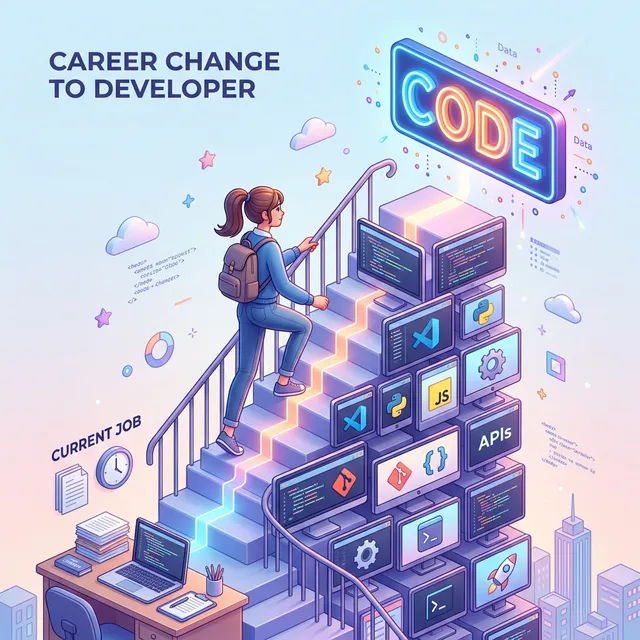
Career Change to Developer: Your Step-by-Step Guide
Every month, thousands of teachers, nurses, baristas, accountants, and marketing managers make the leap into software development. At 25, 35, or even 50, people from every background are becoming successful developers. This guide gives you a realistic, step-by-step plan to make that career change without gambling your savings.
What Does a Career Change to Developer Actually Look Like?
A career change to software development typically takes 6-18 months of consistent study, depending on your hours per week and chosen path. Most career changers start with HTML, CSS, and JavaScript, build a portfolio of 2-3 real projects, then land a junior developer role earning $60K-$90K annually without a computer science degree.
Table of Contents
- Is a Career Change to Development Right for You?
- Paths to Becoming a Developer
- Realistic Timeline & Expectations
- Self-Taught Developer Roadmap
- Building Your Portfolio
- Job Search Strategy
- Real Success Stories
Is a Career Change to Development Right for You?
Coding isn't just about typing on a keyboard; it's about solving a never-ending series of puzzles. Before you spend thousands on a bootcamp, ask yourself: do you enjoy the "aha!" moment of finally fixing a bug?
If you like building things and don't mind feeling a little confused most of the time, you have the "developer mindset."
- You enjoy solving puzzles and logical problems
- You can tolerate frustration and persist when things don't work
- You're willing to learn continuously (tech evolves fast)
- You prefer problem-solving to repetitive tasks
- You want remote work flexibility and location independence
Common concerns (and the reality):
- "I'm too old": False. Age discrimination exists but is overstated. Companies care about your skills and portfolio, not your age. Many developers start in their 30s and 40s.
- "I'm not good at math": Most web development requires only basic arithmetic. Data science and ML need more, but even then, you learn as you go.
- "It's too hard": It's challenging but absolutely learnable. Millions of developers were once complete beginners.
Developer Salaries by Role (2026)
| Level | Experience | Salary Range |
|---|
Paths to Becoming a Developer
There is no "one true way" to become a developer. Some people thrive in the high-pressure environment of a bootcamp, while others prefer the freedom (and low cost) of teaching themselves. The best path is the one you can actually stick to for 6-12 months.
Path 1: Self-Taught (Free to $200/month)
Best for: Motivated self-starters, people with flexible schedules, those who can't afford bootcamp
Pros:
- Free or low-cost
- Learn at your own pace
- Can fit around a job
- Shows employers you're self-motivated
Cons:
- No structured curriculum
- No built-in community or network
- Takes longer without guidance
- Easy to get stuck or take wrong paths
Recommended free resources: TopicTrick courses, MDN Web Docs, freeCodeCamp, The Odin Project, CS50 (Harvard)
Path 2: Immersive Coding Bootcamp ($10K-$20K)
Best for: People who want structure, accountability, and fast-tracking their career change
Top bootcamps in 2026:
- App Academy (deferred tuition available)
- Flatiron School
- General Assembly
- Le Wagon (international)
Questions to ask before enrolling:
- What is your job placement rate within 6 months?
- What is the average salary of graduates?
- Can I talk to 3 recent graduates?
- What's the income share agreement or refund policy?
Path 3: Part-Time Courses (Free-$500/month)
Best for: People who can't quit their day job, families with commitments, those who learn best with structure
This is what TopicTrick is optimized for. You can start our courses free and work through them around your existing schedule.
Path 4: Computer Science Degree (4 years, $40K-$200K)
Best for: Those certain they want a traditional tech career with maximum long-term options
Reality check: Most companies do NOT require a CS degree. A strong portfolio often beats a degree in hiring decisions, especially for web development.
Realistic Timeline & Expectations
The biggest myth in tech is the "Learn to Code in 3 Months" promise. While possible, it's rare. Most successful career changers take about a year of consistent, part-time study. It's a marathon, not a sprint.
Here is what that journey actually looks like month-by-month.
Key variable: Time dedicated per week. At 40hrs/week, you can be job-ready in 6 months. At 15hrs/week, plan for 12-18 months.
Self-Taught Developer Roadmap
Phase 1: Foundation (Months 1-3)
- HTML & CSS - 3-4 weeks
- JavaScript basics - 4-6 weeks (see our beginner JavaScript guide)
- Build: Personal portfolio website + 2 small projects
Phase 2: Core Skills (Months 3-6)
- React (frontend) OR Node.js/Express (backend) - choose one
- Git & GitHub - essential from day 1
- Basic SQL - see our SQL tutorial
- Build: 2-3 substantial projects
Phase 3: Job-Ready (Months 6-9)
- TypeScript - increasingly expected in job listings
- Testing fundamentals
- Deployment (Vercel, Railway, or AWS basics)
- Portfolio refinement
- Technical interview prep
Tools to master alongside coding:
- VS Code - your primary editor
- Git - version control is non-negotiable
- Chrome DevTools - debug in the browser
- TopicTrick tools - JSON Formatter, API Tester, Regex Tester for real work
Building Your Portfolio
In the tech world, your degree matters much less than what you can actually build. Your portfolio is your proof of skill. Instead of having fifty tiny "tutorial" projects, aim for three solid, unique applications that show you know how to solve real problems.
The 3-project portfolio rule:
Project 1: Showcase your skills - A complex app that demonstrates your strongest skills. Full-featured, deployed, polished.
Project 2: Show problem-solving - Something you built to solve a real problem in your life. Personal projects show passion.
Project 3: Show collaboration - Contribute to an open source project. Even documentation improvements count.
Portfolio Red Flags (Avoid These)
- Plain todo apps with no real features
- Projects that only exist locally (use Vercel or Netlify)
- GitHub repos with a single "initial commit"
- Copy-pasted tutorial code
- Broken links or non-responsive design
Job Search Strategy
The job search is a numbers game with strategy.
Where to Apply
- LinkedIn - most white-collar tech job listings
- Indeed - volume + variety
- Glassdoor - salary research before interviews
- AngelList (now Wellfound) - startup jobs often hire junior devs
- GitHub Jobs - developer-specific
- Company websites directly - often less competition than job boards
Application Approach
Apply broadly AND build relationships:
Week 1-2: Apply to 20 jobs
Week 3-4: Follow up on applications, connect with developers at target companies on LinkedIn
Month 2: Start getting coffee chats with developers (informational interviews)
Month 3: Referrals coming in from relationships built earlier
The secret weapon: Internal referrals get interviews at 5-10x the rate of cold applications. Connect with developers at companies you want to work for, engage with their content, be genuinely curious about their work.
Technical Interview Preparation
Technical interviews for junior roles typically include:
- Coding challenges: Platforms like LeetCode and HackerRank are commonly used by employers. Focus on array manipulation, string problems, and basic algorithms first.
- Take-home projects: You may receive a small project to complete in 48-72 hours. Treat it like a real work assignment - add README documentation and clean commits.
- System design basics: Junior roles rarely require deep system design, but understanding REST APIs and basic database schemas helps. Review our REST API tutorial as a primer.
- Behavioural questions: Prepare STAR (Situation, Task, Action, Result) stories about problem-solving, handling feedback, and working under pressure.
Consistent daily practice of 30-60 minutes on coding challenges, starting 2-3 months before you begin applying, makes a significant difference in interview performance.
Real Success Stories
Alex, former teacher -> Frontend Developer ($78K) "I spent 8 months learning on TopicTrick, mostly evenings and weekends. The React course was what made everything click. My first interview was rough but I got an offer on my 12th application."
Maria, former nurse -> Backend Developer ($92K) "I was terrified I was too old at 38, but nobody asked about my age once. They cared about my SQL project and my Node.js API. I built exactly what they needed in my portfolio."
James, former sales rep -> Full Stack Developer ($85K) "The career change took longer than I expected - 14 months total. But my sales background actually helps hugely in client conversations. Unexpected advantage."
Start your career change today with our free courses at TopicTrick. No credit card required. Learn at your pace, with real support from our developer community.
Using AI Tools to Accelerate Your Learning
One underrated advantage for today's career changers is the availability of AI coding assistants. Tools like Claude can explain confusing error messages, review your code logic, and suggest improvements - acting like a patient tutor available 24/7. Understanding how to prompt AI tools effectively is itself a marketable skill. See our AI tools for developers guide to learn which tools are worth adding to your workflow.
For those interested in the intersection of development and AI, the build AI coding agent with Claude API tutorial shows how experienced developers are building automation tools - a skill that commands premium salaries in 2026. Familiarising yourself with these concepts early puts you ahead of other career changers.
According to Stack Overflow's 2024 Developer Survey, over 76% of developers now use AI tools in their workflow, making AI literacy a genuine competitive advantage for new entrants to the field.
Frequently Asked Questions
What age is too old to become a developer?
There's no upper age limit. Developers in their 40s and 50s regularly transition into tech. Age discrimination exists but is less common that people fear, especially in companies that value experience and maturity.
How much does it cost to become a self-taught developer?
It can be nearly free. Quality resources at TopicTrick, freeCodeCamp, and The Odin Project are free. Your main costs are time and a decent computer. If you want additional premium courses or bootcamp support, budget $200-$500/month or $10K-$20K for intensive programs.
Should I quit my job to learn to code?
Only if you have significant savings (6+ months of expenses) and high motivation. Most people learn successfully while working part-time. It takes longer but is much less stressful financially.
What's the fastest path to a developer job?
An intensive bootcamp (3-6 months, full-time) is fastest but most expensive. Self-taught at 40+ hours/week can match bootcamp timelines at much lower cost with proper guidance.