
CI/CD Security: Scanning for Secrets & Vulnerabilities
Shift left or get left behind. Learn how to automate security in your CI/CD pipeline, implement pre-commit secret scanning, and protect your software supply chain using SBOMs and digital signatures.
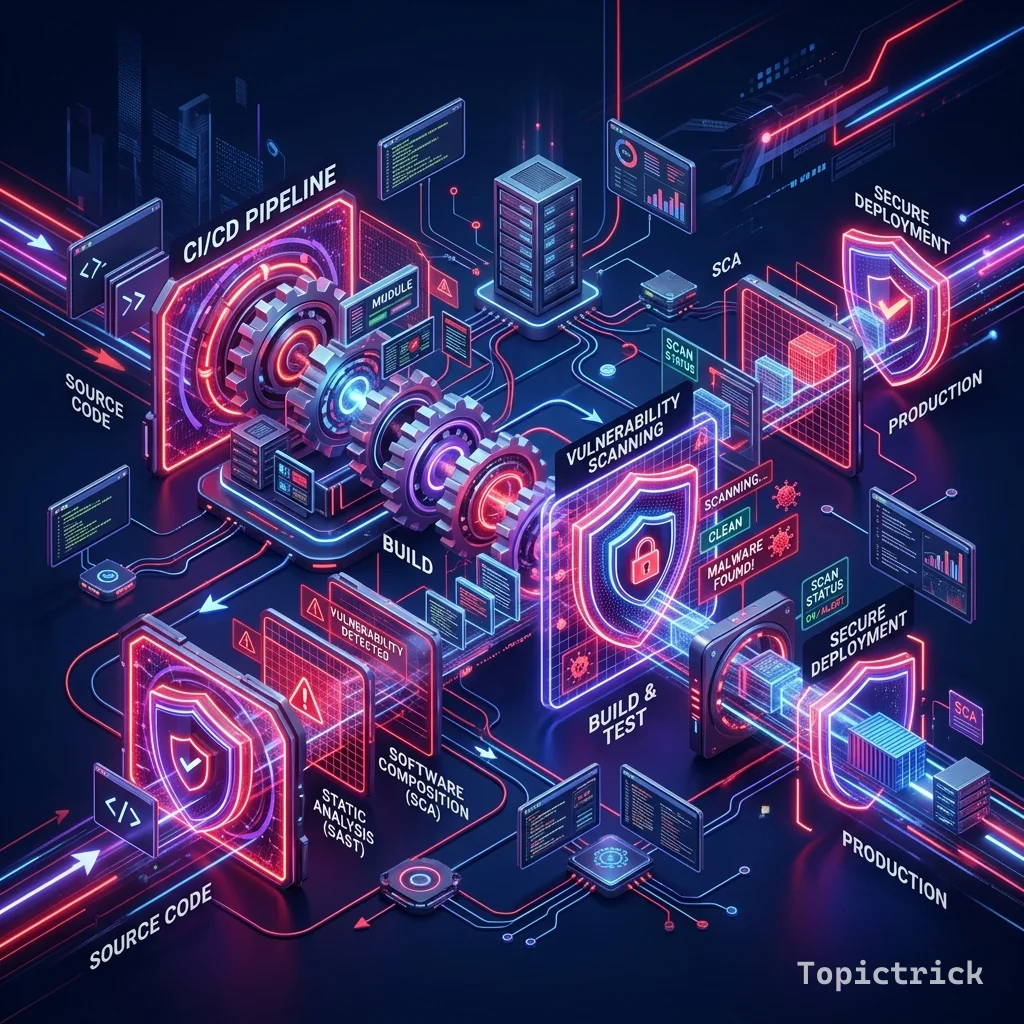
CI/CD Security: Scanning for Secrets & Vulnerabilities
In 2026, the "Software Supply Chain" is the primary target for sophisticated attackers. By compromising a build server or a third-party dependency, they can inject malicious code into thousands of downstream users simultaneously. A vulnerability in your code is a bug; a vulnerability in your CI/CD pipeline is a catastrophe.
This 1,500+ word guide is your blueprint for building a pipeline that is not just a delivery mechanism, but a rigorous security filter.
1. Hardware-Mirror: The Physics of the Supply Chain
To a developer, a library is a require() call. To the hardware, a library is a Serialized Instruction Set that will execute on your physical CPU.
The Provenance of Bytes
- The Concept: Every byte in your production environment should have a "Birth Certificate."
- The Physics of Signing: When a build is completed, it should be digitally signed using a Hardware Security Module (HSM). This ensures that the private key used for signing never leaves the physical silicon of the vault.
- The Defense: If an attacker modifies even a single bit of your binary on the server, the signature will break. The hardware will refuse to load the instructions into memory, physically preventing the execution of unauthorized code.
Architecture Rule: Implement SLSA (Supply-chain Levels for Software Artifacts) Level 3. This requires that your build is performed in a hardened, ephemeral environment that physically vanishes as soon as the build is signed.
1. Shift Left: Security at the Speed of Code
"Shift Left" means moving security checks as early in the development lifecycle as possible.
- The Old Way: Security audit 1 week before release. (Slow, expensive, frustrating).
- The Modern Way: Security scan every time a developer runs
git push. (Fast, automated, educational).
2. The Credential Leak: Pre-commit Scanning
The most common way to breach a company is to find a hard-coded API key or database password in a public Git repository.
The Layers of Protection:
- Pre-commit Hooks: Use tools like
gitleaksortrufflehogon the developer's laptop. If a secret is detected, thegit commitfails immediately. - Server-side Scanning: GitHub/GitLab provide automated secret scanning. If a key is pushed, it is automatically invalidated or flagged.
- Secret Management: Move all secrets out of code and into a dedicated vault (AWS Secrets Manager, HashiCorp Vault). Use environment variables injected at runtime.
3. SAST vs. DAST: Knowing the Difference
SAST (Static Application Security Testing)
- What: Analyzes the source code without running it.
- When: During the "Build" stage of the CI.
- Pros: Finds logic flaws, hard-coded secrets, and SQLi patterns early.
- Tools: SonarQube, Snyk Code, Semgrep.
DAST (Dynamic Application Security Testing)
- What: Attacks the running application from the outside.
- When: During the "Staging" or "QA" stage.
- Pros: Finds configuration issues (missing headers, weak SSL) that SAST cannot see.
- Tools: OWASP ZAP, Burp Suite.
4. Software Supply Chain Security: The SBOM Reality
Your application is likely 10% your code and 90% third-party libraries (npm, Go modules, Python packages).
The Physical Inventory
- SBOM (Software Bill of Materials): Think of this as the "Nutrition Label" for your software. It is a machine-readable inventory of every physical file and dependency in your build.
- The VEX (Vulnerability Exploitability eXchange): In 2026, we pair SBOMs with VEX reports. This tells you not just that a library has a vulnerability, but whether your hardware configuration is actually reachable by that vulnerability.
- The Benefit: When a major zero-day is announced, you don't hunt through code; you run a SQL query against your SBOM database to see every physical chip and server running the affected code.
5. Case Study: The 2020 SolarWinds Sunburst Attack
The SolarWinds attack remains the most significant example of Builder Compromise.
- The Injection: Attackers gained access to the physical build server of the Orion platform.
- The Hardware Trick: They added a malicious file to the build process after the developers had performed their source code reviews but before the final binary was signed.
- The Result: 18,000 customers (including the US Treasury and Pentagon) downloaded a perfectly signed, "trusted" update that contained a back-door.
- The Lesson: You must secure the Physical Build Environment. If the environment that creates the signature is compromised, the signature itself becomes a weapon.
5. Signed Builds: The Provenance of Code
How do you know that the container image in production is actually the one your CI pipeline built?
- Signing: Use a tool like Sigstore (Cosign) to digitally sign your container images and artifacts.
- Verification: Configure your Kubernetes cluster to only pull signed images. If an attacker tries to inject a malicious image with the same name, the cluster will reject the signature and refuse to run the hardware.
6. The Hardware-Mirror: The "Scan Tax"
Automated security isn't free.
- The Physical Impact: Running a deep SAST scan on a 1-million-line codebase can consume 100% of a multi-core build server's CPU for 30 minutes.
- Optimization: Use Differential Scanning. Only scan the files that changed in the current PR. This reduces the "Scan Tax" from minutes to seconds, maintaining developer velocity without compromising security.
Summary: Building a Trusted Pipeline
CI/CD security is about Automation and Provenance. By shifting left with secret scanning, automating SAST/DAST, and enforcing signed builds, you create a pipeline that is not just a delivery mechanism, but a rigorous security filter.
You are no longer just an architect of delivery; you are an Architect of Integrity.
Phase 14: CI/CD Security Actions
- Implement Pre-commit Hooks (Husky/Gitleaks) to physically block secrets from entering your Git history.
- Generate an SBOM for every production release and store it in a centralized repository (like Dependency-Track).
- Sign your container images with Cosign and enforce signature verification in your Kubernetes Admission Controller.
- Audit your build server permissions: Treat your CI/CD hardware as your Most Sensitive Infrastructure.
Read next: AI Prompt Injection: Securing the LLM Interface ->(Coming soon)