
Claude vs ChatGPT vs Gemini 2026: Which AI Should You Use?
Head-to-head comparison of Claude, ChatGPT, and Gemini in 2026. Compare models, pricing, context windows, API quality, and safety to pick the right AI.
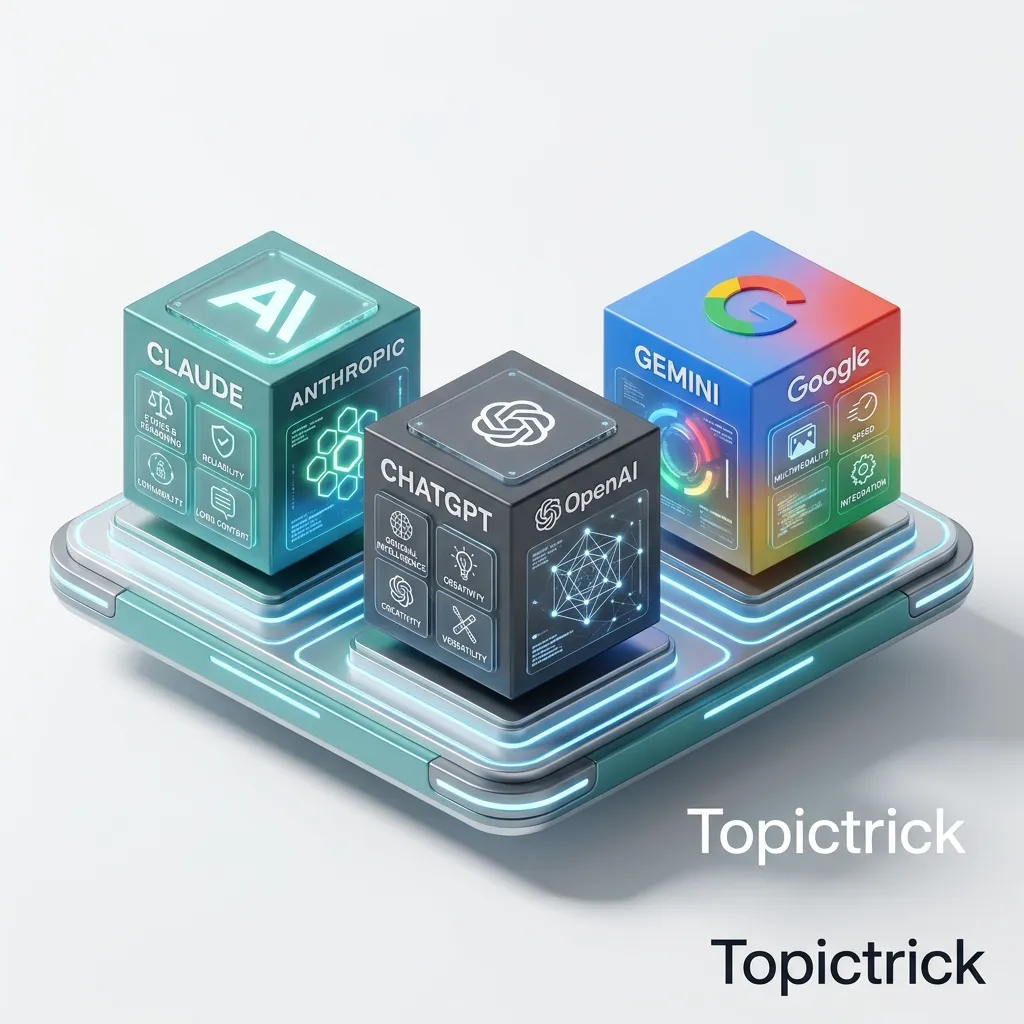
Three companies dominate the frontier of large language model development in 2026: Anthropic with Claude, OpenAI with ChatGPT, and Google with Gemini. Each one promises to be the most helpful, the most capable, and the most trustworthy AI you can use.
But marketing claims are one thing. If you are a developer choosing which API to build on, a student deciding where to learn, or an IT professional evaluating tools for your organisation, you need clear, honest comparisons - not vendor brochures.
Claude vs ChatGPT vs Gemini: Quick Summary
Claude (Anthropic) leads on safety, long-document reasoning (1M token context), and writing quality. ChatGPT (OpenAI) has the broadest ecosystem of integrations and community support, plus multimodal voice and image generation in one platform. Gemini (Google) has the deepest integration with Google services and the strongest real-time web search, with Gemini Flash offering the lowest cost per token. For developers, Claude's prompt caching and extended thinking are distinctive advantages.
This guide gives you exactly that. We will compare Claude, ChatGPT, and Gemini across the dimensions that actually matter: model capability, pricing, safety, API quality, and suitability for real professional work.
The Companies Behind the Models
Before diving into the models themselves, it helps to understand who built them and why that matters.
Anthropic and Claude
Anthropic was founded in 2021 by former OpenAI researchers who left over safety concerns. The company operates as a public benefit corporation with a stated mission to build AI that is safe, helpful, and honest. Its Constitutional AI training method - which uses a written set of principles to guide model behaviour - produces a model that is notably more consistent in refusing harmful requests while remaining genuinely useful. You can compare the full Claude model lineup on the Anthropic model overview page.
OpenAI and ChatGPT
OpenAI is the organisation that launched the first version of ChatGPT in late 2022 and sparked the current wave of mainstream AI adoption. Its GPT-4 and GPT-4o models power ChatGPT and are available through the OpenAI API. OpenAI was originally founded as a non-profit but has since reorganised around a capped-profit structure backed by Microsoft's multi-billion dollar investment.
Google DeepMind and Gemini
Google DeepMind is the research organisation formed by merging Google Brain and DeepMind in 2023. Its Gemini model family - including Gemini Ultra, Pro, and Flash - is deeply integrated into Google's product ecosystem including Search, Workspace, and Google Cloud. Gemini benefits from Google's enormous compute infrastructure and proprietary data advantages.
Why This Comparison Matters
Choosing the wrong AI platform for a production application is expensive to reverse. API contracts, prompt libraries, fine-tuned behaviours, and developer familiarity all accumulate over time. Making an informed choice at the start saves significant rework later.
Model Capability: How Do They Perform?
Reasoning and Complex Analysis
Claude Opus 4.6 consistently ranks among the highest-performing models on complex reasoning benchmarks including GPQA (graduate-level science questions), MATH, and HumanEval (coding). Its extended thinking mode - which lets the model reason step by step before producing an answer - gives it a particular edge on problems that require sustained logical chains.
GPT-4o from OpenAI remains highly competitive on most benchmarks and benefits from multimodal capability that handles voice, image, and text in a single unified model. It is fast and responsive, which matters enormously in consumer-facing applications.
Gemini Ultra 1.5 excels in tasks that benefit from Google's data advantages, particularly tasks involving real-time information retrieval integrated with Google Search. For tasks requiring up-to-date knowledge of the web, Gemini has a structural advantage because of its deep integration with Google's search infrastructure.
Coding Capability
All three platforms perform well at code generation, but with different strengths:
- Claude Opus 4.6: Highest scores on SWE-bench, which tests real-world software engineering tasks on GitHub repositories. Claude Code - Anthropic's dedicated coding product - is designed for full software development workflows including editing, testing, and running code
- GPT-4o: Very strong at code generation across a wide range of languages, with excellent integration into GitHub Copilot and Microsoft's developer toolchain
- Gemini Ultra: Competitive in code generation, particularly within Google Cloud environments and Google Colab notebooks
Writing Quality
Claude is widely regarded by professional writers, researchers, and content teams as producing the most natural, nuanced long-form writing. Its responses tend to be more considered and less likely to produce the kind of confident-but-wrong outputs that have given AI writing tools a bad reputation.
ChatGPT produces clear, readable prose and is particularly good at following format instructions. Gemini's writing quality is strong but its outputs can feel more templated and less distinctive than Claude's in direct comparison.
Context Window: How Much Can They Read at Once?
The context window determines how much text a model can process in a single interaction - documents, conversation history, code, and instructions all count toward this limit.
- Claude Opus 4.6: 1 million tokens - enough to process hundreds of pages of documents, an entire codebase, or hours of transcribed meetings in a single call
- Claude Sonnet 4.6: 1 million tokens at lower cost
- GPT-4o: 128,000 tokens - significantly smaller, which limits document processing for large files
- Gemini 1.5 Ultra: Up to 1 million tokens, matching Claude on raw context size
For most everyday tasks, the difference between 128k and 1M tokens does not matter. But for IT and enterprise use cases - processing large log files, lengthy contracts, codebases, or research documents - the context window becomes a critical factor.
Context Window vs Attention Quality
A large context window is only useful if the model can actually pay attention to content throughout the window. Claude has demonstrated strong performance on tasks that require locating and reasoning about information spread across very long documents - not just at the start and end.
Safety and Reliability
This is where the three platforms diverge most sharply, and where Anthropic's founding philosophy has the most tangible impact.
Claude's Constitutional AI Approach
Claude is trained using Constitutional AI - a process that builds explicit ethical principles into the model's behaviour at a deep level. In practice this means Claude is more consistent in declining genuinely harmful requests, more likely to flag uncertainty rather than fabricate an answer, and more transparent about its limitations.
Claude also does not have advertising or search ranking incentives. Its outputs are not influenced by what would generate clicks or engagement.
ChatGPT's Safety Record
OpenAI has invested heavily in safety research and its models are generally well-behaved. However, ChatGPT has a longer public track record of jailbreaks - techniques that bypass safety filters - largely because of its broader deployment and the enormous community of users experimenting with its limits.
Gemini's Relationship with Google
Gemini's safety profile is broadly strong, but Google's commercial interests introduce a different kind of concern. Gemini is deeply integrated with advertising and search, creating potential incentive conflicts that do not exist for Anthropic. Google's enterprise offerings include strong data privacy controls, but the vertical integration of AI with Google's business model is a factor worth considering for organisations with strict data governance requirements.
No AI is Fully Safe for High-Stakes Decisions
All three platforms can produce incorrect outputs, make up facts, and fail unpredictably on edge cases. For healthcare, legal, financial, and safety-critical applications, every AI output must be reviewed by a qualified human. This is true regardless of which platform you choose.
API Quality and Developer Experience
For developers and IT professionals, the quality of the API and developer tooling matters just as much as the model itself.
Anthropic API
- Documentation: Clear, well-structured, with working code examples in Python, TypeScript, Java, Go, C#, Ruby, and PHP
- SDKs: Official SDKs with automatic retry logic, streaming support, and type safety
- Unique features: Extended thinking, prompt caching (up to 1 hour), the Files API, Model Context Protocol (MCP), and Claude Code
- Rate limits: Tiered system that scales automatically with usage
OpenAI API
- Documentation: Extensive, with the largest community of third-party tutorials and integrations
- SDKs: Well-maintained across many languages; the largest ecosystem of compatible tools and frameworks including LangChain, LlamaIndex, and others
- Unique features: Assistants API, fine-tuning, DALL-E image generation, Whisper transcription all in one platform
- Rate limits: Can be restrictive on lower tiers; enterprise contracts required for high throughput
Google AI (Gemini API and Vertex AI)
- Documentation: Good quality, with strong integration into Google Cloud documentation
- SDKs: Well-maintained, particularly strong for Python and Node.js
- Unique features: Native integration with Google Workspace, Search, and Cloud services; strong multimodal video support
- Rate limits: Generous free tier; enterprise capacity through Vertex AI
Pricing Comparison
Pricing is constantly changing across all three platforms, but the structure is broadly comparable as of early 2026.
Claude Pricing (per million tokens)
- Opus 4.6: $5 input / $25 output
- Sonnet 4.6: $3 input / $15 output
- Haiku 4.5: $1 input / $5 output
- Prompt caching: Up to 90% cost reduction on cached context - a major advantage for applications with large, repeated system prompts
OpenAI Pricing
- GPT-4o: $5 input / $15 output per million tokens
- GPT-4o mini: $0.15 input / $0.60 output - extremely cost-effective for lightweight tasks
Google Gemini Pricing
- Gemini 1.5 Pro: $3.50 input / $10.50 output per million tokens
- Gemini 1.5 Flash: $0.075 input / $0.30 output - one of the cheapest options in the market
Evaluate Total Cost of Ownership
Raw token pricing does not tell the full story. Claude's prompt caching can dramatically reduce costs for applications with large system prompts. OpenAI's fine-tuning costs add up if you need domain-specific customisation. Always model your actual usage patterns before comparing costs.
Which One Should You Choose?
The honest answer is that the best choice depends on what you are actually building and what matters most to your organisation.
Choose Claude if:
- You are building applications where safety, honesty, and refusal of harmful content are critical - healthcare, legal, compliance, education
- You need to process very long documents reliably - contracts, codebases, research papers
- You value transparency in AI safety practices and want an audit trail for how the model makes decisions
- You want best-in-class coding assistance through Claude Code
- Cost optimisation through prompt caching matters at scale
Choose ChatGPT / OpenAI if:
- You need the broadest ecosystem of third-party integrations, tutorials, and community support
- Your application benefits from multimodal capability including voice (Whisper) and image generation (DALL-E) in one platform
- You are deploying in a Microsoft Azure environment and want native integration
Choose Gemini if:
- Your use case requires real-time web search deeply integrated into model responses
- You are building on Google Cloud and want tightly integrated services
- You need multimodal video understanding - Gemini's video processing capability is currently the strongest
- Cost is the primary driver and Gemini Flash's extremely low pricing fits your use case
Summary
All three platforms are capable, mature, and suitable for production use. The choice between them is less about which one is objectively best and more about which one aligns with your technical environment, safety requirements, and cost model.
For most developers and IT professionals starting out in AI development, Claude offers the most thoughtful balance of capability, safety, and documentation quality - which is why this tutorial series focuses on it. But knowing how it compares to the competition makes you a more informed practitioner regardless of which tools you eventually use in production.
In our next post, we go deeper into the Claude model family itself: Claude Model Family: Opus, Sonnet, and Haiku Explained.
For developers who have decided on Claude, the Claude API pricing guide helps you model your real costs including prompt caching. For hands-on experience with Claude's unique features, start with your first Claude API call.
The OpenAI pricing page and Google Gemini pricing page are the authoritative sources for competitor rates, which change frequently - always verify current pricing before making infrastructure decisions.
This post is part of the Anthropic AI Tutorial Series. Don't forget to check out our previous post: What is Anthropic? The Company Building Safe AI.
External references:
Frequently Asked Questions
Q: How does Claude compare to ChatGPT and Gemini for coding tasks in 2026? All three are strong coding assistants, but they have different strengths. Claude (Sonnet/Opus) is often praised for following complex multi-step instructions precisely, producing clean structured code, and excelling at long-context code review. GPT-4o integrates deeply with the OpenAI ecosystem and Codex-era tooling. Gemini 2.x has strong integration with Google's developer tools and long-context window. For any specific use case, run your own benchmark - model rankings shift with each new release.
Q: What is Claude's context window size compared to competitors? As of 2025-2026, Claude supports a 200K token context window across the model family - sufficient for processing entire codebases, long legal documents, or book-length content in a single request. GPT-4o supports 128K tokens and Gemini 1.5 Pro/2.0 supports up to 2 million tokens. For most tasks the differences are academic, but for extremely long document processing Gemini's larger window is an advantage. Effective use of long contexts - not just raw window size - varies by model.
Q: Which AI model is best for enterprise use in 2026? The "best" model depends on your specific requirements: data residency, compliance, existing vendor relationships, API reliability, and task-specific performance. Claude is a strong choice for enterprises that prioritise Constitutional AI safety principles and nuanced instruction-following. OpenAI GPT-4o benefits from the broadest ecosystem. Gemini is preferred in Google Cloud environments. Most enterprises evaluate all three against their actual workloads before committing - running parallel evaluations on your specific tasks is more reliable than third-party benchmarks.
Part of the Claude AI Masterclass.