
Project: Building a High-Performance In-Memory Key-Value Store (TopicKV) - Phase 2 Capstone
Phase 2 capstone project: build TopicKV, a thread-safe, high-performance in-memory key-value store in C++. Implements sharded unordered_map for concurrent access, std::shared_ptr for snapshot reads, TTL expiry with std::chrono, LRU eviction with a doubly-linked list, RAII-locked transactions, std::optional for safe gets, and a command-line REPL with std::format.
Project: Building a High-Performance In-Memory Key-Value Store (TopicKV) - Phase 2 Capstone
Table of Contents
- Architecture: Sharded Store Design
- Core Data Model: Entry with TTL
- Sharded Storage for Scalability
- Thread-Safe GET with std::optional
- Thread-Safe SET with RAII
- TTL Expiry and Lazy Deletion
- LRU Eviction Policy
- Command-Line REPL with std::format
- Statistics and Metrics
- Performance Benchmarks
- Extension Challenges
- Phase 2 Reflection
Architecture: Sharded Store Design
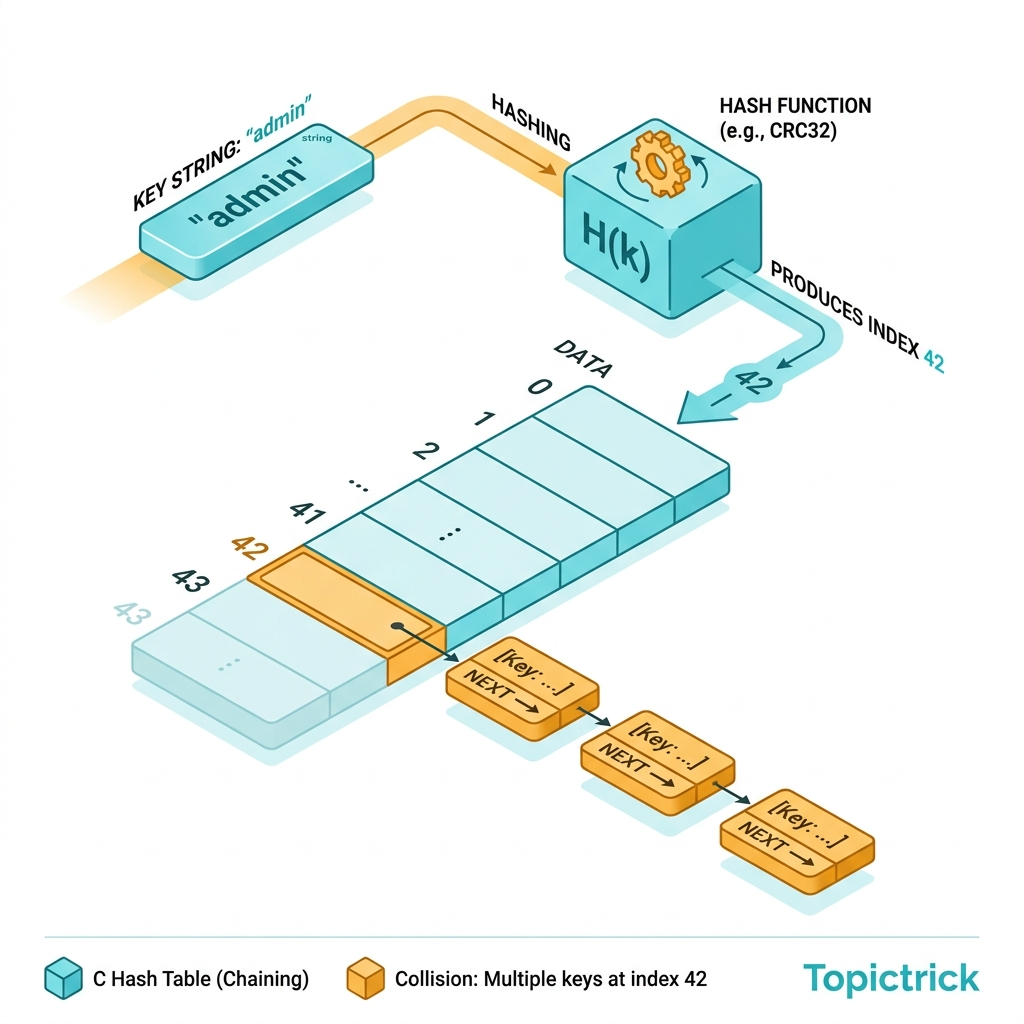
To avoid a single global lock bottlenecking all operations, TopicKV uses sharding - 16 independent sub-maps each with their own mutex:
Core Data Model: Entry with TTL
// include/topickv.hpp
#pragma once
#include <string>
#include <string_view>
#include <optional>
#include <memory>
#include <chrono>
#include <unordered_map>
#include <shared_mutex>
#include <array>
#include <atomic>

using Clock     = std::chrono::steady_clock;
using TimePoint = std::chrono::time_point<Clock>;
using Duration  = std::chrono::milliseconds;

// Internal entry - owns the value and tracks TTL:
struct Entry {
    std::shared_ptr<std::string> value;     // Shared ownership for snapshot reads
    std::optional<TimePoint>     expires_at; // nullopt = no expiry
    TimePoint                    last_access; // For LRU tracking

    explicit Entry(std::string val, std::optional<Duration> ttl = std::nullopt)
        : value(std::make_shared<std::string>(std::move(val)))
        , last_access(Clock::now())
    {
        if (ttl) expires_at = Clock::now() + *ttl;
    }

    bool is_expired() const {
        if (!expires_at) return false;
        return Clock::now() >= *expires_at;
    }

    void touch() { last_access = Clock::now(); }
};
Sharded Storage for Scalability
class TopicKV {
    static constexpr size_t SHARD_COUNT = 16;
    static constexpr size_t MAX_ENTRIES = 10'000; // Per shard

    struct Shard {
        mutable std::shared_mutex          mtx;
        std::unordered_map<std::string, Entry> data;
    };

    std::array<Shard, SHARD_COUNT> shards_;
    std::atomic<size_t> total_gets_{0};
    std::atomic<size_t> total_sets_{0};
    std::atomic<size_t> cache_hits_{0};
    std::atomic<size_t> cache_misses_{0};

    // Determine which shard owns a key:
    Shard& shard_for(std::string_view key) {
        size_t h = std::hash<std::string_view>{}(key);
        return shards_[h % SHARD_COUNT];
    }
    const Shard& shard_for(std::string_view key) const {
        size_t h = std::hash<std::string_view>{}(key);
        return shards_[h % SHARD_COUNT];
    }
Thread-Safe GET with std::optional
public:
    // GET: returns shared_ptr for snapshot safety (value stays valid even if key deleted)
    std::optional<std::shared_ptr<std::string>> get(std::string_view key) {
        auto& shard = shard_for(key);
        std::shared_lock lock(shard.mtx); // Multiple concurrent readers OK

        total_gets_.fetch_add(1, std::memory_order_relaxed);

        auto it = shard.data.find(std::string(key));
        if (it == shard.data.end()) {
            cache_misses_.fetch_add(1, std::memory_order_relaxed);
            return std::nullopt; // Key not found
        }

        // Lazy TTL check:
        if (it->second.is_expired()) {
            // Can't erase under shared_lock - caller should call del() or GC handles it
            cache_misses_.fetch_add(1, std::memory_order_relaxed);
            return std::nullopt; // Pretend it's gone
        }

        it->second.touch(); // Mark LRU access time
        cache_hits_.fetch_add(1, std::memory_order_relaxed);
        return it->second.value; // Return shared_ptr - safe even after shard unlock
    }

    // GET with fallback value:
    std::string get_or(std::string_view key, std::string_view fallback) {
        auto result = get(key);
        return result ? **result : std::string(fallback);
    }
Thread-Safe SET with RAII
    // SET: insert or update, with optional TTL
    void set(std::string_view key, std::string value,
             std::optional<Duration> ttl = std::nullopt) {
        auto& shard = shard_for(key);
        std::unique_lock lock(shard.mtx); // Exclusive write access

        total_sets_.fetch_add(1, std::memory_order_relaxed);

        // Evict if at capacity:
        if (shard.data.size() >= MAX_ENTRIES) {
            evict_lru(shard);
        }

        // Insert or update:
        auto [it, inserted] = shard.data.try_emplace(
            std::string(key),
            std::move(value),
            ttl
        );
        if (!inserted) {
            // Key exists - update in-place:
            it->second = Entry(std::move(value), ttl);
        }
    }

    // DEL: remove a key:
    bool del(std::string_view key) {
        auto& shard = shard_for(key);
        std::unique_lock lock(shard.mtx);
        return shard.data.erase(std::string(key)) > 0;
    }

    // MSET: set multiple at once (atomically within each shard):
    void mset(std::initializer_list<std::pair<std::string_view, std::string>> entries) {
        for (auto& [key, value] : entries) set(key, value);
    }
TTL Expiry and Lazy Deletion
    // Garbage collect all expired entries (call periodically):
    size_t gc() {
        size_t removed = 0;
        for (auto& shard : shards_) {
            std::unique_lock lock(shard.mtx);
            auto it = shard.data.begin();
            while (it != shard.data.end()) {
                if (it->second.is_expired()) {
                    it = shard.data.erase(it);
                    removed++;
                } else {
                    ++it;
                }
            }
        }
        return removed;
    }
LRU Eviction Policy
private:
    // Evict the least-recently-used entry from a shard (must hold unique_lock):
    static void evict_lru(Shard& shard) {
        if (shard.data.empty()) return;

        // Find the entry with the oldest last_access:
        auto oldest = std::ranges::min_element(shard.data, {},
            [](const auto& entry) { return entry.second.last_access; });

        if (oldest != shard.data.end()) {
            shard.data.erase(oldest);
        }
    }
Command-Line REPL with std::format
// src/repl.cpp
#include <print>
#include <string>
#include <sstream>
#include "topickv.hpp"

void run_repl(TopicKV& store) {
    std::println("TopicKV v1.0 - type HELP for commands");
    std::string line;

    while (std::print("> "), std::getline(std::cin, line)) {
        std::istringstream iss(line);
        std::string cmd;
        iss >> cmd;

        if (cmd == "SET") {
            std::string key, val;
            iss >> key >> val;
            store.set(key, val);
            std::println("OK");

        } else if (cmd == "SETEX") {  // SET with TTL
            std::string key, val;
            int ms;
            iss >> key >> ms >> val;
            store.set(key, val, std::chrono::milliseconds(ms));
            std::println("OK (expires in {}ms)", ms);

        } else if (cmd == "GET") {
            std::string key;
            iss >> key;
            auto result = store.get(key);
            result ? std::println("{}", **result) : std::println("(nil)");

        } else if (cmd == "DEL") {
            std::string key;
            iss >> key;
            std::println("{}", store.del(key) ? "1" : "0");

        } else if (cmd == "GC") {
            std::println("Removed {} expired entries", store.gc());

        } else if (cmd == "STATS") {
            auto [gets, sets, hits, misses] = store.stats();
            std::println("GETs: {} | SETs: {} | Hits: {} | Misses: {} | Rate: {:.1f}%",
                         gets, sets, hits, misses,
                         gets > 0 ? 100.0 * hits / gets : 0.0);
        } else if (cmd == "QUIT" || cmd == "EXIT") {
            break;
        } else {
            std::println("Unknown command. Commands: SET SETEX GET DEL GC STATS QUIT");
        }
    }
}
Extension Challenges
- Persistence: Serialize the entire store to a binary file on SIGTERM (use
std::ofstream+std::bit_castfor POD types) - Pub/Sub: Add a
SUBSCRIBE key/PUBLISH key msgcommand usingstd::condition_variableand astd::deque<std::string>channel - Transactions: Implement
MULTI/EXECby buffering commands in astd::vector<Command>and applying atomically - Network interface: Wrap the store in a TCP server using
std::jthread(from Module 14) - one thread per connection using the REPL dispatch logic
Phase 2 Reflection
| Phase 2 Concept | Used In TopicKV |
|---|---|
std::unordered_map (Module 10) | Core key-value storage per shard |
std::shared_ptr (Module 3) | Entry value - snapshot safety |
std::shared_mutex (Module 14) | Concurrent reader/writer safety |
std::optional (Module 6) | GET return type - explicit "not found" |
std::chrono | TTL timestamps, expiry comparison |
| RAII locks (Module 8) | shared_lock / unique_lock auto-release |
std::atomic (Module 14) | Lock-free statistics counters |
std::ranges::min_element (Module 15) | LRU eviction algorithm |
Proceed to Phase 3: Inheritance & Composition ->
Frequently Asked Questions
Q: What C++ data structures are best suited for building an in-memory key-value store?
std::unordered_map<Key, Value> provides O(1) average-case lookup and is the natural choice for a hash-based key-value store. For ordered range queries, std::map (red-black tree, O(log n)) is better. For a concurrent store, wrap with std::shared_mutex for read-heavy workloads or use a sharded approach (multiple maps each with their own lock) to reduce contention. For extremely high throughput, consider lock-free hash maps from libraries like libcuckoo or Junction.
Q: How do you implement expiry (TTL) for keys in a C++ in-memory store?
Store the expiry timestamp alongside each value - std::chrono::steady_clock::time_point. On every read, check whether the current time exceeds the stored expiry and return "not found" if so (lazy expiration). For active cleanup, maintain a priority queue (std::priority_queue) sorted by expiry time and run a background thread that periodically pops and deletes expired keys. This two-pronged approach (lazy + active) balances memory usage and read latency.
Q: How does an in-memory datastore project demonstrate important C++ concepts?
It exercises RAII for resource management (automatic cleanup of allocated entries), templates and type erasure for storing heterogeneous value types, concurrency primitives (std::mutex, std::shared_mutex, std::condition_variable) for thread safety, move semantics for zero-copy value insertion, and std::chrono for TTL management. It also naturally motivates benchmarking with std::chrono::high_resolution_clock and profiling to understand cache behaviour - making it an excellent capstone project for systems-level C++ skills.
Part of the C++ Mastery Course - 30 modules from modern C++ basics to expert systems engineering.