
DB2 vs PostgreSQL vs MySQL: How to Choose (2026)
IBM DB2 owns mainframe SQL. PostgreSQL wins on compliance and extensions. MySQL wins on web speed. Pick by workload: z/OS, cloud, or web app. 2026.
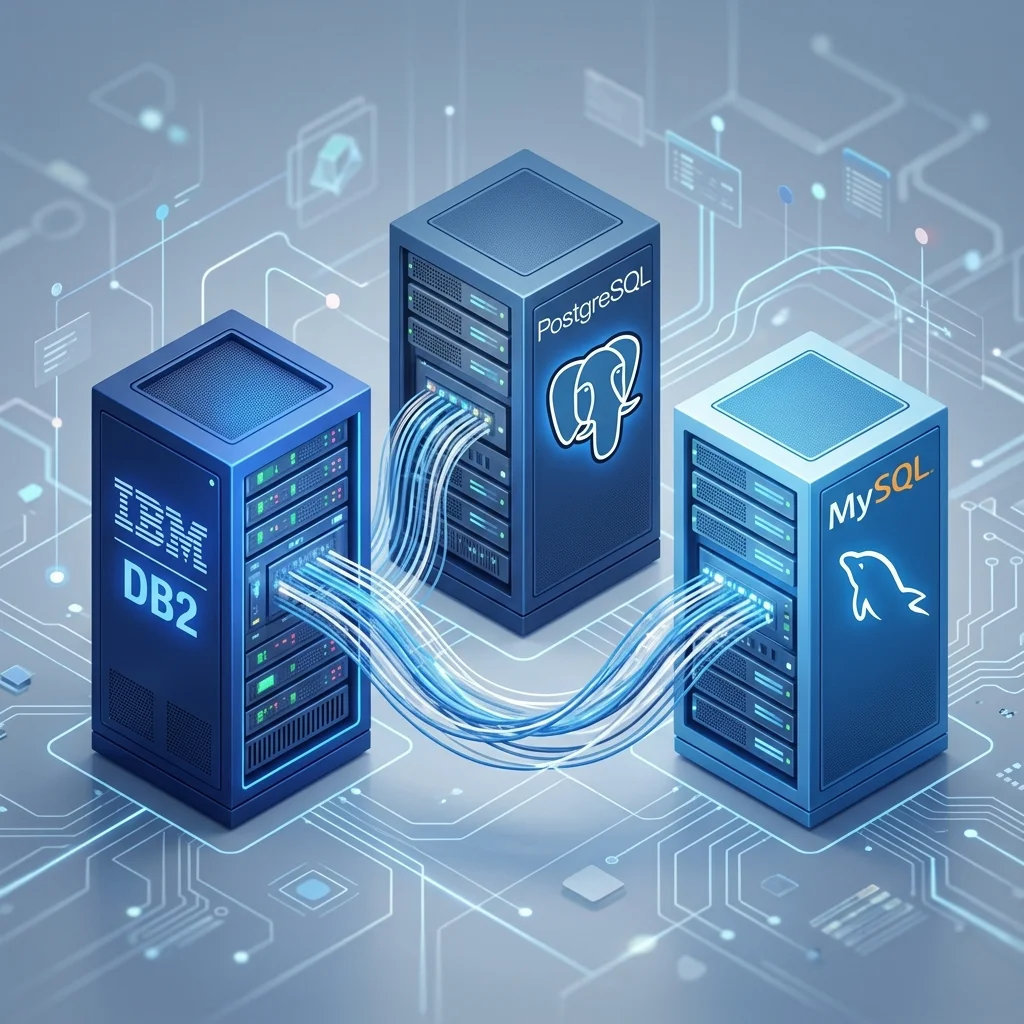
DB2 vs PostgreSQL vs MySQL: Which Database Should You Choose? (2026)
Choosing a relational database is one of the most consequential architecture decisions in enterprise software. IBM DB2, PostgreSQL, and MySQL are three of the most widely deployed relational databases in the world — but they are designed for very different contexts, and understanding those differences is essential before committing to any of them.
This comparison is practical. It covers the real architectural differences, the workloads each database is designed for, the SQL compliance and feature gaps that matter in production, and a direct recommendation for each major use case in 2026.
Overview: Who Uses Each Database and Why
IBM DB2 is deployed primarily in enterprise environments where reliability, throughput, regulatory compliance, and mainframe integration are non-negotiable. The majority of the world's largest banks, insurance companies, and government agencies run DB2 for z/OS as their core transaction database. DB2 LUW handles enterprise ERP, data warehousing, and applications requiring IBM's advanced clustering and high-availability features.
PostgreSQL is the dominant open-source relational database for cloud-native applications, modern web backends, analytics workloads, and any environment where developer experience, extensibility, and community support are valued. It is the most SQL-compliant open-source database available and has become the default choice for new greenfield applications.
MySQL is widely deployed in web applications — particularly those built on the LAMP stack (Linux, Apache, MySQL, PHP). It powers a significant portion of the world's websites and is the underlying database for many popular CMSes and e-commerce platforms. It prioritises simplicity and read performance over full SQL compliance and advanced enterprise features.
Architecture Comparison
| Attribute | DB2 for z/OS | DB2 LUW | PostgreSQL | MySQL |
|---|---|---|---|---|
| Platform | IBM Z mainframe only | Linux, UNIX, Windows | Linux, UNIX, Windows, cloud | Linux, UNIX, Windows, cloud |
| Storage model | Tablespace-based (z/OS datasets) | File-based tablespaces | File-based tablespaces | File-based tablespaces |
| Clustering | Parallel Sysplex + coupling facility | pureScale, HADR | Streaming replication, logical replication | Group Replication, InnoDB Cluster |
| MVCC | Lock-based with isolation levels | Lock-based with isolation levels | Full MVCC | InnoDB: MVCC |
| JSON support | Limited (DB2 11.5+) | BSON/JSON (11.5+) | Native JSONB (excellent) | JSON (limited) |
| Licensing | Commercial (IBM) | Commercial + Community Ed. | Open source (PostgreSQL licence) | Open source (GPL) + Enterprise |
SQL Compliance
All three databases support ANSI SQL but with varying degrees of compliance and proprietary extensions.
DB2 has among the highest levels of SQL compliance of any commercial database. It supports SQL:2016 features including temporal tables (system-time and application-time), advanced window functions, recursive CTEs, MERGE, and TRUNCATE. DB2 for z/OS adds proprietary extensions for JCL integration, utility control language, and z/OS-specific DDL.
PostgreSQL has the highest SQL compliance of any open-source database. It supports the same SQL:2016 features as DB2, plus extensions like JSONB, array types, custom domains, table inheritance, and a rich procedural language ecosystem (PL/pgSQL, PL/Python, PL/Perl).
MySQL has lower SQL compliance than both DB2 and PostgreSQL. It has historically deviated from the SQL standard in ways that cause portability issues: non-standard GROUP BY handling (prior to MySQL 5.7.5), limited window function support (added in MySQL 8.0), and incomplete support for advanced SQL features. MySQL 8.0 improved compliance significantly but gaps remain.
Performance Comparison
Performance comparisons between databases are workload-dependent, but some general patterns hold:
DB2 for z/OS delivers unmatched throughput for mainframe transaction processing workloads. Running on IBM Z hardware with direct coupling facility integration, it achieves millions of transactions per second in Parallel Sysplex configurations. For OLTP workloads at banking scale, no other database comes close.
DB2 LUW performs well for enterprise OLTP and data warehousing but does not hold the same advantage over PostgreSQL and commercial databases on commodity hardware.
PostgreSQL delivers excellent performance for OLAP and mixed workloads on commodity hardware. Its query planner is sophisticated and the parallel query execution (added in version 9.6) handles analytical queries well. For high-concurrency OLTP, PostgreSQL performs competitively with commercial databases at a fraction of the licensing cost.
MySQL performs well for read-heavy, relatively simple workloads — which is why it dominates web applications. For complex analytical queries, heavy write workloads, or large datasets, MySQL underperforms PostgreSQL and DB2.
Enterprise Features: DB2 vs PostgreSQL vs MySQL
| Feature | DB2 for z/OS | DB2 LUW | PostgreSQL | MySQL |
|---|---|---|---|---|
| Row-level security | LBAC (Label-Based Access Control) | RCAC (Row/Column Access Control) | Row Security Policies | Limited (views only) |
| Data compression | Advanced row/column compression | Adaptive compression | TOAST (automatic) | InnoDB page compression |
| Partitioning | Range, hash, list | Range, hash, list, multi-dim | Range, list, hash, composite | Range, list, hash, composite |
| Temporal tables | System-time + application-time | System-time + application-time | No native (extensions exist) | No |
| Materialized views | Materialized Query Tables (MQT) | MQT | Yes (manual refresh) | No |
| Full-text search | Limited | Limited | Built-in tsvector | Built-in FULLTEXT index |
| COBOL/mainframe integration | Native | Limited | No | No |
| Online schema change | Limited | Limited | Transactional DDL | Limited |
Licensing and Cost
DB2 for z/OS requires an IBM software licence that is priced per Million Service Units (MSUs) — the measure of mainframe capacity. Enterprise licences run to millions of dollars annually for large installations.
DB2 LUW is available in a free Community Edition for development and testing. Production use requires the Standard or Advanced Edition licences, priced per processor core.
PostgreSQL is entirely free under the PostgreSQL licence (a permissive open-source licence). Support contracts are available from third parties (EDB, Crunchy Data, AWS RDS) but the software itself has no licence cost.
MySQL Community Edition is free under GPL. MySQL Enterprise Edition, which includes advanced security, monitoring, and backup features, requires an Oracle commercial licence.
Which Database Should You Choose?
Choose DB2 for z/OS if:
- You are working on or maintaining IBM mainframe infrastructure
- Your organisation processes high-volume financial transactions that require mainframe reliability and throughput
- You need native COBOL/CICS/JCL integration
- Regulatory and compliance requirements mandate IBM mainframe infrastructure
Choose DB2 LUW if:
- You need enterprise features (advanced compression, partitioning, pureScale HA) on commodity hardware
- Your organisation has existing DB2 skills and tooling
- You are migrating from DB2 for z/OS to a distributed platform and want minimal SQL changes
Choose PostgreSQL if:
- You are building a new cloud-native or web application
- You need JSONB document storage alongside relational data
- You want maximum SQL compliance and extensibility without licensing cost
- Your team values developer experience and open-source community support
Choose MySQL if:
- You are building a web application with read-heavy, relatively simple query patterns
- You need wide hosting provider support (MySQL is available everywhere)
- You are working with an existing MySQL-based stack (WordPress, Magento, etc.)
- Licensing cost is a constraint and your workload does not require advanced SQL features
Summary
| Decision | Best Choice |
|---|---|
| Mainframe transaction processing | DB2 for z/OS |
| Enterprise OLTP with IBM stack | DB2 LUW |
| Cloud-native application | PostgreSQL |
| Web application, read-heavy | MySQL |
| Maximum SQL compliance, open source | PostgreSQL |
| COBOL + SQL integration | DB2 (LUW or z/OS) |
| Budget-conscious new project | PostgreSQL |
Ready to learn DB2?
If you are working with DB2 in an enterprise or mainframe environment, the DB2 Mastery Course covers all 27 topics from SQL fundamentals to z/OS administration — free.