
Domain-Driven Design (DDD): Foundations, Patterns and Practical Guide 2026
Master the complexity. Learn how to use Bounded Contexts and Ubiquitous Language to align your software architecture with the real-world business.
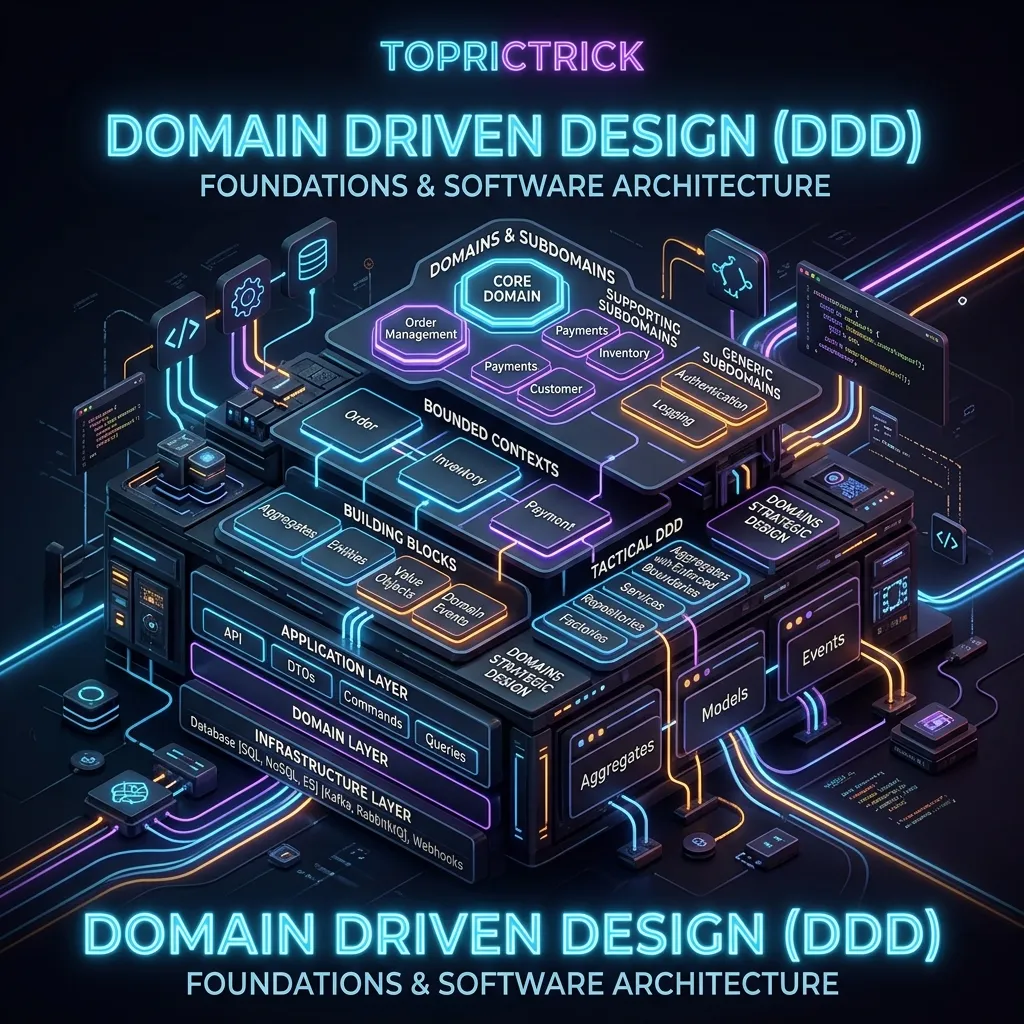
Domain-Driven Design (DDD) Foundations
"If your code doesn't speak the same language as your business, you are building a bridge to nowhere."
In most companies, there is a "Wall" between the Developers and the Business. The Business says "A Customer has a Subscription." The Developer writes TABLE users { subscription_id INT }.
- The Problem: $2$ years later, the developers don't understand the business rules, and the business doesn't understand why the "Simple" change is taking $6$ months.
Domain-Driven Design (DDD) fix this. It forces the software to perfectly mirror the Business Reality. This 1,500+ word guide explores the "Strategic Design" that separates the world-class architects from the coders.
1. Ubiquitous Language: The Unified Dialect
The #1 goal of DDD is to have The Same Words in the Meetings and in the Code.
- If the Sales team calls it an "Order," the code MUST call it
Order. NotTransaction. NotRequest. - Every word must have a clear definition that everyone agrees on.
2. Bounded Contexts: The "Silo" strategy
One word can mean two different things.
- To the Shipping team, a "Product" is a box with a weight and a height.
- To the Marketing team, a "Product" is an image with a price and a description.
The Mistake: Putting both into one giant
Productclass. This causes "Coupling" bugs. The DDD Solution: Create a "Shipping Context" and a "Marketing Context." They are separate worlds. This is the foundation of Microservices.
3. Entities vs. Value Objects
- Entity: Has an ID. (e.g., A
User. Even if they change their name, they are the same person). - Value Object: Has no ID. It is defined by its data. (e.g.,
AddressorMoney). The Pro-Tip: In $2026$ architecture, we try to make everything a Value Object. It is immutable and much easier to test.
4. Aggregates: The Consistency Boundary
An Aggregate is a group of objects that must stay synchronized.
- An
Orderand itsOrderItems. - You should NEVER update an
OrderItemdirectly. You must go through theOrder(The Aggregate Root). - This ensures that your "Total Price" always matches the list of items. It prevents data corruption.
5. Strategic vs. Tactical DDD
- Strategic: Bounded Contexts and Ubiquitous Language. (Thinking about the whole company).
- Tactical: Entities, Value Objects, and Repositories. (Writing the code). The Rule: Strategic DDD is more important. If you have the wrong Bounded Contexts, no amount of "Clean Code" will save your architecture.
Summary: The DDD Checklist
- Language First: Sit with the business team and define your terms.
- Define Contexts: Map out the different "Departments" of your app.
- Identify Aggregates: Find your "Consistency Islands."
- Use Value Objects: Avoid giving IDs to things that don't need them (like colors or addresses).
- No Leaks: Ensure code from the "Shipping" context never touches the "Marketing" database directly.
DDD is the "Philosophy" of high-end engineering. By mastering the alignment of code and business logic, you gain the ability to build systems that stay clean and maintainable for decades. You graduate from "Writing code" to "Architecting Organizations."
Part of the Architecture Masterclass - engineering the reality.