
IBM IMS Introduction: DB, TM & DL/I Explained (2026)
IBM IMS handles 50 billion transactions per day at the world's largest banks. IMS DB, IMS TM, DL/I calls and the hierarchy model explained. 2026.
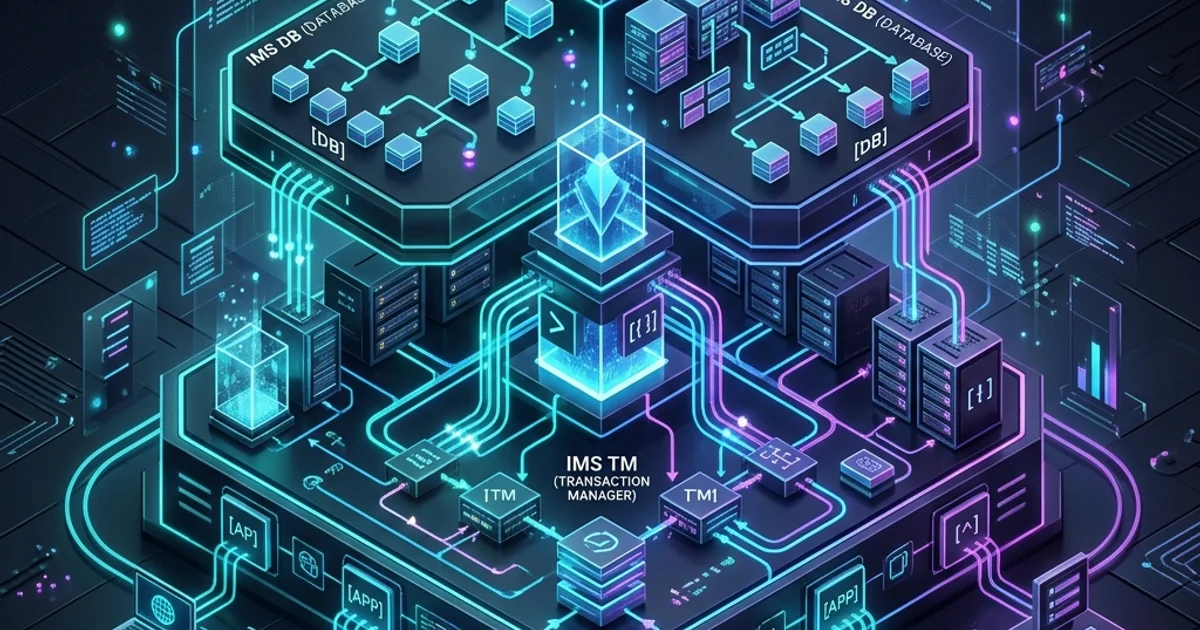
IBM IMS (Information Management System) is one of the world's oldest and most resilient enterprise database and transaction management systems. First developed in 1966 as part of the Apollo moon programme, IMS has been running mission-critical workloads for over five decades. Today it processes an estimated 50 billion transactions per day across the world's largest banks, insurance companies, and government agencies.
Understanding what IMS is — and why it is still relevant — is the foundation for every mainframe developer working on z/OS systems.
What IMS Is
IMS is a two-part IBM product that provides both a hierarchical database management system (IMS DB) and an online transaction processing system (IMS TM). These two components can be used together or independently. Most large enterprises use both.
IMS DB — The Hierarchical Database
IMS DB stores data in a tree-like parent-child structure called a hierarchy, rather than the row-and-column tables used by relational databases like DB2. Every piece of data has exactly one parent (except the root segment), creating a strict top-down organisation. This model was designed for the access patterns of its era and delivers exceptional performance for applications that always retrieve data starting from a known root.
IMS TM — The Transaction Manager
IMS TM (Transaction Manager) handles online transaction processing — accepting terminal or application messages, routing them to the correct program, and returning responses. It is the IMS equivalent of CICS, though with a different architecture and programming model.
Who Uses IMS in 2026?
IMS is disproportionately concentrated in industries where data volume, reliability, and historical continuity matter most:
Banking and Financial Services — Every major global bank runs IMS. Account balances, transaction histories, and core banking records for hundreds of millions of accounts are managed in IMS databases. The reasons are stability, throughput, and the cost of migration.
Insurance — Policy records, claims data, and customer hierarchies map naturally to IMS's hierarchical model. Many insurers have IMS databases that are decades old with accumulated business logic that would take years to recreate.
Healthcare — Patient records, billing systems, and pharmaceutical supply chains run on IMS at large healthcare organisations and government health agencies.
Government and Public Sector — Social security, tax, and benefits systems in the United States, United Kingdom, Germany, and Japan rely heavily on IMS. The US Social Security Administration's systems are a well-known IMS installation.
Retail and Logistics — Large retailers with decades of operational history often maintain IMS databases for inventory, order history, and customer data alongside modern systems.
Why IMS Is Still Used After 50+ Years
The persistence of IMS is not nostalgia — it is economics and risk.
Performance at scale: IMS hierarchical access is extraordinarily fast when data is retrieved via known root-to-dependent paths, which is exactly how most transaction processing works. Retrieving a customer's account history in IMS requires traversing a pre-built hierarchy, not executing a JOIN across tables.
Extreme reliability: IMS has a decades-long track record of near-zero unplanned downtime. The banking systems that cannot afford even minutes of outage depend on this.
Migration cost and risk: A large IMS installation may contain millions of lines of COBOL, decades of tuning, and business logic that is incompletely documented. Migrating this to a modern system is a multi-year, multi-billion-dollar project with significant risk. Most organisations choose to modernise around IMS rather than replace it.
Skills shortage creating stability: Paradoxically, as fewer developers know IMS, enterprises are less likely to attempt risky migrations because they cannot find the expertise to execute them safely.
IMS vs Relational Databases
The key differences between IMS and relational databases like DB2:
| Aspect | IMS | DB2 / Relational |
|---|---|---|
| Data model | Hierarchical (tree) | Relational (tables) |
| Query language | DL/I calls (in COBOL) | SQL |
| Relationships | Parent-child only | Any via JOIN |
| Primary strength | Known-path navigation | Ad hoc querying |
| Schema changes | Expensive | Easier |
| Typical use | Transactional, high volume | Reporting, analytics |
IMS in the Modern Mainframe Ecosystem
Modern IMS installations are not isolated relics. IBM continues to develop IMS actively, adding support for:
- Open access via JDBC/ODBC — Java and other modern applications can access IMS databases through IBM's IMS Universal Drivers without writing DL/I code.
- REST APIs — IMS Connect and IMS Explorer allow REST-based access to IMS transactions and data.
- Hybrid cloud — IBM Z can run alongside public cloud workloads, with IMS data accessible from cloud applications.
- DevOps tooling — IMS supports Git-based change management and modern CI/CD through IBM's Wazi and other tools.
Frequently Asked Questions
Q: Is IMS still being developed by IBM? Yes — IBM ships annual releases of IMS with new features. Recent releases added IMS Explorer enhancements, improved open access via Universal Drivers, and integration with IBM's hybrid cloud platform. IMS is very much a current product, not a legacy system in maintenance mode.
Q: Can a new mainframe developer learn IMS and find work? IMS skills are among the most in-demand and undersupplied in mainframe development. Because the pool of experienced IMS developers is shrinking through retirement, enterprises actively recruit and train new developers. Starting with IMS fundamentals — hierarchy, DL/I calls, DBD/PSB/PCB — opens doors at major financial institutions and government agencies.
Q: What programming language is used with IMS? COBOL is the dominant language for IMS DL/I programming in production environments. PL/I is also used in older codebases. IBM also provides Java-based Universal Drivers for modern access patterns, but the production maintenance developer role is predominantly COBOL.
Ready to Master IMS?
This lesson is part of the IMS Mastery Course — 22 free modules covering IMS DB and IMS TM, from hierarchical database fundamentals to DL/I programming, Fast Path, MFS, and production administration.