
Python Inheritance & Operator Overloading: OOP Masterclass
Master Python inheritance types, MRO, and operator overloading with dunder methods. Practical examples for writing clean, reusable OOP code across all skill.
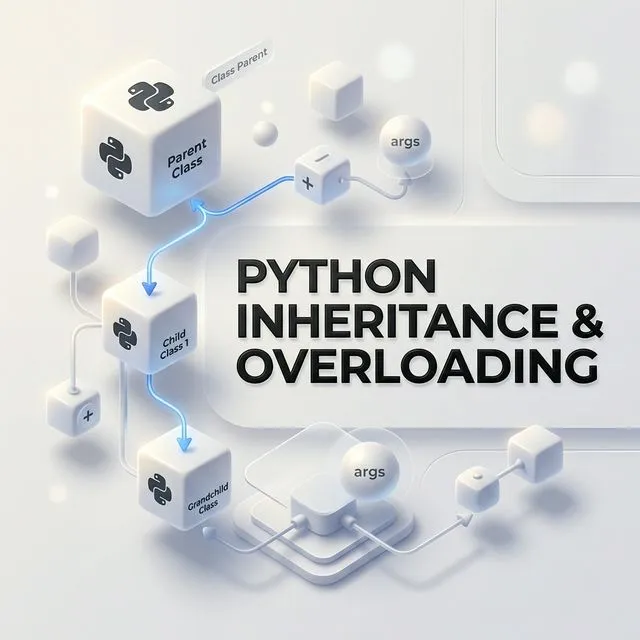
What is Python Inheritance?
Python inheritance lets a child class acquire the attributes and methods of a parent class, enabling code reuse and clean object hierarchies. Combined with operator overloading, it allows you to build intuitive custom types that feel like native Python objects.
Introduction to Inheritance
Inheritance is one of the pillars of Object-Oriented Programming (OOP). Much like biological inheritance, it allows a "child" class to take on the attributes and methods of a "parent" class. This promotes code reusability and helps you follow the DRY (Don't Repeat Yourself) principle.
In Python, every class you create automatically inherits from the built-in object class, giving it basic functionality.
class Parent:
    def speak(self):
        print("Parent speaking")

class Child(Parent):
    def play(self):
        print("Child playing")

c = Child()
c.speak() # Inherited method
c.play()  # Own method
Types of Inheritance in Python
Python is incredibly flexible and supports several inheritance patterns:
1. Simple Inheritance
A single child class inherits from a single parent class.
Example: Class B(A)
2. Multiple Inheritance
A child class inherits from more than one parent class. This is a powerful feature where Python uses MRO (Method Resolution Order) to decide which method to call if both parents have the same one.
Example: Class C(A, B)
3. Multilevel Inheritance
A child class inherits from a parent, which in turn inherits from another class.
Example: Class C(B) where Class B(A)
4. Hierarchical Inheritance
Multiple child classes inherit from the same parent.
Example: Class B(A) and Class C(A)
5. Hybrid Inheritance
A combination of two or more of the above types.
Method Resolution Order (MRO)
When dealing with Multiple Inheritance, Python needs a way to decide which class to look in first. This is called MRO.
Modern Python uses the C3 Linearization Algorithm (or simply the "New Style MRO") to create a consistent search path. You can check the MRO of any class using the .mro() method.
class A: pass
class B(A): pass
class C(A): pass
class D(B, C): pass

print(D.mro())
# Output: [D, B, C, A, object]
Pro Tip: C3 Linearization
Python's MRO is designed to be monotonic, meaning it respects the order of inheritance you define and ensures a class is always searched after its children.
Operator Overloading
Operator Overloading allows you to define how standard operators (like +, -, *) behave when used with your custom objects. This makes your classes feel like built-in Python types.
Python implements this using Dunder (Double Under) Methods.
Common Overloading Methods
| Operator | Dunder Method | Purpose |
|---|---|---|
+ | __add__(self, other) | Addition |
- | __sub__(self, other) | Subtraction |
* | __mul__(self, other) | Multiplication |
/ | __truediv__(self, other) | Division |
== | __eq__(self, other) | Equality |
< | __lt__(self, other) | Less Than |
** | __pow__(self, other) | Power |
Example: Overloading Multiplication
Let's create a Point class where the * operator calculates the cross product (or simple coordinate multiplication).
class Point:
    def __init__(self, x, y):
        self.x = x
        self.y = y

    def __mul__(self, other):
        # Custom logic for multiplication
        return (self.x * other.x) + (self.y * other.y)

p1 = Point(2, 3)
p2 = Point(4, 5)

print(p1 * p2) # Output: 23 (2*4 + 3*5)
Practical Tips for Using Inheritance in Real Projects
When applying inheritance in production Python code, keep these guidelines in mind:
- Prefer composition over deep inheritance chains. More than three levels of inheritance becomes hard to follow. If you find yourself using hybrid inheritance frequently, consider breaking functionality into mixins.
- Always call
super().__init__()in the child's constructor to ensure parent attributes are initialised correctly, especially in multiple inheritance. - Use
isinstance()andissubclass()to safely check relationships between classes at runtime without hard-coding type checks.
class Animal:
    def __init__(self, name):
        self.name = name

class Dog(Animal):
    def __init__(self, name, breed):
        super().__init__(name)  # Initialises Animal's name attribute
        self.breed = breed

d = Dog("Rex", "Labrador")
print(isinstance(d, Animal))  # True
When to Use Operator Overloading
Operator overloading is most valuable when you are building numeric types, vector or matrix classes, or domain objects (like money or measurements) where standard operators carry intuitive meaning. Avoid overloading operators in ways that surprise users - + should always feel like addition, not concatenation followed by sorting.
A practical real-world example: a Money class where + adds amounts and == compares values regardless of representation:
class Money:
    def __init__(self, amount, currency="GBP"):
        self.amount = amount
        self.currency = currency

    def __add__(self, other):
        if self.currency != other.currency:
            raise ValueError("Cannot add different currencies")
        return Money(self.amount + other.amount, self.currency)

    def __eq__(self, other):
        return self.amount == other.amount and self.currency == other.currency

    def __repr__(self):
        return f"{self.currency} {self.amount:.2f}"

wallet = Money(10.00) + Money(5.50)
print(wallet)  # GBP 15.50
Related Python OOP Topics
To build on what you've learned here, explore these related guides:
- Python OOP Overview: Classes, Objects & Constructors - the foundation before inheritance
- Python Class Methods and Attributes - instance vs class vs static methods
- Python Functions and Arguments - understanding how methods pass data
- Exception Handling in Python - essential for robust class designs
For the official language reference on Python's data model and dunder methods, see the Python Data Model documentation. The full list of supported dunder methods is in the special method names reference, and Python's built-in super() is covered in the built-in functions documentation.
Common Mistakes
-
Not calling
super().__init__()in the child constructor. If you forget this, the parent's attributes are never initialised, leading toAttributeErrorat runtime - often in a place far removed from the root cause. -
Operator overloading that surprises users.
__add__should always behave like addition. Overloading+to perform sorting, logging, or database writes breaks the Principle of Least Surprise and makes your class very hard to debug. -
Forgetting to implement
__eq__when implementing__hash__. If you override__eq__, Python sets__hash__toNoneautomatically, making your class unhashable. Implement both together if you need objects to be usable in sets or as dict keys. -
Deep inheritance hierarchies. Chains of four or more classes become difficult to follow, especially with multiple inheritance. Prefer composition (including other objects as attributes) over excessive inheritance.
-
Relying on MRO without checking it. With multiple inheritance, use
ClassName.mro()orhelp(ClassName)to verify the lookup order before shipping. Subtle bugs arise when developers assume one parent's method will be called but another is resolved first.
FAQ
What is super() and when should I use it?
super() returns a proxy that delegates method calls to the next class in the MRO. In Python 3, super() without arguments automatically determines the correct class and instance. Use it whenever a child class overrides a method but still needs to run the parent's version - most commonly in __init__ to initialise inherited attributes.
Can I overload comparison operators like < and >?
Yes. Implement __lt__, __le__, __gt__, __ge__, __eq__, and __ne__ to enable all comparison operators on your class. Python also provides the @functools.total_ordering decorator, which lets you define just __eq__ and one of __lt__/__gt__, and it fills in the rest automatically.
What is the difference between issubclass() and isinstance()?
issubclass(Child, Parent) checks whether a class is a subclass of another - it works with class objects, not instances. isinstance(obj, Parent) checks whether a specific instance belongs to that class or any of its subclasses. Use isinstance() in runtime checks; use issubclass() when writing metaclasses or decorators.
Conclusion
Inheritance and Operator Overloading are advanced tools that allow you to create elegant, powerful, and intuitive software architectures. By mastering these, you can write Python code that is both highly reusable and extremely readable.
What's Next?
Now that you've mastered OOP concepts, explore Python Decorators to learn how to modify function behavior dynamically!
Common Mistakes with Python Inheritance and Operator Overloading
1. Forgetting to call super().__init__()
When a child class defines __init__, it overrides the parent's initializer completely. If you don't call super().__init__(), the parent class attributes are never set up, causing AttributeError when you access them. Always call super().__init__(*args, **kwargs) as the first line of a child __init__. See the Python super() documentation for the full MRO resolution rules.
2. Inconsistent __eq__ and __hash__
If you define __eq__ without defining __hash__, Python automatically sets __hash__ to None, making your object unhashable (cannot be added to a set or used as a dict key). Always define both together, or explicitly set __hash__ = ParentClass.__hash__ if the parent's hash is still correct. The Python data model reference explains the requirement.
3. Operator overloading returning NotImplemented instead of raising
When an operator method cannot handle the other operand's type, return the built-in constant NotImplemented (not raise NotImplementedError). Returning NotImplemented tells Python to try the reflected method on the other object. Raising an exception prevents Python from trying the fallback and breaks composed expressions.
4. Deep vs. shallow inheritance chains
Inheriting five or six levels deep makes super() call chains hard to trace and debug. Prefer composition (holding an instance of a class as an attribute) over deep inheritance when the relationship is not truly "is-a". Python's MRO (C3 linearization) handles multiple inheritance correctly, but the logic becomes difficult to reason about beyond two or three levels.
5. Mutating default mutable arguments in __init__
Defining def __init__(self, items=[]) shares the same list across all instances. Use def __init__(self, items=None) and assign self.items = items if items is not None else [] inside the body. This applies equally to inherited classes where the default is defined in a parent.
Frequently Asked Questions
What is the difference between method overriding and operator overloading in Python?
Method overriding replaces a parent class method in a child class with a new implementation - the method name is the same but the behaviour changes. Operator overloading defines what Python's built-in operators (+, ==, <, etc.) do when applied to your custom objects, using special dunder methods like __add__ and __eq__. Both rely on Python's method resolution order but serve different design goals. The Python data model documents every overloadable operator.
When should I use multiple inheritance in Python?
Multiple inheritance is appropriate for mixin patterns - small, focused classes that add a single capability (e.g., LoggingMixin, SerializableMixin) to a base class. Avoid using it to model complex "is-a" hierarchies with multiple concrete parents, as the MRO can produce surprising method resolution. The Python MRO documentation explains C3 linearization in detail.
How do I check which class a method is inherited from?
Use ClassName.__mro__ (or inspect.getmro(ClassName)) to see the full method resolution order. To find which class in the MRO actually defines a method, use inspect.getmembers(instance) or check type(instance).method_name against each class in the MRO. The inspect module provides getmro, ismethod, and isfunction helpers for this kind of introspection.