
Java Control Flow: From Static Logic to Pattern Matching
Master the logic. Learn modern Switch expressions, Pattern Matching for instanceof, and high-performance error handling with checked vs unchecked exceptions.
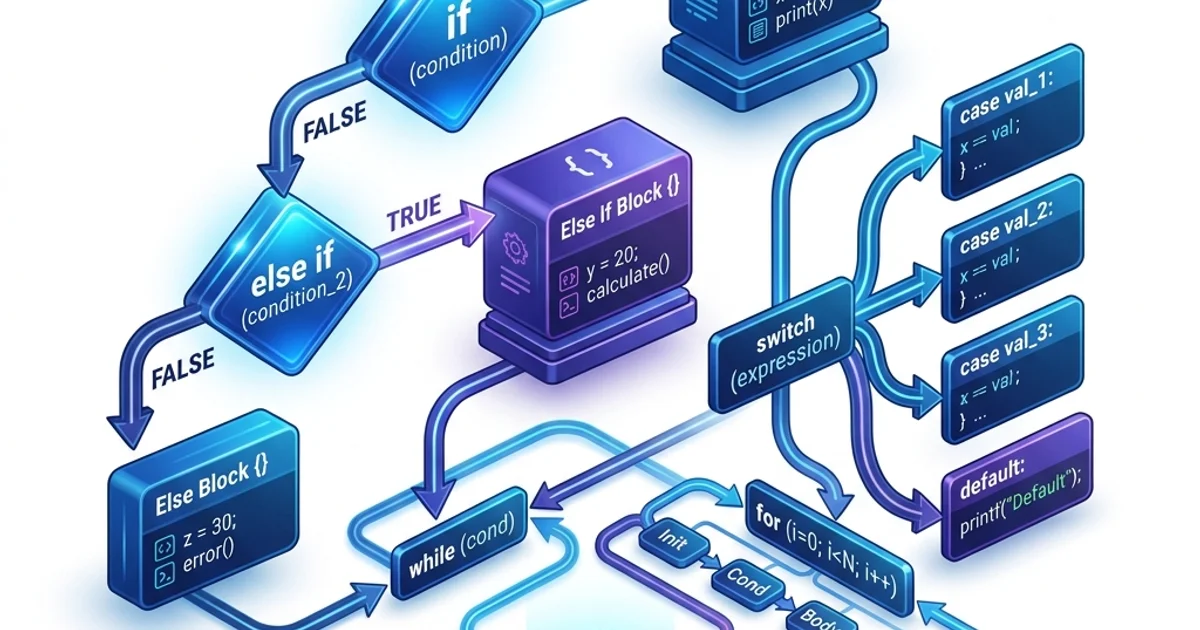
Java Control Flow: From Static Logic to Pattern Matching
1. Modern Switch Expressions: The Arrow Revolution
In the old way, a switch needed a break on every line or you'd "Fall through" and cause a bug. Modern Java uses the Arrow Syntax (->).
String result = switch (day) {
    case MONDAY, FRIDAY -> "Busy Day";
    case SATURDAY, SUNDAY -> "Relaxing";
    default -> "Normal Day";
};- Yields a Value: A switch is now an Expression, meaning it can return a result directly to a variable.
- Exhaustive: The compiler will ERROR if you forget a case (when using enums). No more "Missing Case" bugs.
2. Pattern Matching for instanceof
No more manual casting.
Old way: if (obj instanceof String) { String s = (String) obj; ... }
New way:
if (obj instanceof String s) {
    System.out.println(s.toLowerCase());
}
The variable s is automatically created and cast for you. This reduces boilerplate and eliminates ClassCastException risks.
3. Exception Handling: The Checked vs. Unchecked Debate
Java is unique for its Checked Exceptions (IOException, SQLException). You MUST catch them or declare them.
- The Philosophy: Force the developer to think about "Expected Failures."
- The Reality: Often leads to "Empty Catch Blocks" where developers hide errors just to make the compiler happy.
Professional Rule of Thumb:
- Use Checked Exceptions for things outside your control (Network down, File missing).
- Use Unchecked (Runtime) Exceptions for logic errors (Null Pointer, Array out of bounds).
4. The try-with-resources Pattern
Never manually close a file or a database connection again.
try (var reader = new BufferedReader(new FileReader("data.txt"))) {
    System.out.println(reader.readLine());
} // Auto-closed HERE, even if an exception happens!
Frequently Asked Questions
Is 'Goto' in Java?
No. Java has no goto keyword. We use structured control flow and exceptions to manage jumps. If you find your logic is too complex for an if/else, you should probably refactor into the Strategy Pattern.
What is the cost of an Exception? Throwing an exception is Expensive. Creating a stack trace requires the JVM to crawl through the memory of every active method. You should never use exceptions for "Normal Logic" (like checking if a user exists). Use them only for Exceptional events.
Key Takeaway
Control flow is the "Intelligence" of your app. By mastering modern Switch expressions and Pattern Matching, you write code that is descriptive and safe. By using exceptions strategically (and with try-with-resources), you build systems that don't just "Perform" well, but fail "Gracefully."
Read next: Java Functional Programming: Streams and Lambdas ->
Part of the Java Enterprise Mastery - engineering logic.