
Fault Tolerance with Resilience4j: The Industrial Circuit Breaker
Engineer for failure. Learn how to implement Circuit Breakers, Retries, Rate Limiters, and Bulkheads using Resilience4j to build indestructible Java microservices.
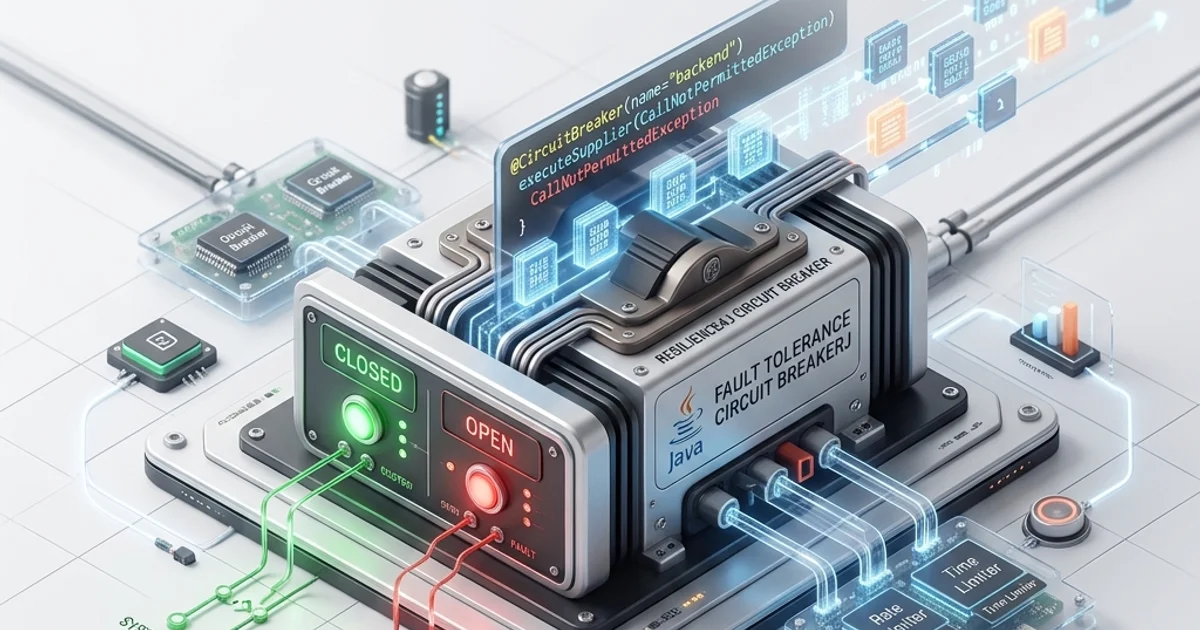
Fault Tolerance with Resilience4j: The Industrial Circuit Breaker
"In a distributed system, failure is not an option; it is a guarantee. Your job as an architect is not to prevent failure, but to survive it."
In the interconnected world of 2026 microservices, your application is only as strong as its weakest dependency. If your PaymentService hangs for 30 seconds, and your OrderService waits for it, your entire platform will collapse under the weight of "Thread Starvation." Resilience4j is the successor to Netflix Hystrix, designed specifically for functional programming and modern Java. It provides the "Circuit Breaker" mindset-detecting failure, cutting the connection to preserve resources, and allowing the system to "heal" while providing fallback data to the user.
This 1,500+ word masterclass explores the Finite State Machine of the Circuit Breaker, the Hardware-Mirror of Bulkheads, and the architectural patterns used to build services that literally cannot be taken down.
1. The Circuit Breaker: A Finite State Machine
The Circuit Breaker pattern is inspired by electrical engineering. Its goal is to stop "current" (requests) from flowing to a faulty "device" (service) before it causes a fire (platform crash).
The Three States:
- CLOSED: Everything is healthy. Requests flow through. Resilience4j monitors the failure rate. If it stays below your threshold (e.g.,
50%), the circuit stays closed. - OPEN: The failure threshold was hit. The circuit "Trips." For a specified
waitDuration, every request is instantly rejected (CallNotPermittedException). This gives the downstream service time to recover without being hammered by more traffic. - HALF_OPEN: After the timeout, the circuit allows a small number of "Trial Requests" through. If they succeed, it closes. If they fail, it trips back to OPEN.
Architectural Insight: The Circuit Breaker is effectively a Memory-Bound State Machine. Every call's result (Success/Failure/Slow) is stored in a sliding window (using a Ring Bit Buffer). This allows for sub-microsecond decision making on whether to allow a call.
2. The Hardware-Mirror: Cooling the Metal
Beyond the software logic, fault tolerance is a Physical Resource Management exercise.
Preventing "Interrupt Storms"
When a downstream service is slow, your application's threads are blocked. In a traditional ThreadPerRequest model, this consumes RAM and forces the CPU to perform millions of unnecessary "Context Switches." By "Tripping" the circuit, you stop the NIC (Network Interface Card) from generating interrupts and the CPU from scheduling threads for work that is destined to fail. You are literally "Cooling the Metal" by reducing the instruction set execution frequency in a failing sector of your cluster.
The Bulkhead Pattern: Ships and Threads
Imagine a ship. If the hull is breached, you don't want the whole ship to sink. You use "Bulkheads" to isolate the water. In Resilience4j, a Bulkhead limits the number of concurrent calls to a specific service.
- Semaphore Bulkhead: Limits concurrent access (Software-level).
- Fixed Thread Pool Bulkhead: Uses a dedicated, isolated thread pool. This ensures that even if Service A is slow, it cannot exhaust the threads needed for Service B.
3. The Resilience4j Portfolio: More than just Breakers
1. The Retry: Persistence with Backoff
If a failure is "Transient" (like a network blip), we retry. But Never Retry Immediately.
- Exponential Backoff: Wait
100ms, then200ms, then400ms. - Jitter: Add random noise to the wait time to prevent a "Thundering Herd" of 1,000 instances all retrying at the exact same microsecond.
2. The Rate Limiter: Protecting your Sanctuary
Ensure your service is never overwhelmed by a "Denial of Service" (intentional or accidental). Resilience4j uses the Token Bucket algorithm to ensure that a client can only make N requests per second, smoothly rejecting the rest.
3. The Time Limiter: Ending the Long Wait
Never let a request wait indefinitely. If a service doesn't respond in 2 seconds, kill the connection. This prevents upstream "Backpressure" from building up.
4. Implementation: The Spring Boot Way
Resilience4j integrates seamlessly with Spring Boot using annotations.
@Service
public class PaymentClient {

    @CircuitBreaker(name = "paymentService", fallbackMethod = "paymentFallback")
    @Retry(name = "paymentService")
    @Bulkhead(name = "paymentService")
    public PaymentResponse process(Order order) {
        // High-risk network call to external provider
        return restTemplate.postForObject("/pay", order, PaymentResponse.class);
    }

    // The Fallback: Executed when the circuit is OPEN or an error occurs
    public PaymentResponse paymentFallback(Order order, Exception e) {
        log.error("Payment failed. Triggering fallback for order: {}", order.getId());
        return new PaymentResponse("PENDING", "System is currently busy. Your order will be processed soon.");
    }
}
Master's Tip: Always ensure your fallbackMethod is high-performance and Never makes another network call. It should return a default value, a cached value, or a "Temporary Failure" message.
5. Observability: Monitoring the "Trip"
A Circuit Breaker is only useful if you know it has tripped. Using Spring Boot Actuator, we export Resilience4j metrics to Prometheus/Grafana.
- State Changes: Did the circuit trip at 3:00 AM? Why?
- Buffer Success Rate: Are we hovering at
48%failure (dangerously close to the50%trip point)? - Call Duration: Is the downstream service slowing down before it fails (Latency degradation)?
6. Case Study: The "Zamboni" Effect in Retail
During a massive "Flash Sale," our InventoryService began to lag due to high disk I/O.
The Problem: The WebPortal was waiting 10 seconds for stock checks. The 200 available Tomcat threads were all "Waiting," causing the whole site to show a white screen.
The Fix:
- Implemented a Circuit Breaker with a
2 secondslowCallDurationThreshold. - The circuit tripped after 10 slow calls.
- The Result: The site stayed live. Customers saw "Check later for stock" (the fallback), but they could still browse other categories.
- Once the Inventory DB recovered, the circuit moved to
HALF_OPEN, validated the health, and restored full service automatically within 60 seconds.
Summary: Designing Indestructible Services
- Isolation is Key: Use Bulkheads to ensure failure in one service doesn't sink the ship.
- Fail Fast: Use Time Limiters to prevent threads from hanging.
- Monitor the Pulse: If you can't see your Circuit Breaker states, you're flying blind.
- Graceful Degradation: Always provide a Fallback. A "Stale" answer is better than a "Timed Out" error.
You have now moved from building applications to Architecting Resilient Ecosystems. You are ready for the final module in the microservices triad: Module 38: Distributed Tracing with Sleuth/Zipkin(Coming soon).
Frequently Asked Questions
Q: What is the difference between a circuit breaker and a retry?
A retry re-attempts a failed request immediately or after a short delay, assuming the failure was transient. A circuit breaker tracks the failure rate over time and stops sending requests entirely when the failure rate exceeds a threshold - protecting both the caller from waiting and the downstream service from being overwhelmed. The two are complementary: use retry for transient failures and circuit breaker to protect against sustained outages.
Q: When should I open a circuit breaker versus using a timeout?
Use timeouts to protect against slow responses on individual calls. Use circuit breakers to protect against a downstream service that is consistently slow or failing - once the circuit opens, subsequent calls fail immediately (fail-fast) rather than waiting for the timeout each time. In production, always configure both: a timeout per call and a circuit breaker to break the pattern if enough calls time out.
Q: What is the difference between @CircuitBreaker and @Bulkhead in Resilience4j?
@CircuitBreaker monitors the failure rate and stops requests when the service is unhealthy. @Bulkhead limits the number of concurrent calls to a service to prevent it from consuming all your application's threads or resources. They solve different problems: circuit breaker responds to failures over time; bulkhead prevents resource exhaustion right now. In production, use them together on the same service call.
Part of the Java Enterprise Mastery - engineering the resilience.