
Monolith vs. Microservices in 2026: The Honest Technical Guide
Comprehensive comparison of Monolith vs Microservices architectures in 2026. Covers the Amazon Prime Video 90% cost reduction case study, hidden costs of microservices (distributed tracing, network unreliability, eventual consistency, Kubernetes overhead), vertical vs horizontal scaling, when microservices become justified, the Modular Monolith middle ground, team topology impact (Conway's Law), and a decision framework based on team size and traffic.
Monolith vs. Microservices in 2026: The Honest Technical Guide
Table of Contents
- The Amazon Prime Video Case Study
- Monolith: A Precise Technical Definition
- Microservices: A Precise Technical Definition
- The Microservice Tax: What You Pay Before You See a Benefit
- Scalability: Vertical vs Horizontal - The Real Trade-off
- Conway's Law: Your Org Chart Determines Your Architecture
- Data Consistency: ACID vs Eventual Consistency
- The Modular Monolith: The Pragmatic Middle Path
- Decision Framework: When to Use Each
- Migration Pattern: Strangler Fig
- Frequently Asked Questions
- Key Takeaway
The Amazon Prime Video Case Study
In 2023, the Amazon Prime Video team published a technical blog post that sent shockwaves through the engineering community. Their audio/video monitoring service had been built on a distributed serverless architecture using AWS Step Functions and Lambda:
Original Architecture Problems:
- AWS Step Functions charged per-state-transition - each video frame processed triggered multiple state transitions, costing thousands of dollars
- Video frame data had to pass through S3 (cloud object storage) between steps - massive I/O latency and egress cost
- The distributed architecture made end-to-end tracing extremely complex
The Monolith Migration: They moved the core processing pipeline into a single service - data moved in memory instead of over the network.
Results:
- Infrastructure costs reduced by 90%
- Performance improved significantly (in-memory vs network I/O)
- Debugging became dramatically simpler
The Lesson: Microservices introduce a communication cost. When that communication involves high-volume data passing between tightly coupled components, a monolith is objectively faster and cheaper.
Monolith: A Precise Technical Definition
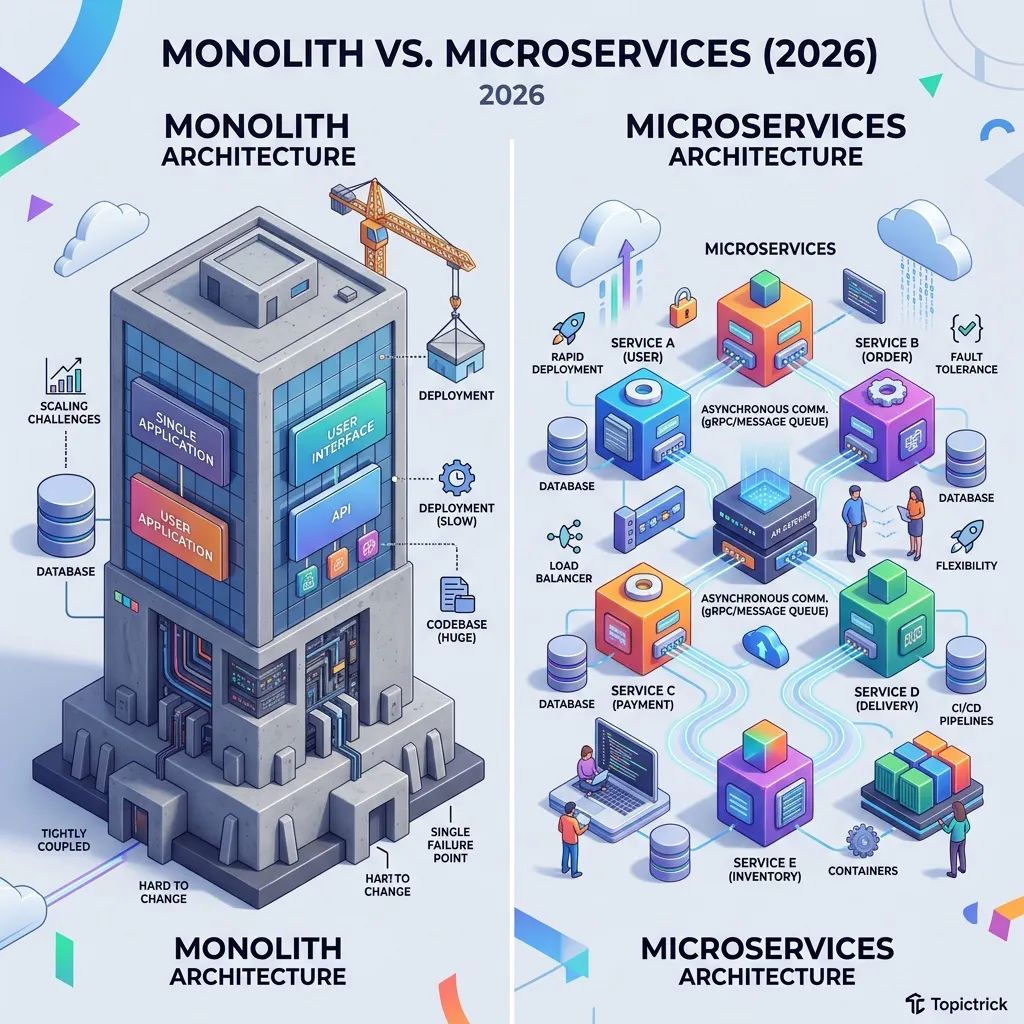
A monolith is an application where all functionality is packaged and deployed as a single unit. There are three distinct types:
| Type | Description | Example |
|---|---|---|
| Single-Process Monolith | One process, one database, all code together | Classic Rails/Django app |
| Modular Monolith | One deployable, but strict internal module boundaries | Well-structured monolith |
| Distributed Monolith | Multiple services, but tightly coupled - worst of both worlds | Microservices that can't deploy independently |
Monolith Advantages:
- Simple local development (one
docker compose up) - Zero network latency between internal modules (nanoseconds vs milliseconds)
- ACID transactions across the entire application
- One CI/CD pipeline, one test suite
- Easy refactoring - rename a class, compiler finds all usages
Microservices: A Precise Technical Definition
Microservices decompose an application into independently deployable services, each responsible for a specific business capability.
Microservice Advantages:
- Independent deployment - the Payments team deploys 10x per day without coordination
- Independent scaling - scale only the bottleneck service
- Technology heterogeneity - Payments uses Java, Notifications uses Node.js
- Fault isolation - one service crashes, others continue
The Microservice Tax: What You Pay Before You See a Benefit
Microservices impose mandatory complexity costs that do not exist in a monolith:
1. Distributed Tracing (Day 1 Requirement)
In a monolith, a stack trace shows you exactly where a request failed. In microservices, a request touches 8 services - you need OpenTelemetry + Jaeger/Zipkin to reconstruct the trace.
Cost: 2-4 weeks to set up properly. Ongoing maintenance.
2. Network Unreliability
Every in-process function call becomes a network request. Networks fail. You must implement:
- Retries with exponential backoff
- Circuit Breakers (Resilience4j, Polly)
- Timeouts on every client
- Bulkheads to prevent cascade failures
Cost: Every service integration point requires defensive code that didn't exist in the monolith.
3. Distributed Transactions -> Saga Pattern
In a monolith, you wrap a multi-step operation in a database transaction. ACID guarantees rollback if anything fails.
In microservices, each service has its own database. A cross-service operation must use the Saga Pattern - a sequence of local transactions with compensating transactions for failures. This is significantly more complex and error-prone than a single ACID transaction.
4. Service Discovery and Load Balancing
Services need to find each other's network addresses. This requires:
- Service Registry (Consul, Eureka, Kubernetes DNS)
- Load Balancer (Istio, AWS ALB, Nginx)
- Health Checks and automatic deregistration of failed instances
5. Kubernetes Overhead
Deploying 20 microservices in production requires Kubernetes - which itself requires:
- Cluster management expertise
Deployment,Service,Ingress,ConfigMap,SecretYAML for each serviceHorizontalPodAutoscalerconfiguration- Monitoring stack (Prometheus + Grafana)
Realistic time investment: 3-6 months for a team to become proficient. $50K-$200K in additional annual infrastructure cost for a mid-size company.
Scalability: Vertical vs Horizontal - The Real Trade-off
The honest truth about monolith scaling: Modern cloud infrastructure can run multiple replicas of a monolith behind a load balancer. Netflix ran on a well-structured monolith until 100M subscribers. The need for per-service independent scaling only becomes critical when different parts of your application have wildly different load profiles.
Conway's Law: Your Org Chart Determines Your Architecture
"Any organization that designs a system will produce a design whose structure is a copy of the organization's communication structure." - Melvin Conway, 1967
This means:
- 5 engineers in one team -> Monolith works perfectly (low communication overhead)
- 50 engineers in 8 teams -> Services aligned to team ownership reduce coordination cost
- 500 engineers in 50 teams -> Microservices are almost inevitable
The practical implication: adopt microservices when team coordination becomes the bottleneck, not when you imagine it might become one.
Data Consistency: ACID vs Eventual Consistency
| Operation | Monolith | Microservices |
|---|---|---|
| Transfer money between accounts | Single DB transaction - perfect ACID | Saga pattern - compensating transactions |
| Create order + reduce inventory | One BEGIN/COMMIT block | Two separate DB operations, eventual consistency |
| Roll back on failure | Automatic db rollback | Manual compensation logic per step |
| Compliance/auditability | Query one database | Correlate events across multiple databases |
Decision Framework: When to Use Each
Choose Monolith when:
- Team size is under 30 engineers
- You're building a new product (unknown requirements - don't over-architect)
- You need to iterate fast on the business model
- Your data is highly relational (many cross-domain queries)
- You don't have Kubernetes expertise
Choose Microservices when:
- You have 100+ engineers organized into autonomous product teams
- Different services need to scale independently (10x traffic difference between parts)
- You need technology heterogeneity (different languages/runtimes)
- Regulatory compliance requires isolation (PCI-DSS for payments, HIPAA for health data)
- You have mature DevOps, observability, and on-call infrastructure
Migration Pattern: Strangler Fig
The Strangler Fig pattern (Martin Fowler) is the industry-standard way to extract microservices from a monolith:
- Identify one bounded context to extract (e.g., Payments)
- Build the new service
- Route only Payments traffic to the new service via API Gateway
- Delete the Payments code from the monolith
- Repeat
This allows gradual migration without a big-bang rewrite.
Frequently Asked Questions
Is 'Distributed Monolith' the worst of both worlds? Yes. A distributed monolith is a set of services that cannot be deployed independently - every deployment requires coordinating all services together. You have microservice complexity (network calls, distributed tracing) with none of the benefits (independent deployability, team autonomy). The primary cause is tight coupling through shared databases or synchronous calls creating dependency chains.
Did AWS/Netflix prove microservices always work at scale? Partly. AWS and Netflix pioneered the tooling (Hystrix, Eureka, Envoy) because microservices at scale required tooling that didn't exist. But both companies also acknowledge that microservices work for them because they have thousands of engineers for whom the coordination cost of a monolith would be catastrophic. For a 15-person startup, the same architecture would be organizational suicide.
Key Takeaway
The monolith vs. microservices debate in 2026 has a mature answer: start with a well-structured monolith, earn microservices through demonstrated scaling pain. The Amazon Prime Video case study was a reminder that distributed systems impose a real cost in complexity, latency, and debugging overhead. The engineers who thrive in 2026 are the ones who can accurately identify which part of their system has a scaling or organizational problem that justifies microservice extraction - and resist the temptation to apply the pattern everywhere prematurely.
Read next: The Modular Monolith: The Architect's Sweet Spot ->
Part of the Software Architecture Hub - comprehensive guides from architectural foundations to advanced distributed systems patterns.