
Platform Engineering Architecture: Building Internal Developer Platforms That Ship Faster
Complete guide to Platform Engineering Architecture in 2026. Understand why DevOps cognitive overload necessitates platform teams, design an Internal Developer Platform (IDP) with Backstage portal, ArgoCD GitOps, Crossplane for cloud resource provisioning, and Terraform security baselines. Define Golden Paths that reduce developer toil, implement self-service workflows, measure platform success with DORA metrics and cognitive load reduction, and avoid the Golden Cage anti-pattern.
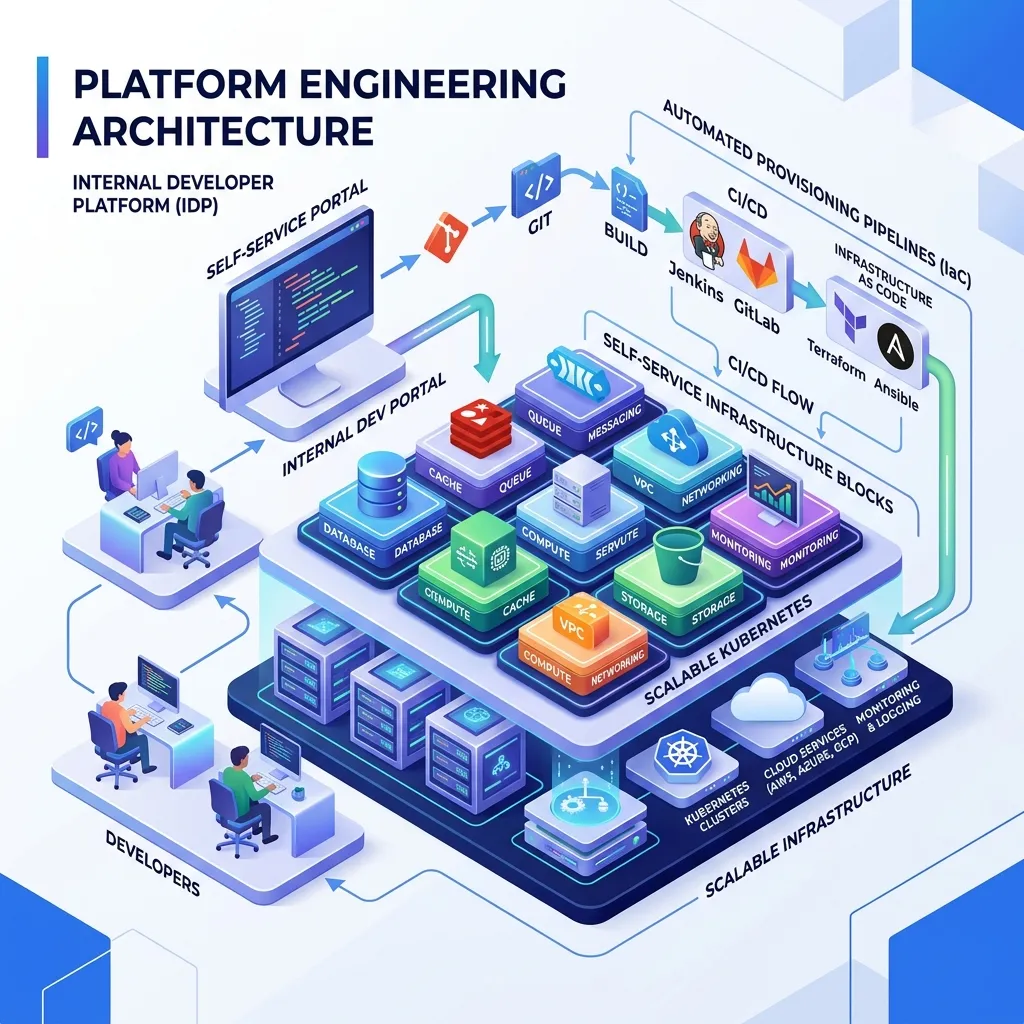
Platform Engineering Architecture: Building Internal Developer Platforms That Ship Faster
Table of Contents
- The Cognitive Load Crisis: Why Pure DevOps Failed at Scale
- Platform as a Product: The Cultural Shift
- The IDP Architecture: Four Layers
- The Developer Portal: Backstage Implementation
- Golden Paths: Opinionated Automation
- Self-Service Resource Provisioning with Crossplane
- GitOps Deployment with ArgoCD
- Security Baselines: The Non-Negotiable Layer
- Measuring Platform Success: DORA + Cognitive Load
- The Golden Cage Anti-Pattern
- Frequently Asked Questions
- Key Takeaway
The Cognitive Load Crisis: Why Pure DevOps Failed at Scale
The 2024 State of DevOps report found that developer cognitive load - the mental burden of managing infrastructure alongside feature development - is the leading predictor of burnout and slow delivery in engineering organizations with 50+ engineers.
The full stack a developer must master in "pure" DevOps:
Application Layer:    Language, framework, dependencies, testing
Container Layer:      Dockerfile, multi-stage builds, image security
Orchestration Layer:  Kubernetes manifests, Helm charts, resource limits
Infrastructure Layer: Terraform, VPC, IAM, networking
Observability Layer:  Prometheus metrics, Grafana dashboards, alert rules
Security Layer:       mTLS, secrets management, CVE scanning
CI/CD Layer:          GitHub Actions pipelines, build caching, deployment strategies
Data Layer:           Database provisioning, migrations, backup policies
This is 8 expert domains. A world-class team of 10 cannot master all of them while also delivering customer features. The result: inconsistent security configurations, undefined infrastructure, and developers spending 40% of their time on "plumbing" instead of product.
Platform as a Product: The Cultural Shift
The defining shift in platform engineering is treating the developer as a customer and the platform as a product with SLAs, feedback loops, and continuous improvement cycles:
| Traditional IT/Ops | Platform Engineering |
|---|---|
| "Submit a ticket for a new database" | Self-service: provision in 2 minutes via UI |
| "Config managed by the ops team" | Config as code - developers own their config via git |
| Tell developers what they must do | Provide golden paths that make the right thing easy |
| On-call for all infrastructure | Platform team on-call for platform; developers on-call for their services |
| Success metric: uptime | Success metric: developer lead time + deployment frequency |
The IDP Architecture: Four Layers
The Developer Portal: Backstage Implementation
Backstage (Spotify, open source) is the industry-standard developer portal. It provides a software catalog, scaffolding templates, and plugin ecosystem:
# Backstage: Software Catalog Entity (catalog-info.yaml in every repo)
apiVersion: backstage.io/v1alpha1
kind: Component
metadata:
  name: order-service
  description: "Handles order lifecycle - creation, payment, fulfilment"
  annotations:
    github.com/project-slug: "myorg/order-service"
    backstage.io/techdocs-ref: dir:.
    argocd/app-name: "order-service-production"
    datadoghq.com/dashboard-url: "https://app.datadoghq.com/dashboard/abc"
  tags: [java, spring-boot, postgres, kafka]
  links:
    - url: "https://order-service.mycompany.com/swagger"
      title: API Docs
spec:
  type: service
  lifecycle: production
  owner: orders-team
  system: commerce-platform
  dependsOn:
    - component:payments-service
    - resource:orders-postgres-db
Backstage automatically generates a rich service page showing: owner, tech stack, dependencies, deployment status (via ArgoCD integration), on-call schedule, recent incidents, and documentation.
Golden Paths: Opinionated Automation
A Golden Path is a pre-built, opinionated template for a common task. It encodes the best security, observability, and deployment practices into a single command:
# Developer creates a new service in 2 minutes:
idp create service \
  --name payment-processor \
  --type java-spring-boot \
  --database postgres \
  --messaging kafka \
  --team payments-team

# What this provisions automatically (in the background):
# ✅ GitHub repo with branch protection + required reviews
# ✅ Dockerfile + multi-stage build (security hardened)
# ✅ GitHub Actions CI pipeline (build, test, scan, push)
# ✅ Kubernetes Deployment + Service + HPA + PodDisruptionBudget
# ✅ ArgoCD Application (auto-sync to staging, manual to prod)
# ✅ Prometheus ServiceMonitor + Grafana dashboard template
# ✅ Vault secrets role (least-privilege DB credentials)
# ✅ Backstage registration (auto-added to software catalog)
# ✅ PagerDuty service + on-call schedule link
The developer writes Java code. They do not touch Kubernetes, Vault, Prometheus, or CI YAML - the golden path generates all of it from their idp create invocation.
Self-Service Resource Provisioning with Crossplane
Crossplane extends Kubernetes to provision cloud resources (databases, queues, storage) as Kubernetes custom resources - without Terraform or ticket-based workflows:
# Developer self-provisions a PostgreSQL database:
# (No ticket, no waiting for ops - just apply this YAML)
apiVersion: database.myplatform.io/v1alpha1
kind: PostgreSQLInstance
metadata:
  name: orders-db
  namespace: orders-team
spec:
  parameters:
    storageGB: 50
    version: "16"
    tier: standard  # Platform pre-defines: standard, performance, critical
    backup: enabled
    region: eu-west-1

  # Platform auto-injects: VPC config, security groups, KMS encryption,
  # automated backups, Vault dynamic secrets, Datadog monitoring
  # Developer specifies WHAT they need; platform handles HOW
Crossplane's controller reconciles this spec against the cloud provider API, provisions the actual RDS instance, configures Vault to issue dynamic credentials, and registers the resource in Backstage - all automatically.
Measuring Platform Success: DORA + Cognitive Load
DORA metrics track delivery performance:
| Metric | Before Platform | After Platform (target) |
|---|---|---|
| Deployment frequency | Weekly | Multiple per day |
| Lead time for changes | 2-4 weeks | < 1 day |
| Change failure rate | 15% | < 5% |
| MTTR | 4 hours | < 30 minutes |
Cognitive load metrics (platform-specific):
- Time to first production deployment for a new service (target: < 1 day)
- % of developers who deployed to production in their first week
- Number of platform support tickets per developer per month (target: < 0.5)
- Developer satisfaction survey score on infrastructure tooling (target: > 4/5)
Frequently Asked Questions
How big does a team need to be before Platform Engineering makes sense? Platform Engineering investment becomes net positive at approximately 50+ engineers. Below that, the platform team (minimum 3-4 engineers to sustain) consumes too large a fraction of total engineering capacity. With 10-50 engineers, a well-structured DevOps practice with shared runbooks and standardised Terraform modules provides most benefits without the organizational overhead of a dedicated platform team.
What's the difference between Platform Engineering and DevOps? DevOps is a cultural philosophy (collaboration between development and operations, "you build it, you run it"). Platform Engineering is an architectural pattern (a dedicated team builds the infrastructure tools that enable all other teams to "run it" without friction). Platform Engineering is how DevOps culture is sustained at scale - without it, "you build it, you run it" degrades into cognitive overload and inconsistency.
Key Takeaway
Platform Engineering is the infrastructure abstraction layer that separates "building products" from "managing cloud infrastructure." The investment in a dedicated platform team, Backstage portal, self-service resource provisioning, and golden path templates pays off through measurable DORA metric improvement - faster lead times, more frequent deployments, lower change failure rates. The success condition is simple: if a new engineer can deploy their first service to production on day one without asking anyone for help, the platform is working.
Read next: IDP Architecture Layers: The Core Orchestrator ->
Part of the Software Architecture Hub - comprehensive guides from architectural foundations to advanced distributed systems patterns.