
Software Architecture Patterns Overview: The Complete Developer Guide 2026
Master the blueprint. Learn the differences between Layered, Microkernel, Microservices, and Event-Driven patterns to choose the right foundation for your app.
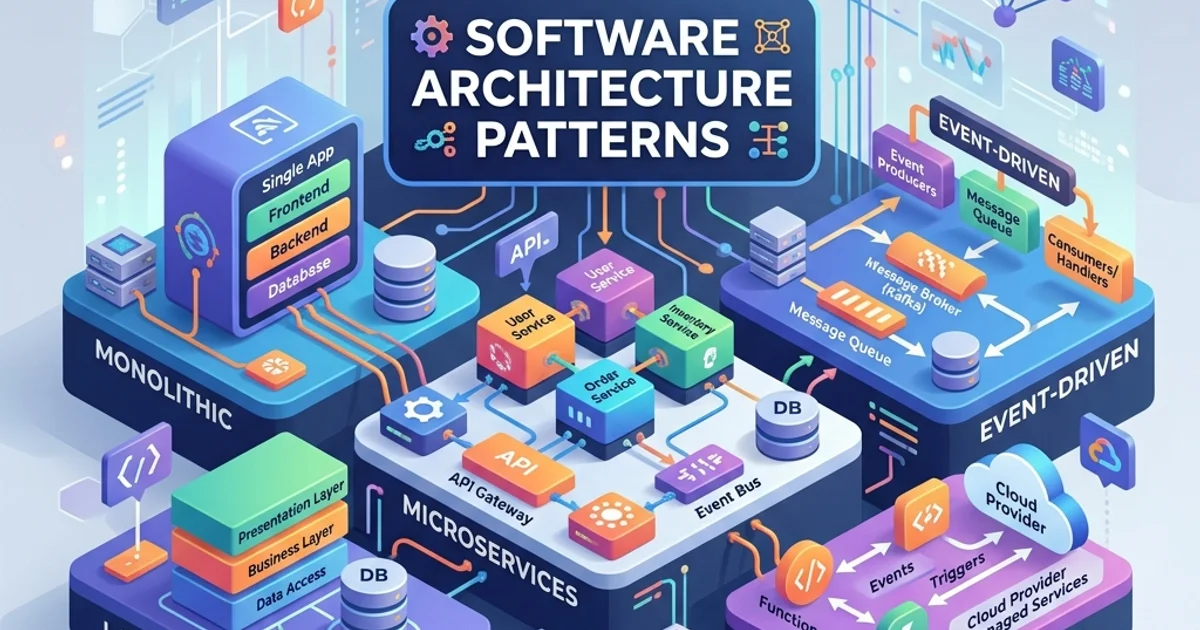
Software Architecture Patterns Overview
"If you don't choose a pattern, your software will choose one for you. Usually, it's called 'The Big Ball of Mud'."
Software architecture is the art of limiting choices. A pattern is a pre-made set of boundaries that keep your code organized as it grows from 1,000 to 1,000,000 lines.
This 1,500+ word guide is your "Bird's eye view" of the entire industry. We will compare the $4$ Big Families of architecture and learn how to choose the right "Blueprint" based on your team's size, budget, and performance requirements.
1. The Layered (N-Tier) Architecture
The "Standard" pattern for most apps.
- Layers: UI -> Business Logic -> Data Access -> Database.
- The Rule: Each layer can only talk to the one DIRECTLY below it.
- The Pro: Very easy to understand for junior developers.
- The Con: "The Sinkhole Anti-Pattern." Sometimes, a simple request (like getting a user's name) has to pass through 4 useless layers of code just to reach the database.
2. The Microkernel (Plugin) Architecture
Used by tools like VS Code, Chrome, and Photoshop.
- Core: A tiny engine that does almost nothing.
- Plugins: High-performance modules that add features (e.g., "Python support" or "Filter X").
- The Power: You can add features to the app WITHOUT ever touching the core code. It is the gold standard for "Platform" products.
3. The Event-Driven (EDA) Pattern (Module 104)
Used for high-concurrency systems like Uber or Netflix.
- Services don't "Talk" to each other. They "Shout" events into a stream.
- The Benefit: High decoupling. If the "Email" service is down, the "Checkout" service still works.
- The Cost: Very hard to debug. You can't just follow a single "Line" of code to see what happened.
4. The Microservices Pattern (Module 107)
Used for massive, fast-moving companies.
- Every business unit (Billing, Cart, Search) is a separate, tiny project with its own database.
- The Benefit: Team Independence. The Billing team can use Zig while the Cart team uses Go.
- The Cost: "The Tax of Distribution." You spend 50% of your time managing networks and security instead of writing code.
5. The "Decision Matrix": How to Choose?
In 2026, we follow a simple path:
- Small Startup? Layered Monolith. Don't waste time on Microservices.
- Building a Platform? Microkernel.
- High-Traffic Logistics? Event-Driven.
- 1,000+ Developers? Microservices.
Summary: The Selection Checklist
- Deployment: Do you need to update one feature without rebooting the whole app? (Microservices).
- Scalability: Does only one specific part of your app get high traffic? (EDA).
- Complexity: Is your team mostly juniors? (Layered).
- Customization: Do you need third-parties to add features to your app? (Microkernel).
- Cost: Remember that every service you add increases your monthly cloud bill.
Patterns are the "Scaffolding" of your success. By mastering the trade-offs between simplicity (Layered) and scale (Microservices), you gain the ability to build systems that grow with the business rather than against it. You graduate from "Writing functions" to "Architecting Possibilities."
Part of the Architecture Masterclass - engineering the overview.