
Software Architecture Roadmap 2026: From Senior Developer to Principal Architect
A complete, practical roadmap for becoming a software architect in 2026. Covers the four phases - design fundamentals, distributed systems, business strategy, and technical leadership - with specific skills, books, and projects for each stage.
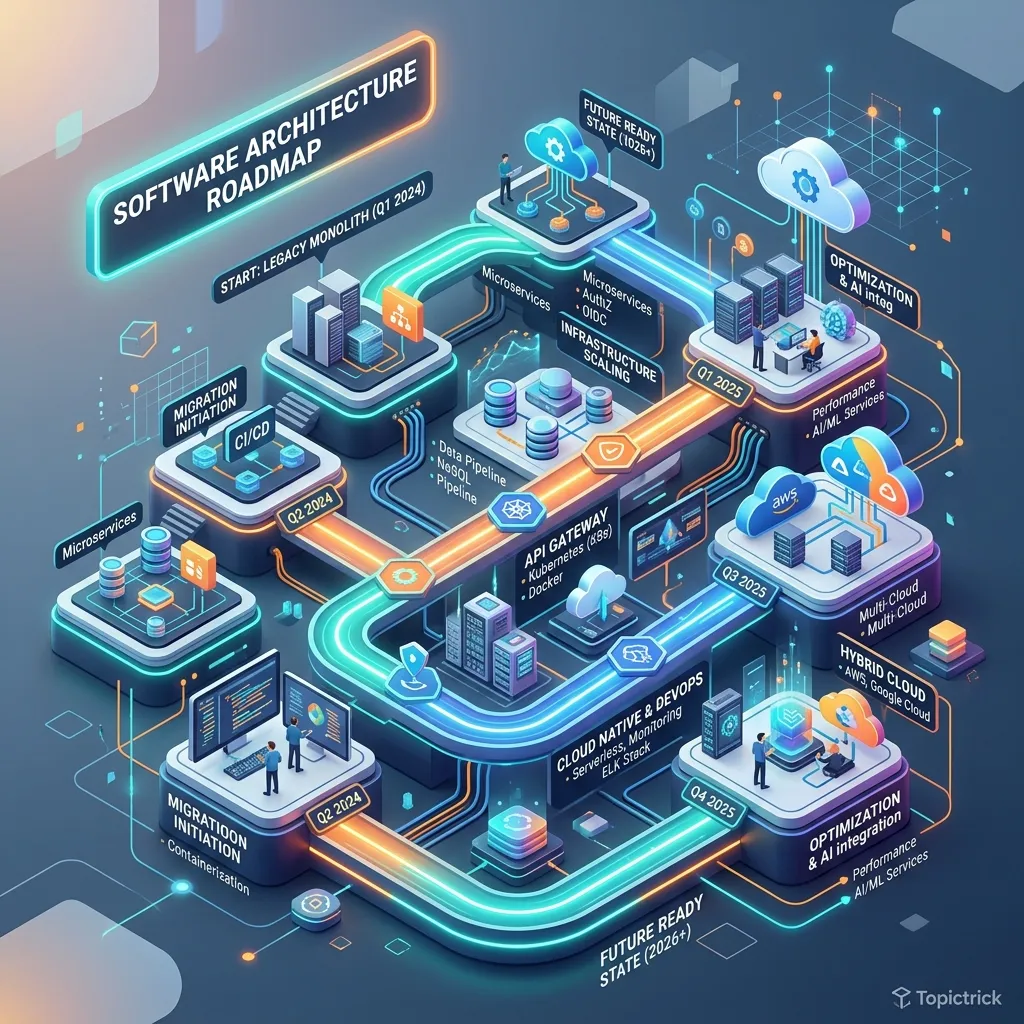
Software Architecture Roadmap 2026: From Senior Developer to Principal Architect
Software architecture is not a certification you earn - it is a capability you develop through years of designing, building, and learning from real systems. The path from senior developer to architect is less about learning new facts and more about developing judgment: knowing when to apply patterns, when to break rules, and how to make decisions under uncertainty with incomplete information.
This roadmap breaks the journey into four phases, each with concrete skills, projects, and common mistakes to avoid.
What Does a Software Architect Actually Do?
Before starting the journey, understand what the destination looks like. A software architect:
- Defines system structure: Decides how the application is divided into components, how those components communicate, and what boundaries exist between them
- Makes technology decisions: Chooses frameworks, databases, messaging systems, and cloud services - and documents why
- Sets non-functional requirements: Defines target latency, throughput, availability, security posture, and observability requirements
- Guides teams: Explains architectural decisions to developers, reviews critical code for violations, and runs architecture review boards
- Manages technical debt: Identifies areas of the system that need improvement and plans systematic refactoring
- Bridges business and engineering: Translates business requirements into technical constraints and translates technical limitations into business trade-offs
The architect does not write most of the code - the senior developers do. The architect ensures all that code fits together coherently and will remain maintainable as the system grows.
Phase 1: Design Fundamentalist (0-2 Years Post-Senior)
At this phase you move from writing good code to designing good systems at the module and service level.
Core Skills to Master
SOLID Principles - Applied, Not Memorized
Most developers can recite SOLID. Architects can identify SOLID violations in a pull request within seconds and explain the real-world consequences:
- S (Single Responsibility): A class that handles HTTP parsing, business logic, and database access will be painful to test and risky to modify
- O (Open/Closed): A switch statement with 15 cases for different payment providers needs a new deployment every time a provider is added
- L (Liskov Substitution): A
ReadOnlyListthat extendsListbut throws onadd()breaks every function that expects aList - I (Interface Segregation): A repository interface with 20 methods forces every test to implement 19 stubs for the one method it cares about
- D (Dependency Inversion): Business logic that
imports a specific ORM will need to be rewritten when the ORM is replaced
Design Patterns - Know When NOT to Use Them
Patterns are solutions to recurring problems. The bigger risk is pattern overuse - applying the Observer pattern when a simple function call is sufficient.
Essential patterns to understand deeply:
- Strategy: Swap algorithms at runtime (payment providers, sorting, serialization formats)
- Repository: Abstract data access behind an interface so business logic never touches SQL
- Factory/Abstract Factory: Decouple object creation from business logic
- Observer/Event: Decouple a publisher from its subscribers
- Decorator: Add behavior to an object without modifying its class
- Adapter: Bridge incompatible interfaces (e.g., wrap a legacy API in your domain interface)
Architectural Patterns
Work through these in increasing order of complexity:
- Layered Architecture (N-tier)
- Hexagonal Architecture (Ports and Adapters)
- Clean Architecture
- Domain-Driven Design (tactical patterns: Entities, Value Objects, Aggregates)
- Event Sourcing + CQRS (start with CQRS read-side separation)
Practice Project: Take an existing monolithic codebase and refactor it to Hexagonal Architecture. Measure: can you run all business logic tests without a database running?
Common Mistakes at Phase 1
- Applying every pattern you just learned (pattern overuse creates accidental complexity)
- Prioritizing elegance over simplicity (a simple if-else is often better than an elaborate Strategy pattern)
- Designing for hypothetical requirements that never materialize
- Not writing tests for the architecture (testability is a measure of good design)
Phase 2: Distributed Systems Strategist (2-4 Years)
At this phase you expand your thinking from one application to multiple services communicating over a network.
Core Skills to Master
Distributed Systems Fundamentals
- CAP Theorem: Know which databases are CP vs AP and when each is appropriate
- Consistency models: Strong consistency vs eventual consistency vs causal consistency
- Distributed transactions: Why two-phase commit is rarely the right answer; when to use sagas
- Idempotency: Any distributed operation that can fail must be safe to retry
- Observability: Structured logging, distributed tracing (OpenTelemetry), and metrics (Prometheus)
Communication Patterns
- Synchronous (REST, gRPC): When services need an immediate response
- Asynchronous (message queues, event streams): When temporal decoupling is needed
- Event-driven architecture: When one action in the system should trigger reactions in others
- API gateway patterns: Authentication, rate limiting, and routing at the edge
Scaling Patterns
| Pattern | Problem it solves |
|---|---|
| Horizontal scaling | Single instance CPU/memory limits |
| Read replicas | Read-heavy database load |
| Caching (Redis, CDN) | Repeated expensive computations |
| Database sharding | Single database write throughput limits |
| Queue-based load leveling | Traffic spikes that would overwhelm synchronous processing |
| Circuit breaker | Cascading failures from slow dependencies |
Data Architecture
- Database selection: OLTP vs OLAP vs document vs graph vs time-series
- Data replication strategies and consistency trade-offs
- Schema design for microservices (database per service, anti-corruption layers)
- Event streaming with Kafka or Kinesis
Practice Project: Design the backend for a food delivery app at 1M daily orders. Draw the architecture diagram, identify the databases for each service, design the event flow from order placement to delivery confirmation, and explain how you would handle payment failures mid-order.
System Design Interview Preparation
Architecture skills are tested in system design interviews at top companies. The framework:
- Clarify requirements: Functional requirements (what it does) and non-functional requirements (scale, latency, availability)
- Estimate scale: Daily active users, read/write ratio, data storage needs
- High-level design: Main components and their interactions
- Deep dive: Focus on the most interesting or critical component
- Trade-offs: Explain what you gave up to achieve what you got
Classic problems to practice:
- Design Twitter/X
- Design a URL shortener
- Design a distributed cache
- Design a notification system
- Design a rate limiter
- Design a web crawler
Phase 3: Business Strategist (4-6 Years)
At this phase the technical work is table stakes. The differentiator is connecting architecture decisions to business outcomes.
Core Skills to Master
Total Cost of Ownership (TCO) Analysis
Every architectural decision has a cost: build cost, operational cost, opportunity cost, and migration cost. Architects who cannot quantify these have no standing in business decisions.
Example: Should we build a custom search engine or use Elasticsearch?

Build custom:
- 3 engineer-months initial build: $60,000
- 0.5 engineer-months/month ongoing maintenance: $10,000/month
- Operational complexity: 1 additional on-call incident per month

Use Elasticsearch:
- 2 weeks setup: $10,000
- $400/month managed service (Elastic Cloud)
- Limited customization for advanced use cases

Break-even at: ~5 months if we grow beyond Elasticsearch's limits
Decision: Elasticsearch until search queries exceed X/second or require Y custom behavior
Build vs Buy vs Open Source
The default answer in 2026 is "buy a managed service for non-differentiating infrastructure." Authentication, payments, email, observability, and search are rarely competitive differentiators. Spending 3 engineer-months building a custom auth system is almost never justified.
Know when to deviate from this default:
- Cost at scale (a $50,000/month SaaS bill vs $5,000/month self-hosted may justify the engineering investment)
- Compliance requirements (data residency, HIPAA, SOC 2 may preclude certain vendors)
- Unique requirements the market doesn't address
Architecture Decision Records (ADRs)
Document every significant decision with:
- Context: What problem were we solving?
- Decision: What did we choose?
- Rationale: Why did we choose it over the alternatives?
- Consequences: What are we accepting as trade-offs?
# ADR-023: Use PostgreSQL for User Service

## Status: Accepted

## Context
The user service requires ACID transactions for profile updates and
subscription changes. We need strong consistency for billing data.

## Decision
PostgreSQL with synchronous replication to one read replica.

## Alternatives considered
- DynamoDB: AP system, eventual consistency unacceptable for billing
- MongoDB: Lacks multi-document transaction guarantees needed for profile + billing updates

## Consequences
- Higher operational complexity than DynamoDB
- Need to manage connection pooling (RDS Proxy)
- Strong consistency for all user data
Technology Radar
Maintain a personal technology radar - a categorization of tools and techniques by adoption maturity:
- Adopt: Use in new projects (proven, recommended)
- Trial: Use in low-risk projects (promising, still learning)
- Assess: Research and experiment with (worth watching)
- Hold: Avoid for now (problematic or superseded)
Phase 4: Technical Leadership (6+ Years)
At this phase your leverage is through other people and systems - not through code you write yourself.
Core Skills to Master
Facilitating, Not Dictating
The worst architects impose decisions. The best architects create the conditions where teams make good decisions:
- Run architecture reviews as collaborative discussions, not audits
- Publish architectural guidelines as starting points, not laws
- Explain the reasoning behind patterns so teams can apply judgment
- Create feedback loops - review decisions 6 months later and learn from the outcomes
Conway's Law in Practice
"Organizations design systems which mirror their own communication structure." - Melvin Conway
Your architecture will reflect your org chart whether you want it to or not. To change the architecture, you may first need to change how teams are organized. A single team that owns both the frontend and backend of a user-facing feature will build differently (and better) than separate frontend and backend teams that must coordinate every change.
Technical Debt Management
All codebases accumulate technical debt. The architect's job is not to eliminate it (impossible) but to manage it:
- Identify debt: Code complexity metrics, developer surveys, bug hotspot analysis
- Categorize debt: By impact (how much does it slow teams down?) and by cost to fix
- Communicate debt: Frame debt in business terms - "this slows feature delivery by X"
- Plan remediation: Schedule refactoring alongside feature work, not instead of it
Mentoring Senior Developers
The principal architect's biggest force multiplier is developing other architects. Techniques:
- Pair on architecture reviews - explain your thinking, not just your conclusions
- Create "good enough" ambiguity in problems so engineers must exercise judgment
- Debrief after architecture failures - focus on systemic factors, not individual blame
- Build a reading group around architecture books
Essential Reading by Phase
Phase 1:
- Clean Code - Robert C. Martin
- Design Patterns - Gang of Four
- A Philosophy of Software Design - John Ousterhout
Phase 2:
- Designing Data-Intensive Applications - Martin Kleppmann (essential)
- Building Microservices - Sam Newman
- Release It! - Michael Nygard
Phase 3:
- Domain-Driven Design - Eric Evans
- The Architecture of Open Source Applications - various (free online)
- Accelerate - Nicole Forsgren (engineering metrics and business impact)
Phase 4:
- Staff Engineer - Will Larson
- An Elegant Puzzle - Will Larson
- The Manager's Path - Camille Fournier (for understanding your management peers)
Frequently Asked Questions
Q: Is a degree required to become a software architect?
No. Architecture is evaluated on demonstrated judgment and delivery record. Architects who have designed and shipped real systems at scale - regardless of educational background - are highly valued. Certifications like AWS Solutions Architect or TOGAF can help demonstrate structured knowledge, but they do not substitute for hands-on system design experience.
Q: What is the difference between a Staff Engineer and a Software Architect?
The terminology varies by company. Generally: a Staff Engineer is individual-contributor-focused, solving the hardest technical problems and setting technical direction within a product area. A Software Architect (or Principal Architect) has broader cross-team or cross-company scope, focuses more on org-level technical strategy, and often has formal authority over technology standards. Many companies use the titles interchangeably.
Q: How long does the full roadmap take?
The phases are experience-based, not time-based. Some engineers move through all four phases in 6 years; others with different opportunities or pacing may take 12 years. The most important accelerator is deliberately taking on architectural responsibility - asking to own a system design, proposing ADRs, volunteering for architecture reviews - rather than waiting to be given the title.
Key Takeaway
The architect's roadmap moves from code quality (Phase 1) to distributed systems (Phase 2) to business alignment (Phase 3) to organizational leadership (Phase 4). Each phase builds on the previous - you cannot effectively manage technical debt (Phase 4) without understanding the distributed systems trade-offs that created it (Phase 2). The most common mistake is trying to skip phases: a developer who learns distributed systems patterns before mastering design fundamentals will apply distributed complexity to problems that don't need it. Progress through the phases with deliberate projects, real systems, and a willingness to be wrong and learn from it.
You have completed the Architecture Hub - masters of the blueprint.