
SQL Introduction: Relational Databases and ACID
Master the data foundation. Learn the difference between SQL vs NoSQL, the mathematical theory of Codd's Rules, and the ACID properties that protect global finance.
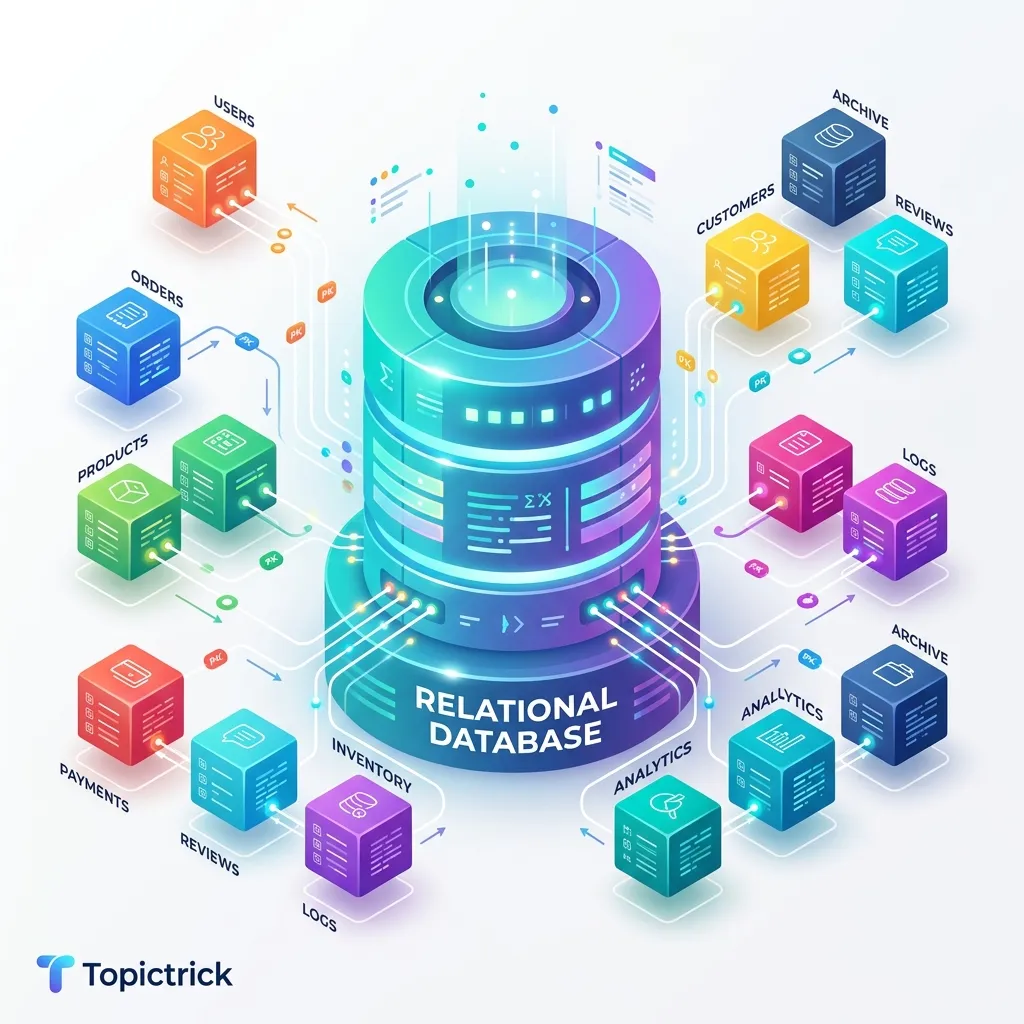
SQL Introduction: The Relational Mirror
In the 1960s, data storage was a chaotic frontier. Companies relied on "Hierarchical" or "Network" databases where data was stored in fixed, physical paths. If you wanted to find an employee's salary, your program had to "Navigate" a specific physical linked-list on the disk. If a developer moved a single pointer, every application in the company would crash. This was known as Data Dependence, and it was the single biggest bottleneck in early computer science.
Everything changed in 1970. Edgar F. Codd, an IBM researcher with a PhD in computer science, published a paper that would change the world: "A Relational Model of Data for Large Shared Data Banks." Codd proposed a radical idea: Data Independence. He argued that users should never care how data is stored on a spinning disk or a flash drive; they should only care about the Logical Relationship between pieces of information.
1. The Relational Model: Logic Over Physicality
The Relational Model is built on Set Theory and Predicate Logic. Unlike a spreadsheet, which is a visual layout, a Relational Database is a mathematical set of "Relations" (Tables).
The Mathematical Foundation
To understand SQL at a senior level, you must understand the terminology:
- Relation (Table): A set of tuples. Mathematically, a relation is a subset of the Cartesian product of a list of domains.
- Tuple (Row): A single record. In a set, the order of elements doesn't matter. This is why SQL doesn't guarantee the order of your results unless you use
ORDER BY. - Attribute (Column): A named domain. Every attribute has a physical constraint (e.g.,
INT32,UTF-8 String). - Degree: The number of columns in a table.
- Cardinality: The number of rows in a table.
Codd's Rules: The 12 Commandments
Codd defined $12$ (actually $13$, starting from $0$) rules that a database must follow to be considered truly "Relational." The most critical for modern architects are:
- Rule 1: The Information Rule: All information is represented in one and only one way-as values in tables. There are no "Hidden pointers."
- Rule 3: Systematic Treatment of NULL: The database must handle "Missing information" in a consistent way, distinct from zero or an empty string.
- Rule 12: Nonsubversion Rule: If the system has a low-level interface, it cannot be used to subvert the security or integrity constraints of the high-level SQL language.
2. Hardware-Mirror: The Anatomy of a Transaction
When you run an UPDATE or INSERT, you aren't just changing a file-you are interacting with the physical limitations of silicon and magnetism.
The Storage Engine vs. The Relational Engine
A modern RDBMS like PostgreSQL is split into two halves:
- The Relational Engine (The Brain): Parses your SQL, optimizes the math, and decides which rows to touch.
- The Storage Engine (The Hands): Writes bits to the disk and manages the Buffer Pool (RAM).
The Physiology of a Write: The WAL Pattern
If every transaction required a "Random Write" to the middle of a 1TB data file, databases would be impossibly slow. Instead, SQL uses the Write-Ahead Log (WAL):
- The Sequential Write: The change is first written to a simple log file. Writing to the end of a log is a "Sequential I/O" operation. On modern NVMe drives, this is nearly as fast as RAM.
- The Acknowledgment: Only once the WAL entry is "Sync'd" to the physical disk platter does the database tell you "Success."
- The Checkpoint: Later, a background process (The Checkpointer) moves the data from the WAL to the actual table files. If the power goes out, the database simply "Replays" the WAL entries to rebuild the state.
The 8KB Data Page Mirror
To understand how SQL physically "sees" your data, you must understand the Page.
- The Physical Unit: Databases like PostgreSQL do not read rows; they read 8KB Pages.
- The Slotted Page Physics: Every page has a header, a line-pointer array, and the actual tuple data at the bottom. When you ask for a single row, the database must pull the entire 8KB page into the Buffer Pool (RAM).
- The IO Cost Mirror: This is why "Selecting *" is so expensive. If your row size is small, you fit more rows per page, reducing the number of physical disk reads required to mirror your results into RAM.
3. The ACID Deep Dive: The Pillars of Global Finance
"ACID" is not just a marketing term; it is the contract that prevents banks from losing your money.
Atomicity: The Unit of Work
A transaction is "Atomic"-it cannot be split. If you move $$100$ from User A to User B, and the server crashes after subtracing $$100$ but before adding it to B, Atomicity forces a Rollback.
- Internal Reality: Every data page has a "LSN" (Log Sequence Number). The engine uses these numbers to undo partial changes.
Consistency: Data Integrity
Consistency ensures the database never enters an "Impossible State."
- Constraints: Foreign keys, unique indexes, and
CHECKconstraints are enforced before the transaction commits. - Business Logic Integration: By putting a
CHECK (balance >= 0)in SQL, you protect your company from bugs in your frontend or backend code. Even if a junior developer writes bad code, the database refuses to be "Inconsistent."
Isolation: Concurrent Realities
Isolation allows thousands of people to use the same table at the same time without seeing each other's "Drafts."
- MVCC (Multi-Version Concurrency Control): PostgreSQL doesn't overwrite data. It creates a Version of a row. While Transaction A is updating the row, Transaction B is reading the "Old Version."
- The Performance Win: "Readers never block Writers." This is why SQL scales to the massive demands of 2026.
Durability: The Hard Drive Contract
Durability means that once a transaction is committed, it will survive a power outage, a system crash, or even an OS failure.
- The fsync Call: The engine uses the
fsync()primitive to bypass the OS's software cache and force the disk controller to physically write the data to the non-volatile surface.
4. Case Study: The "Phantom Read" Disaster
Imagine a simple E-commerce audit.
- Transaction 1 (Audit): Counts all orders for the day. Result: $100$.
- Transaction 2 (New Sale): A customer buys a product. Transaction 2 commits.
- Transaction 1 (Audit): Checks the same table again to calculate total revenue. Result: $101$.
The Result: The audit is now logically broken because the count (100) and the revenue (101 orders worth) don't match. This is a Phantom Read.
The Architectural Solution
Professional architects solve this by choosing the correct Isolation Level:
- Read Committed: The default. Fast but allows Phantoms.
- Repeatable Read: Ensures that if you read a row once, it won't change while your transaction is open.
- Serializable: The highest level. It makes the database behave as if every transaction happened one-by-one in a perfect line.
5. SQL vs NoSQL: The 2026 Convergence
For a decade, the "NoSQL" movement (MongoDB, Cassandra) claimed that SQL couldn't scale. They sacrificed ACID for "Speed."
The Current Reality:
- PostgreSQL now supports JSONB, giving you NoSQL flexibility inside a SQL engine.
- Distributed SQL (CockroachDB, Yugabyte) has solved the "Scaling Problem" by using the Raft Consensus Algorithm to keep ACID properties across thousands of servers.
- The Verdict: Unless you are building something specialized like a real-time game server or a massive log-aggregator, Postgre/SQL is the 2026 standard for 99% of mission-critical applications.
7. The Mathematical Mirror: Relational Algebra
Beyond the hardware, SQL is an implementation of Relational Algebra. When you write a query, you are performing set operations.
The Algebra Physics
- Selection ($\sigma$): Filtering rows based on a predicate (The
WHEREclause). - Projection ($\pi$): Choosing specific columns (The
SELECTclause). - Join ($\bowtie$): Composing two relations into a new set.
- Set Operations:
UNION,INTERSECT, andEXCEPT.
Understanding that SQL is "Declarative Math" changes how you optimize. You don't tell the database how to loop over data; you describe the desired result set, and the Query Optimizer (the database's "Silicon Brain") builds the most efficient physical execution mirror.
6. Summary: The SQL Master's Vocabulary
- Relation: A mathematical set of data (Table).
- WAL: The sequential log that handles the "Durability" of your ACID promise.
- MVCC: The versioning system that allows high concurrency without locking.
- Optimizer: The engine that converts your "Request" (SQL) into "Execution" (Physical IO).
- Schema: The contract that defines the types and constraints of your digital universe.
SQL is the "Language of Logic." By mastering the relational model and the physics of how data hits the disk, you gain the ability to build systems that are not just "Fast," but Indestructible. You move from being a "User of data" to an "Architect of Truth."
Phase 1: Action Items
- Install Docker and start a PostgreSQL 16 container.
- Create a table and insert $1,000$ rows.
- Observe the
pg_waldirectory in your container to see the physical Write-Ahead Log being generated.
Read next: SQL Installation and Environment Setup: Postgre vs MySQL ->
Frequently Asked Questions
Q: What is a relational database and how is it different from a spreadsheet?
A relational database stores data in tables with defined schemas, enforces relationships between tables via foreign keys, and guarantees data integrity through constraints. Multiple applications and users can read and write simultaneously with full transaction support. A spreadsheet is a single-user document - it has no referential integrity, no concurrent access control, and no query optimiser. Relational databases handle millions of rows efficiently through indexing and query planning; spreadsheets degrade noticeably past tens of thousands of rows. Use a database any time data is shared, application-driven, or needs to survive beyond a single session.
Q: What is the difference between SQL and a database like PostgreSQL or MySQL?
SQL (Structured Query Language) is the standard language for querying and manipulating relational data - it is a specification, not software. PostgreSQL, MySQL, SQLite, and SQL Server are database management systems (DBMS) that implement SQL along with their own extensions and storage engines. SQL is largely portable between systems; the extensions (window functions syntax differences, JSON support, procedural language) vary. Learning standard SQL gives you a foundation that applies everywhere; learning a specific DBMS's extensions makes you productive in that system.
Q: When should I choose a relational database over a NoSQL database?
Choose a relational database when your data has clear structure and relationships, when you need strong consistency and ACID transactions (financial data, inventory, user accounts), or when you need ad-hoc querying flexibility with SQL. Choose NoSQL when you need horizontal scalability across many nodes for write-heavy workloads, when your schema changes frequently and rapidly, or when your data is naturally document-shaped with no cross-document relationships (product catalogs, event logs, session data). Many modern applications use both - a relational database for core transactional data and a NoSQL store for specific high-scale or flexible-schema use cases.
Part of the SQL Mastery Course - engineering the truth.