
SQL OUTER JOINS: Master Left, Right, and Full
Master the 'Null' logic. Learn how to keep data even if there is no match, understand why LEFT JOIN is the king of reporting, and how to handle missing data.
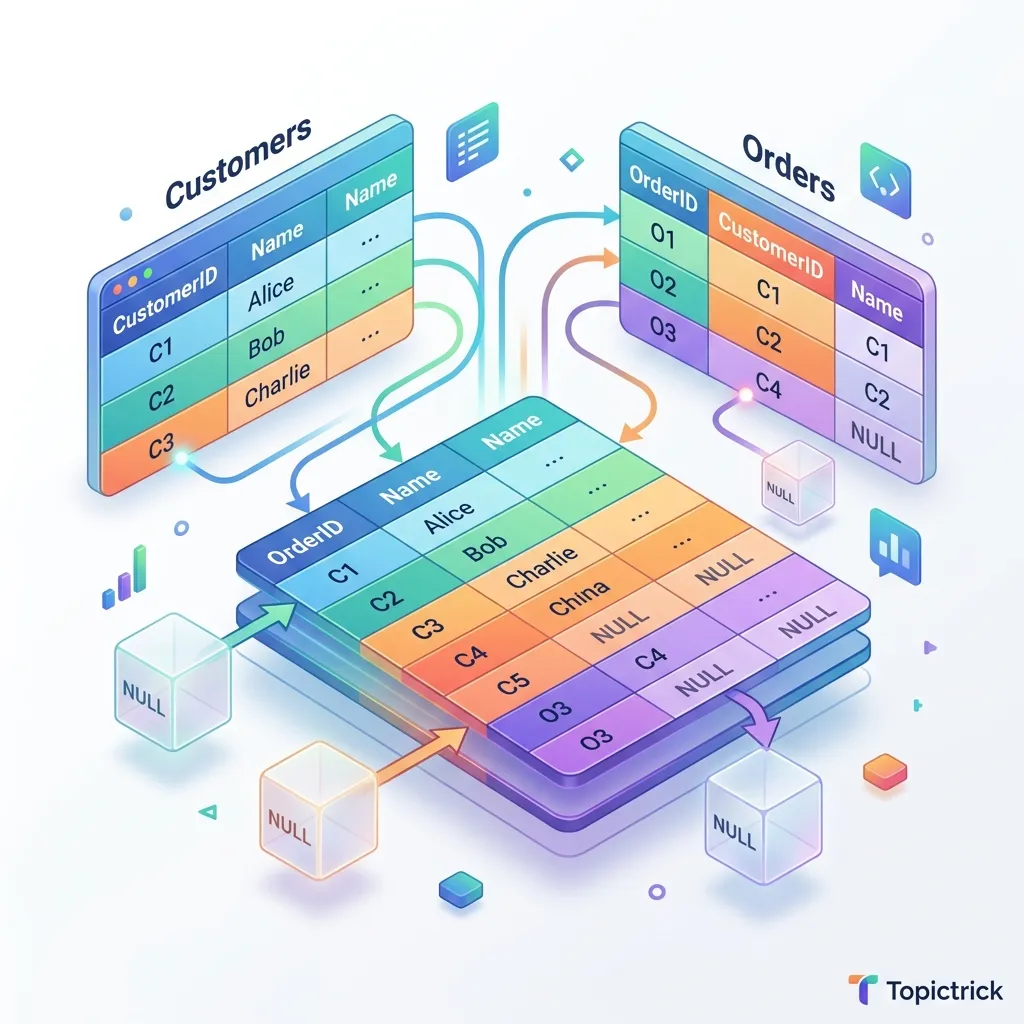
SQL OUTER JOINS: Handling Data Gaps
In an Inner Join, if a row doesn't have a match, it is discarded from the result. If you have 100 users and 20 of them haven't placed an order yet, an INNER JOIN will only return 80 users. But what if you are building an "Inactive Users" report? Or a dashboard that shows every customer, regardless of their purchase history?
This is where the Outer Join family comes in. This 1,500+ word guide is your blueprints for managing the "Gaps" in your digital universe.
1. The Logic of Inclusion: LEFT and RIGHT
Outer joins are "Asymmetric." They designate one table as the Preserved Table.
The LEFT OUTER JOIN (The Standard)
The table on the left of the JOIN keyword is the "Master." The engine will return every single row from this table. If it finds a match in the right table, it fills in the data. If it doesn't, it fills the columns with NULL.
- Use Case: "Show me all products and their reviews (even products with zero reviews)."
The RIGHT OUTER JOIN (The Inverse)
The table on the right is preserved. In professional development, we rarely use RIGHT JOIN. Why? Because it is harder for a human to read.
- Architect's Standard: Always use
LEFT JOIN. If you need a Right Join, just flip the order of the tables in yourFROMclause. This keeps your query logic flowing in the same direction as the English language.
2. Hardware-Mirror: The Anti-Join Internals
One of the most powerful uses of a Left Join is the Anti-Join. This is how we find "What is NOT there."
Finding the Gaps
SELECT * FROM users u LEFT JOIN orders o ON u.id = o.user_id WHERE o.id IS NULL;
- What happens inside?: The database engine performs a Nested Loop or Hash Join. For every user, it looks for an order. Once it finishes the join, the
WHEREclause filters out everyone who did have an order. - Hardware Performance: In modern engines (Postgres 16+), if the engine sees a
WHERE ... IS NULLon a non-nullable column after a join, it optimizes the operation into an ANTI JOIN algorithm. It skips the "Data merging" step entirely and just returns the user ID as soon as it confirms no match exists. This is significantly faster than a standard join.
The Hash Outer Join Mirror
When performing a LEFT JOIN with a Hash Join, the engine builds the hash table from the Right (Inner) table.
- The Probe Physics: As it scans the Left (Outer) table, it "Probes" the hash table.
- The Match Bit: If it finds a match, it emits the result. If it doesn't, it emits the Left row and sets the Null Bitmap bits for the Right columns in the result tuple.
- Efficiency Mirror: This allows the database to preserve the entire Left set while only scanning each table exactly once ($O(N+M)$).
The NULL Bitmap: The Join Result Page
How does the database physically represent a "Data Gap"?
- The Result Tuple Mirror: When a Join creates a new row in RAM, it builds a new HeapTupleHeaderData.
- The Bit Manipulation: For every column in the "Missing" table, the engine flips a bit in the Null Bitmap of the result record to "0".
- Frontend Impact: This bit is what your application driver (JDBC, PGO, Node-Postgres) reads to determine if a value should be returned as
nullorundefined.
3. The FULL OUTER JOIN: The Complete Picture
The FULL OUTER JOIN preserves rows from both sides.
- If a User has no Order: Result includes the User (Order columns are NULL).
- If an Order has no User (an Orphaned row): Result includes the Order (User columns are NULL).
The Data-Diff Mirror
We use Full Outer Joins as a "Microscope" to find differences between two datasets.
- The Case: You have a
Stagingtable and aProductiontable. - The Logic:
SELECT * FROM prod FULL OUTER JOIN staging ON prod.id = staging.id WHERE prod.id IS NULL OR staging.id IS NULL; - The Result: This instantly reveals rows that exist in Staging but not Prod, or vice-versa. It is the "Indestructible Audit" for database migrations.
Why this is rare: In a well-designed normalized database with Foreign Key Constraints, you should never have an "Orphaned" order. A Full Outer Join is usually a tool for Data Auditing and Cleanup during a warehouse migration, not for standard application logic.
4. The "Ghost Filter" Bug (Architect's Warning)
This is the most common bug in SQL engineering. It happens when you combine a LEFT JOIN with a WHERE filter.
The Failure
SELECT u.name, o.amount FROM users u LEFT JOIN orders o ON u.id = o.user_id WHERE o.status = 'COMPLETED';
The Disaster: Because the WHERE clause checks the status of the order, and NULL is not 'COMPLETED', this query effectively becomes an INNER JOIN. All users with zero orders (NULL rows) are filtered out by the WHERE clause!
The Fix: Move the filter into the ON condition.
SELECT u.name, o.amount FROM users u LEFT JOIN orders o ON u.id = o.user_id AND o.status = 'COMPLETED';
- Now, the engine filters the orders before trying to match them to users, preserving the "Left-side" user list.
5. Case Study: The "Empty Category" SEO Disaster
An e-commerce site was building their "Category Sidebar." They used an INNER JOIN to fetch categories and their products.
The Problem: If a category was new and had zero products, it didn't appear in the sidebar. The Google Search spider couldn't "See" the category pages, so the site's SEO ranking for those terms plummeted.
The Fix: A switch to LEFT JOIN categories u LEFT JOIN products o.
- This ensured that even empty categories appeared in the UI.
- By using
COALESCE(COUNT(p.id), 0), they showed "Books (0)" instead of an empty space. This small architectural shift saved the company's Q4 revenue.
6. Summary: The Outer Join Checklist
- Preservation: Define clearly which table MUST appear in the results (The "Left" table).
- NULL Strategy: Always use the
COALESCE()function in your SELECT to provide default values (e.g., changing a NULL price to $0.00$) for your frontend. - The Filter Rule: If you need to filter the "Optional" table (the Right side), put that logic in the
ONclause, not theWHEREclause. - Anti-Join Optimization: Use
LEFT JOIN ... WHERE ... IS NULLas a high-performance alternative toNOT EXISTSin simple scenarios. - Audit Constraints: If you find yourself using
FULL OUTER JOINoften, check your database for missingNOT NULLconstraints on your foreign keys.
Outer joins are the "Safety Net" of relational logic. By mastering the asymmetry of the Left Join and the traps of the filtering engine, you build applications that handle "Missing Information" with professional grace. You graduate from "Data Retrieval" to "Architecting the User Experience."
7. The Semi-Join Mirror: Checking for Existence
Sometimes you don't want the data from the second table-you just want to know if any match exists.
Semi-Join vs. Left Join
A Semi-Join (expressed as EXISTS or certain IN clauses) is a "Short-Circuit" operation.
- The Execution Reality: As soon as the engine finds the first match for a row, it stops searching and returns "True."
- Performance Mirror: A Semi-Join is often faster than a
LEFT JOINwith aDISTINCTclause because it avoids the overhead of reading and deduplicating multiple matches. In 2026, we use Semi-Joins for permissions checks and feature flagging.
Masterclass Gap Checklist
- Audit Outer Filter Logic: Move all Right-table filters from the
WHEREclause to theONclause. - Implement Sovereign Defaults: Use
COALESCE()to replace NULLs with user-friendly strings ('None', '0', 'N/A'). - Optimize Anti-Joins: Use
WHERE ... IS NULLon the Primary Key of the right table to trigger the hardware Anti-Join algorithm. - Monitor Join Cardinality: Be careful of "Row Explosion" when joining a 1:N relationship-audit your
LEFT JOINresults for duplicate parents.
Read next: SQL Aggregate Functions: The Grouping Mirror ->
Frequently Asked Questions
Q: Why does filtering on a LEFT JOIN's right-side column in WHERE turn it into an INNER JOIN?
When you write LEFT JOIN table2 ON ... WHERE table2.column = value, the WHERE filter requires table2.column to be non-NULL and equal to a value - but LEFT JOIN produces NULLs for unmatched right-side rows. The WHERE filter then eliminates those NULL rows, effectively turning the LEFT JOIN into an INNER JOIN. To filter on the right-side table while keeping unmatched left-side rows, move the condition into the ON clause: LEFT JOIN table2 ON t1.id = t2.id AND t2.column = value. The ON clause filters which right-side rows participate in the join; WHERE filters the final result.
Q: What is the difference between IS NULL and = NULL in SQL?
= NULL always evaluates to NULL (unknown), never TRUE - SQL uses three-valued logic (TRUE, FALSE, NULL) and NULL is not equal to anything, including itself. IS NULL correctly tests whether a value is null. This means WHERE column = NULL will never return any rows, which is a common silent bug. Always use IS NULL and IS NOT NULL for null checks. The same applies to joins and CASE expressions - NULL comparisons must use IS NULL rather than equality operators.
Q: How do I replace NULL values with defaults in query output?
Use COALESCE(column, default_value) - it returns the first non-NULL argument. COALESCE(phone, 'No phone') returns the phone number if present or 'No phone' if NULL. NULLIF(a, b) is the inverse - it returns NULL if a equals b, otherwise returns a. It is useful for turning sentinel values (like 0 or empty string) back into NULL for calculation purposes. Both are ANSI SQL and work across all major databases.
Part of the SQL Mastery Course - engineering the gap.