
Web Development Trends 2026 - What's Shaping the Future
Explore the top web development trends of 2026: AI-assisted coding, React Server Components, edge computing, TypeScript adoption, and Core Web Vitals. Stay.
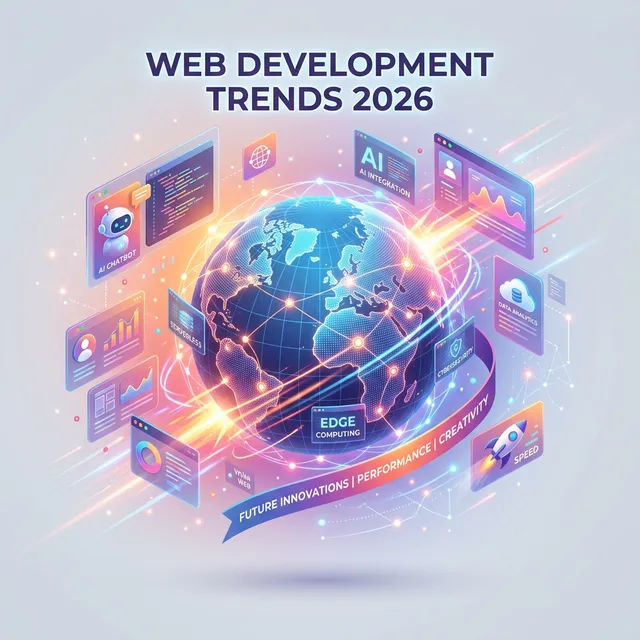
Web Development Trends 2026: The Short Summary
The six defining web development trends of 2026 are: AI-assisted development becoming the default workflow, React Server Components reducing JavaScript bundle sizes, edge computing moving processing closer to users, TypeScript reaching 80%+ adoption in professional projects, the full-stack renaissance blurring frontend and backend boundaries, and Core Web Vitals performance standards becoming non-negotiable for SEO. Developers who master these trends in 2026 will be significantly more productive and employable than those who don't.
The web development landscape continues to evolve at breakneck speed. Staying current with emerging trends isn't just nice to have - it's how you stay employable and competitive. This guide covers the key web development trends of 2026 that every developer should know.
Table of Contents
- AI-Assisted Development is the New Normal
- Server Components & React's Evolution
- Edge Computing Goes Mainstream
- Web Performance Revolution
- TypeScript Becomes the Default
- The Full-Stack Renaissance
- What to Learn Now
1. AI-Assisted Development is the New Normal
The biggest shift in 2026 isn't a new CSS trick or a faster backend language - it's the fact that developers are no longer coding alone. AI has become the "junior partner" for every engineer, handling the boring, repetitive parts of the job so humans can focus on the big picture.
If you aren't using AI tools yet, you're essentially trying to build a house with a hand-saw while everyone else is using power tools.
- Copilot-style autocomplete: 85% of developers use some form of AI code completion
- AI code review: Automated security and performance analysis
- LLM-powered debugging: Paste an error, get an explanation and fix
- AI documentation generation: Docstrings and READMEs written automatically
- Test generation: AI suggests edge cases you hadn't considered
The key insight: AI hasn't replaced developers - it's made them dramatically more productive. A developer using AI tools ships 2-4x faster than one who doesn't. This is creating a productivity gap that's reshaping hiring.
// Modern AI-assisted workflow example (2026)
// 1. Write a comment describing what you want
// 2. AI completes the implementation
// 3. You review, test, and refine

// "Rate limit API calls to 100 per minute using token bucket algorithm"
class RateLimiter {
  constructor(maxRequests, windowMs) {
    this.tokens = maxRequests;
    this.maxTokens = maxRequests;
    this.refillRate = maxRequests / (windowMs / 1000);
    this.lastRefill = Date.now();
  }

  tryAcquire() {
    this.refillTokens();
    if (this.tokens >= 1) {
      this.tokens--;
      return true;
    }
    return false;
  }

  refillTokens() {
    const now = Date.now();
    const elapsed = (now - this.lastRefill) / 1000;
    this.tokens = Math.min(this.maxTokens, this.tokens + elapsed * this.refillRate);
    this.lastRefill = now;
  }
}
Our AI Prompt Optimizer helps you get better results from AI coding tools.
2. Server Components & React's Evolution
For years, the trend was to send as much code as possible to the user's browser. But in 2026, we've realized that's making websites slow. Server Components represent a "back to basics" movement where the heavy lifting happens on the server, sending only the final result to the user.
It's like the difference between sending someone the ingredients for a cake (Client Components) versus sending them the finished cake itself (Server Components).
// App Router with Server Components (Next.js 15+)
// This runs on the SERVER - zero JavaScript sent to client
async function BlogPost({ slug }: { slug: string }) {
// Direct database query - no API needed
const post = await db.post.findUnique({ where: { slug } });
const author = await db.user.findUnique({ where: { id: post.authorId } });
return (
<article>
<h1>{post.title}</h1>
<p>By {author.name}</p>
<div dangerouslySetInnerHTML={{ __html: post.content }} />
</article>
);
}
// Interactive island - only THIS goes to the client
"use client";
function LikeButton({ postId }: { postId: string }) {
const [liked, setLiked] = useState(false);
return (
<button onClick={() => setLiked(!liked)}>
{liked ? "❤️" : "ðŸ¤"} Like
</button>
);
}Benefits: Dramatically smaller JavaScript bundles, better SEO, faster initial page loads, simpler data fetching.
3. Edge Computing Goes Mainstream
If your server is in New York and your user is in Tokyo, there's a physical limit to how fast the data can travel. Edge Computing solves this by putting tiny "mini-servers" in hundreds of cities around the world.
Instead of the user coming to your data, you bring the data to the user.
- Cloudflare Workers: 300+ locations globally
- Vercel Edge Functions: Integrated with Next.js
- Deno Deploy: 35+ regions
- AWS Lambda@Edge: Enterprise-grade
Edge functions excel at:
- Authentication and authorization (no cold starts)
- A/B testing without flicker
- Geolocation-based redirects
- API rate limiting and caching
- Real-time personalization
// Cloudflare Worker - runs globally in 300+ locations
export default {
  async fetch(request: Request): Promise<Response> {
    const url = new URL(request.url);

    // Geolocation-based redirect
    const country = request.cf?.country;
    if (country === "GB" && url.pathname === "/pricing") {
      return Response.redirect("https://example.com/pricing-gbp", 302);
    }

    // Cache API calls
    const cache = caches.default;
    const cached = await cache.match(request);
    if (cached) return cached;

    const response = await fetch("https://api.example.com" + url.pathname);
    await cache.put(request, response.clone());
    return response;
  }
};
4. Web Performance Revolution
Core Web Vitals are now a confirmed Google ranking factor, making performance optimization a business requirement, not just a nice-to-have.
2026 Performance Standards:
2026 Web Performance Standards
| Task / Feature | Metric | Good Threshold |
|---|---|---|
| No comparison data available | ||
Key techniques:
<!-- Image optimization - critical for LCP -->
<img
  src="/hero.webp"
  width="1200" height="630"
  alt="TopicTrick hero"
  loading="eager"
  fetchpriority="high"
  decoding="async"
/>

<!-- Resource hints -->
<link rel="preconnect" href="https://fonts.googleapis.com">
<link rel="dns-prefetch" href="https://cdn.example.com">
<link rel="preload" href="/fonts/inter.woff2" as="font" type="font/woff2" crossorigin>
5. TypeScript Becomes the Default
In the early days of the web, JavaScript was known for being "loose" and prone to random errors. TypeScript fixed this by adding a layer of rules. In 2026, writing plain JavaScript for a professional project is like driving without a seatbelt - you might get there, but it's unnecessarily risky.
TypeScript adoption crossed 80% in professional JavaScript projects in 2026. New frameworks default to TypeScript. Job listings increasingly require it.
See our detailed TypeScript vs JavaScript guide for when and how to use TypeScript.
6. The Full-Stack Renaissance
The distinction between frontend and backend is increasingly blurring. In 2026, the most in-demand developers are those who can:
- Write React components (client-side)
- Handle Server Components and server actions (server-side)
- Design database schemas (PostgreSQL, Prisma)
- Deploy to cloud platforms (Vercel, Railway, AWS)
- Implement auth (Auth.js, Clerk, Supabase)
The 2026 full-stack toolkit:
The 2026 Full-Stack Toolkit
Grid showing the modern full-stack developer's choice of tools in 2026.What to Learn Now
Based on job market data and trend analysis, here's the priority learning list for 2026:
High Priority (Learn Now):
- TypeScript (if you haven't - it's no longer optional for jobs)
- React + Server Components (Next.js App Router)
- SQL and PostgreSQL (Prisma ORM)
- AI tool proficiency (Copilot, ChatGPT in your workflow)
- Performance & Core Web Vitals optimization
Medium Priority (Learn in 6-12 months):
- Edge computing basics (Cloudflare Workers or Vercel Edge)
- WebAssembly concepts
- Testing with Vitest/Playwright
- Containerization basics (Docker)
Stay ahead of web development trends with our continuously updated programming courses. Learn the skills companies are actively hiring for in 2026.
Frequently Asked Questions
Is React still the best framework to learn in 2026?
Yes, for job opportunities. React still dominates job listings. However, if you're starting fresh and open to alternatives, also consider Svelte or Vue - they have excellent developer experience and growing communities.
Will AI replace frontend developers?
No. AI tools make frontend developers faster but cannot replace the product thinking, design collaboration, accessibility expertise, and architectural judgment that comes with experience. AI-assisted developers are more valuable, not less.
Should I learn Web3 or blockchain development?
Only if you're specifically interested in that niche. Traditional web development skills (React, TypeScript, SQL, APIs) have far more job opportunities and more stable career prospects in 2026.