
What Are AI Coding Agents? Complete Guide (2026)
AI coding agents go beyond autocomplete - they plan, write, run, test, and fix code autonomously. Learn how they work, which tasks they excel at, and what.
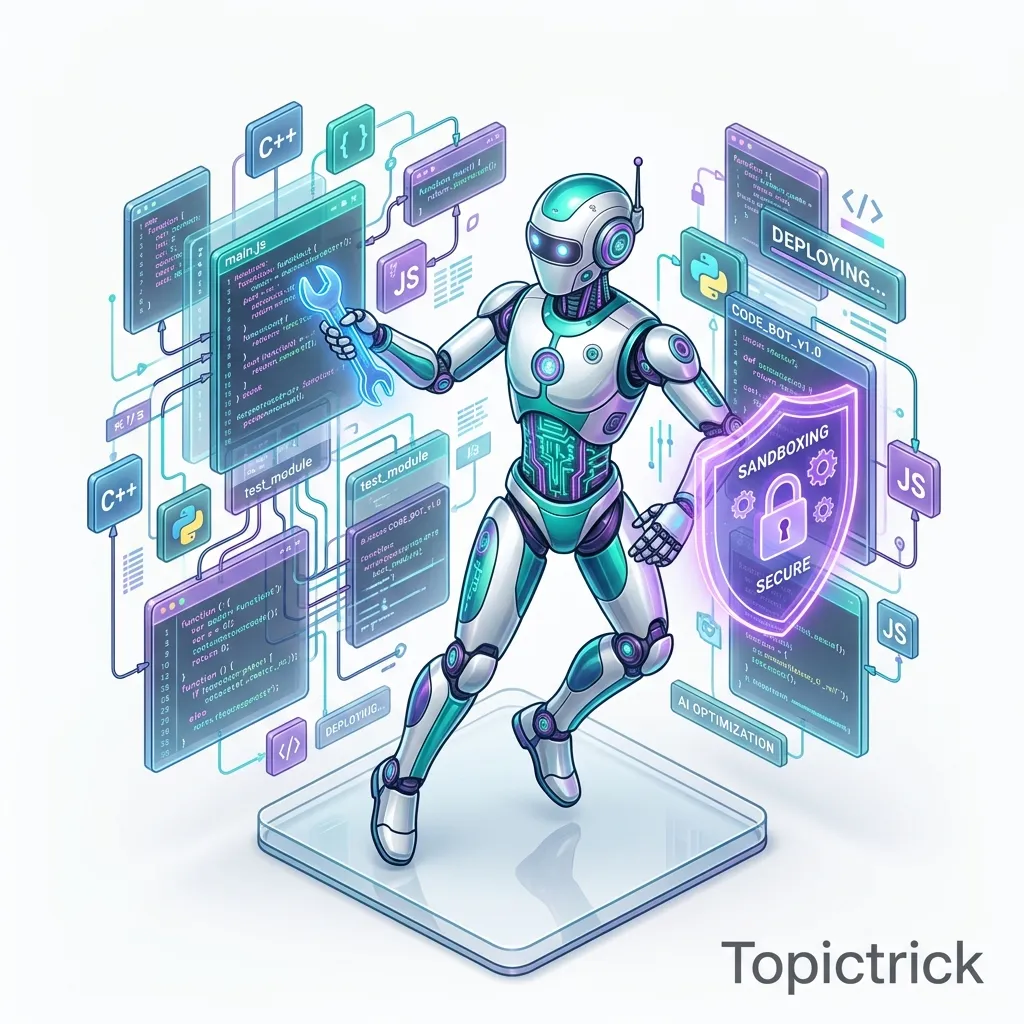
What Are AI Coding Agents?
AI coding agents are autonomous software systems that can plan, write, execute, test, debug, and submit code changes with minimal human intervention. Unlike AI copilots that suggest code as you type, coding agents operate on multi-step agentic loops - perceiving the codebase, planning a sequence of actions, executing those actions using tools like file read/write and shell commands, observing the results, and iterating until the task is complete. In 2026, they represent the fastest-growing category in developer tooling.
In 2023, AI coding meant an autocomplete suggestion in your IDE. You typed, the model suggested the next line, you accepted or ignored it. The human was still doing all the thinking.
In 2026, AI coding agents do something fundamentally different. You describe a task - "add rate limiting to the login endpoint" - and an agent reads your codebase, plans the implementation, writes the code across multiple files, runs the tests, fixes the failures it introduced, and opens a pull request. You review the diff.
That shift - from suggestion to autonomous execution - is why AI coding agents attracted over $12 billion in VC investment in 2025 alone. Cognition AI (Devin) raised at a $2B valuation. Cursor raised $900M. Magic.dev closed a $320M round. Every major tech company has an internal coding agent programme. The category went from a curiosity to a core engineering platform in under 18 months.
This post explains exactly what AI coding agents are, how they work under the hood, what distinguishes them from earlier AI coding tools, and what this means for developers today.
The Spectrum: From Autocomplete to Autonomous Agent
AI coding tools exist on a spectrum of autonomy:
Level 1 - Autocomplete / Copilot: Suggests the next line or block as you type. You are fully in control. The AI is a fast, context-aware autocomplete. Examples: GitHub Copilot (base mode), Tabnine, Codeium.
Level 2 - Chat-based coding assistant: You describe what you want in natural language; the AI writes a function or explains a block of code. Single-turn or short conversation. You copy-paste the result. Examples: ChatGPT, Claude.ai, Copilot Chat.
Level 3 - IDE-integrated inline agent: The AI reads your entire codebase, edits multiple files simultaneously, and proposes changes you can accept or reject - all within your editor. Examples: Cursor, Windsurf, GitHub Copilot Workspace.
Level 4 - Autonomous coding agent: Given a task (as a GitHub issue, text description, or ticket), the agent independently plans, writes code, executes it in a sandbox, runs tests, debugs failures, and submits a pull request - with minimal or no human intervention mid-task. Examples: Devin (Cognition), GitHub Copilot Coding Agent, SWE-agent, Claude Code.
The phrase "AI coding agent" in 2026 almost always refers to Level 3 or Level 4. The distinction matters: Level 3 agents augment your workflow; Level 4 agents can execute tasks while you are doing something else.
What Makes Something an "Agent"
The word "agent" has a specific technical meaning. An AI coding agent is not just a model that writes code - it is a system that:
- Perceives its environment: reads files, runs commands, calls APIs, browses documentation
- Maintains a goal: works towards completing a task rather than just responding to a single prompt
- Takes actions: writes and edits files, executes shell commands, runs tests, calls tools
- Observes outcomes: reads command output, test results, error messages
- Iterates: adjusts its plan based on what it observes
This is the agentic loop: perceive -> plan -> act -> observe -> repeat. A traditional chatbot answers and stops. An agent acts and keeps going until the task is done or it determines it cannot proceed.
The underlying LLM provides the reasoning capability. The agent framework provides the tools, memory, and loop structure that allow the model to act in the world rather than just generate text.
The Core Components of an AI Coding Agent
Tool Use
The agent's ability to do things comes from tools. A coding agent typically has access to:
- File tools: read_file, write_file, create_file, delete_file, list_directory
- Shell tools: run_command (execute bash/PowerShell), which lets it run tests, install packages, build code
- Search tools: grep_codebase, semantic_search (find relevant code by meaning)
- Version control tools: git_status, git_diff, git_commit, create_pull_request
- Browser tools: fetch_url (read documentation, stack traces from error pages)
- Code execution tools: run_python, run_tests (execute code in a sandboxed environment)
The model decides which tools to call, in which order, based on its reasoning about the current task. This is the key insight: the LLM is not just generating code - it is orchestrating a sequence of tool calls to accomplish a goal.
Memory and Context
A coding agent needs to understand many things simultaneously:
- Repository context: the structure, conventions, and relevant code in the codebase
- Task context: what it has been asked to do and what constraints apply
- Execution history: what it has already done, what succeeded, what failed
For large codebases that exceed the model's context window, agents use retrieval: they embed the codebase and semantic-search for relevant files on each step. This is code RAG - retrieval-augmented generation applied to source code.
Planning
The best coding agents plan before acting. Given a task, the agent first produces a step-by-step plan:
Task: Add rate limiting to the login endpoint

Plan:
1. Read the current login endpoint implementation (src/routes/auth.py)
2. Read the existing middleware patterns in the codebase
3. Check if a rate-limiting library is already installed (requirements.txt)
4. Implement rate limiting middleware using existing patterns
5. Add unit tests for the rate limiting behaviour
6. Run the test suite to verify no regressions
7. Update the README if rate limiting configuration is needed
This plan then drives a sequence of tool calls. Separating planning from execution dramatically improves reliability - the model is less likely to skip steps or make inconsistent decisions because it committed to a plan first.
Sandboxed Execution Environment
Running arbitrary code is dangerous on a production machine. Serious AI coding agents execute code inside an isolated environment:
- Docker containers: the agent operates inside a container with a copy of the repo. Filesystem writes are isolated. Network can be restricted.
- Virtual machines: complete OS isolation for the highest security requirement
- Cloud sandboxes: providers like E2B, Modal, and Daytona offer API-accessible sandboxed compute specifically designed for AI coding agents
The agent can run pytest, npm test, go test ./... freely inside the sandbox. If it breaks something catastrophically, the container is simply reset. The changes only propagate to the real codebase when the agent proposes a PR for human review.
AI Coding Agents vs AI Copilots: The Key Differences
| Dimension | AI Copilot | AI Coding Agent |
|---|---|---|
| Autonomy | Responds to prompts | Executes multi-step tasks independently |
| Context | Current file / selection | Entire codebase |
| Actions | Suggests code | Writes, runs, tests, fixes, and commits code |
| Loop | Single turn | Multi-turn agentic loop |
| Output | Code suggestion | Working, tested code (PR-ready) |
| Human in the loop | Every keystroke | Review the finished PR |
| Failure handling | Fails silently | Iterates on errors until resolved |
| Time horizon | Seconds | Minutes to hours |
The mental model shift: a copilot is a tool. An AI coding agent is a junior developer - you assign it tasks, it goes and does them, you review the work.
What AI Coding Agents Are Good At (and What They Are Not)
Where They Excel
- Boilerplate and scaffolding: generating CRUD endpoints, data models, migration files, test harnesses
- Refactoring: renaming, restructuring, extracting functions across multiple files consistently
- Adding tests: writing unit and integration tests for existing code that lacks coverage
- Bug fixing with clear error messages: given a stack trace, agents often fix the root cause faster than a human would
- Documentation: generating docstrings, README sections, API documentation from code
- Dependency upgrades: updating package versions, fixing breaking API changes across a codebase
- Code review comments: analysing a diff and producing structured review feedback
Where They Struggle
- Novel system design: designing a new architecture from scratch still benefits enormously from human judgment
- Complex state bugs: race conditions, distributed system failures, and subtle logic errors that require deep domain understanding
- Long-horizon tasks without checkpoints: agents can drift on tasks that take many hours without intermediate human feedback
- Security-critical code: authentication, cryptography, and access control deserve careful human review regardless of who wrote the first draft
- Ambiguous requirements: agents fill gaps with assumptions; vague tasks produce more creative but less correct results
Review All Agent-Generated Code
AI coding agents can write plausible-looking code that has subtle bugs, security vulnerabilities, or incorrect business logic. Always review agent-generated PRs with the same scrutiny you would apply to an unfamiliar developer's contribution. Treat the agent as a fast junior developer, not an infallible expert.
The VC Investment Wave and What It Signals
The scale of investment in AI coding agents in 2024-2026 is unprecedented for a developer tooling category:
- Cognition AI (Devin): $175M Series A at $2B valuation, 2024
- Cursor (Anysphere): $900M Series C at $9.9B valuation, 2025
- Magic.dev: $320M raise, 2025
- Poolside AI: $500M Series B, 2024
- GitHub (Copilot Coding Agent): Microsoft investing heavily in the platform
- Google (Jules): Gemini-powered autonomous coding agent in beta
- Anthropic (Claude Code): Claude Code CLI and API released 2025, rapidly adopted
Why is this happening? The total addressable market for developer productivity is enormous. There are roughly 30 million professional software developers globally. If an AI coding agent can make each one 30% more productive - or replace 30% of routine tasks - the economic value is in the hundreds of billions annually.
Investors are betting that AI coding agents become as fundamental to software development as the IDE itself. The ones who get the interaction model right, earn developer trust, and integrate deeply into existing workflows (GitHub, VS Code, Jira) will capture a massive market.
For individual developers, the implication is straightforward: learning to work with AI coding agents - knowing when to use them, how to prompt them effectively, how to review their output - is becoming a core professional skill.
How the Major Agents Compare
A quick orientation before we dive deeper in the next post:
GitHub Copilot Coding Agent (Microsoft/OpenAI): Integrates directly into GitHub issues. Assign an issue to Copilot, it opens a PR against your repo. Deeply integrated with the GitHub workflow. Best for GitHub-centric teams.
Cursor (Anysphere): IDE-first. Replaces VS Code with an AI-native editor. The Composer and Agent modes can make multi-file changes with full codebase context. Best for developers who want agent capabilities inside their editor.
Devin (Cognition): The most autonomous Level 4 agent available commercially. Operates in its own sandboxed environment. Can handle tasks spanning hours. Best for long-horizon tasks that benefit from full autonomy.
Claude Code (Anthropic): CLI-based coding agent powered by Claude. Reads your codebase, runs commands, writes and edits files. Available via the Anthropic API for embedding in custom workflows. Best for teams building custom coding automation.
SWE-agent (open source): Princeton's open-source research agent, designed to solve GitHub issues. Useful for understanding the internals of how coding agents work.
We compare all of these in detail in the next post.
Key Takeaways
- AI coding agents operate on a multi-step agentic loop: plan -> act -> observe -> iterate, not a single prompt-response turn
- The core difference from copilots is autonomy: agents execute tasks while copilots suggest completions
- Agents need tools (file access, shell execution, search) - without tools, an LLM cannot act on a codebase
- Sandboxed execution is non-negotiable for safe autonomous code execution
- Agents excel at well-defined, testable tasks; they struggle with ambiguous design decisions and subtle logic bugs
- Over $12B in VC investment in 2025 signals this category is becoming infrastructure-level for software development
What's Next in the AI Coding Agents Series
- What Are AI Coding Agents? ← you are here
- AI Coding Agents Compared: GitHub Copilot vs Cursor vs Devin vs Claude Code (2026)
- Build Your First AI Coding Agent with the Claude API
- Build an Automated GitHub PR Review Agent
- Build an Autonomous Bug Fixer Agent
- AI Coding Agents in CI/CD: Automate Code Reviews and Fixes in Production
For primary sources: the Claude Code documentation explains how Anthropic's agent tool use works in practice. The SWE-agent paper from Princeton is the best open-source reference for understanding how coding agents navigate repositories. For the agentic loop concepts underpinning all modern coding agents, see our post on The Claude Agentic Loop Explained.
Part of the Claude AI Masterclass.