
Zig Error Handling: Try, Catch, and Errdefer
Master the safety. Learn about Zig's error union types, the errdefer unwinding mechanism, and why Zig's explicit error handling beats exceptions for systems programming.
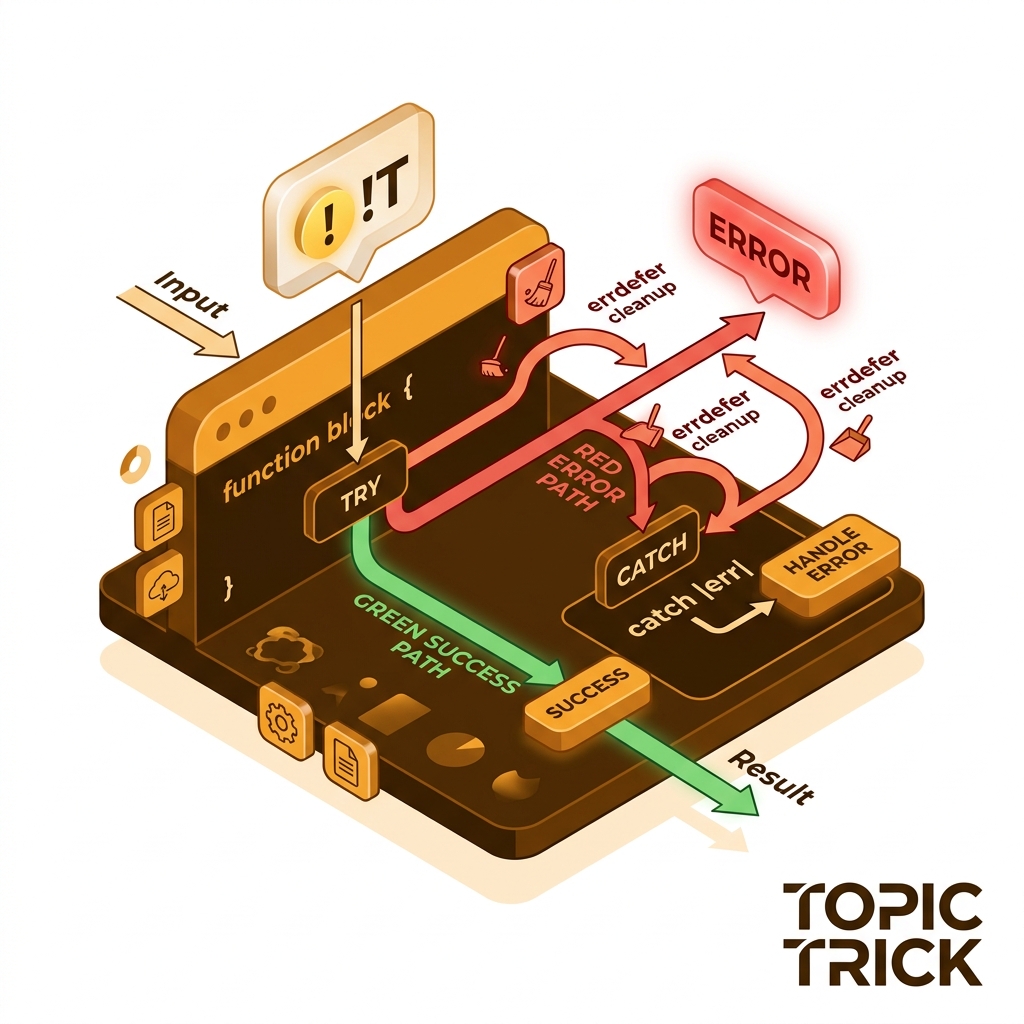
Zig Error Handling: Try, Catch, and Errdefer
In languages like Java, C#, or Python, an error is an Exception. When an exception is thrown, it "Teleports" out of the current function, unwinds the stack, and crashes the application unless caught by a magical try-catch block somewhere higher up. This mechanism is expensive, hidden, and makes control flow difficult to audit.
In Zig, errors are Values. They are treated with the same respect as a u32 or a String. They are passed along the stack explicitly, and the compiler forces you to acknowledge them. This 1,500+ word guide explores the "Error Union" and the unique errdefer keyword that ensures your memory and hardware states are always safe, even when your logic fails.
1. Error Sets: Defining the "Failures"
An error set is similar to an enum, but it lives in a global namespace of possible failure states. You don't "Throw" an error; you return an error value.
Creating an Error Set
const FileError = error{
    FileNotFound,
    AccessDenied,
    DiskFull,
};
Error Set Merging
Zig allows you to combine error sets using the || operator. This is incredibly useful for building "Middleware" that handles errors from multiple sub-systems.
const AppError = FileError || NetworkError || error{Unknown};2. The Physics of the Error Return: Status in Registers
In C, an error is often an int. In C++, an exception is a complex object. In Zig, an error is a 16-bit Integer (at the binary level).
The Error Register Mirror
- The Concept: When a function returns an error, it doesn't just "Crash." It places a specific status code (the error value) into a CPU register (like
AX). - The Physics: Returning a value across a register takes 1 clock cycle. This is thousands of times faster than jumping into an "Exception Handler" in C# or Java.
- The Union: An Error Union (
!i32) is stored as a small struct in memory. The CPU checks a "Tag" bit to see if the value is an error or the result. This is Hardware-Accelerated Branching at its most efficient.
3. Error Unions: The ! Engine
The core of Zig's safety is the Error Union Type. A type like !i32 means "This function returns a signed 32-bit integer OR it returns an error."
fn parseAge(input: []const u8) !u8 {
    if (input.len == 0) return error.EmptyString;
    const age = try std.fmt.parseInt(u8, input, 10);
    return age;
}
Why this is Professional
In C, if a function returns -1 on error, you can accidentally "Ignore" it and keep calculating with the -1. In Zig, you cannot use the result of parseAge directly. The compiler will block the build until you handle the error.
4. The Handling Trio: try, catch, and if
Zig provides three explicit ways to "Deal" with an error union:
A. The try Keyword (Gifting the Error)
try is a shorthand for: "If this function fails, return that error right now and let my caller deal with it."
const data = try readFile(); // "I'm passing the buck"B. The catch Keyword (The Safety Net)
catch allows you to provide a default value or run a local recovery block.
const port = getEnvPort() catch 8080; // "If env fails, use 8080"C. The if Capture (Full Fidelity)
If you need to know exactly which error happened to take different actions, use the payload capture:
if (doWork()) |result| {
    std.debug.print("Success: {d}\n", .{result});
} else |err| {
    switch (err) {
        error.OutToLunch => try retryLater(),
        error.Fatal => return err,
    }
}
5. errdefer: The "Cleanup on Failure"
This is Zig's most revolutionary contribution to systems programming. While defer runs code at the end of a block no matter what, errdefer only runs if the function returns an error.
The Transaction Pattern
Imagine you are writing a database:
- Open a transaction.
errdeferRollback the transaction.- Write data.
- If everything works, Commit and return.
pub fn createAccount(name: []const u8) !u32 {
    const id = try db.startTransaction();
    errdefer db.rollback(id); // Only runs if we FAIL later

    try db.insertName(id, name);
    try db.allocateStorage(id);

    return id; // Success! rollback is ignored.
}
This pattern makes "Resource Leaks" almost impossible to create.
6. Errdefer Internal Logic: The Unwinding Mirror
Many developers ask: "How does errdefer know when to trigger?"
The Stack Mirror
- The Mechanism: When the compiler sees
errdefer, it inserts a "Finalizer" into the function's stack frame. - The Logic: Before the function returns, it checks the Status Register. If the return value is an error, the
errdeferblock is jumped to and executed. If the return value is success, the block is skipped. - The Result: This provides the "Rollback" safety of a database transaction at the speed of a single
CMP(Compare) andJE(Jump if Equal) machine instruction.
7. Tracing: Where did it go wrong?
Because Zig doesn't have "Exceptions," you might worry about losing the "Stack Trace." Zig solves this with Error Return Traces.
In Debug and ReleaseSafe modes, Zig keeps a small, high-performance log of every function that "bubbled up" an error via try. When your app crashes or logs an error, you see a perfect path of exactly where the failure originated.
8. anyerror: The Universal Set
You will often see fn main() anyerror!void.
anyerror is a special type that can represent any error in the entire program. While convenient for your main function, you should avoid it in your libraries. Being explicit about which errors can happen is the key to building resilient, predictable systems.
Error handling is the "Security" of your software. By mastering the Error Union and the logic of errdefer, you gain the ability to build software that handles failure gracefully, never leaks memory, and provides a clear audit trail for every failure. You graduate from "Managing success" to "Architecting Resilience."
Phase 8: Resilience Checklist
- Audit your function signatures: Replace boolean "Success" flags with explicit Error Unions.
- Implement
errdeferimmediately after every allocation that must be rolled back on failure. - Use
catchwith a default value to eliminate "Bubble-Up" complexity in non-critical paths. - Verify your Error Return Trace: purposefully trigger an error in a deep nested function and observe the trace output in your terminal.
- Refactor your error sets: Use specific
error{...}sets instead of the globalanyerrorin library code.
Read next: Testing and Benchmarking: The Logic of Validation →
Frequently Asked Questions
Q: How does error handling in Zig work without exceptions?
Zig uses error unions — a return type written ErrorSet!T that holds either a value of type T or an error. The try keyword is shorthand for "return the error if present, otherwise unwrap the value." This makes every possible failure explicit in the function signature and forces callers to handle errors, all without any exception unwinding overhead.
Q: What is errdefer and how does it differ from defer?
defer runs a cleanup expression when the current scope exits, regardless of success or failure. errdefer runs its expression only when the scope exits with an error, making it ideal for releasing resources that were partially acquired — for example, freeing a partially initialised struct if a later allocation fails. Together they provide deterministic cleanup without try/finally.
Q: How do you create and combine custom error sets in Zig?
Declare an error set with const MyError = error { NotFound, PermissionDenied };. Functions can return narrowly typed errors (MyError!T) for precise documentation, or use anyerror for maximum flexibility. Zig merges error sets automatically in catch and switch branches — if a function calls two functions with different error sets, the inferred return type is their union, so you never need to manually map errors like in some other languages.
Part of the Zig Mastery Course — engineering the resilience.