
Zig vs. Rust: A Philosophical Memory Comparison
Master the debate. Learn the fundamental differences between Zig's explicit allocators and Rust's Borrow Checker, and choose the right tool for your project.
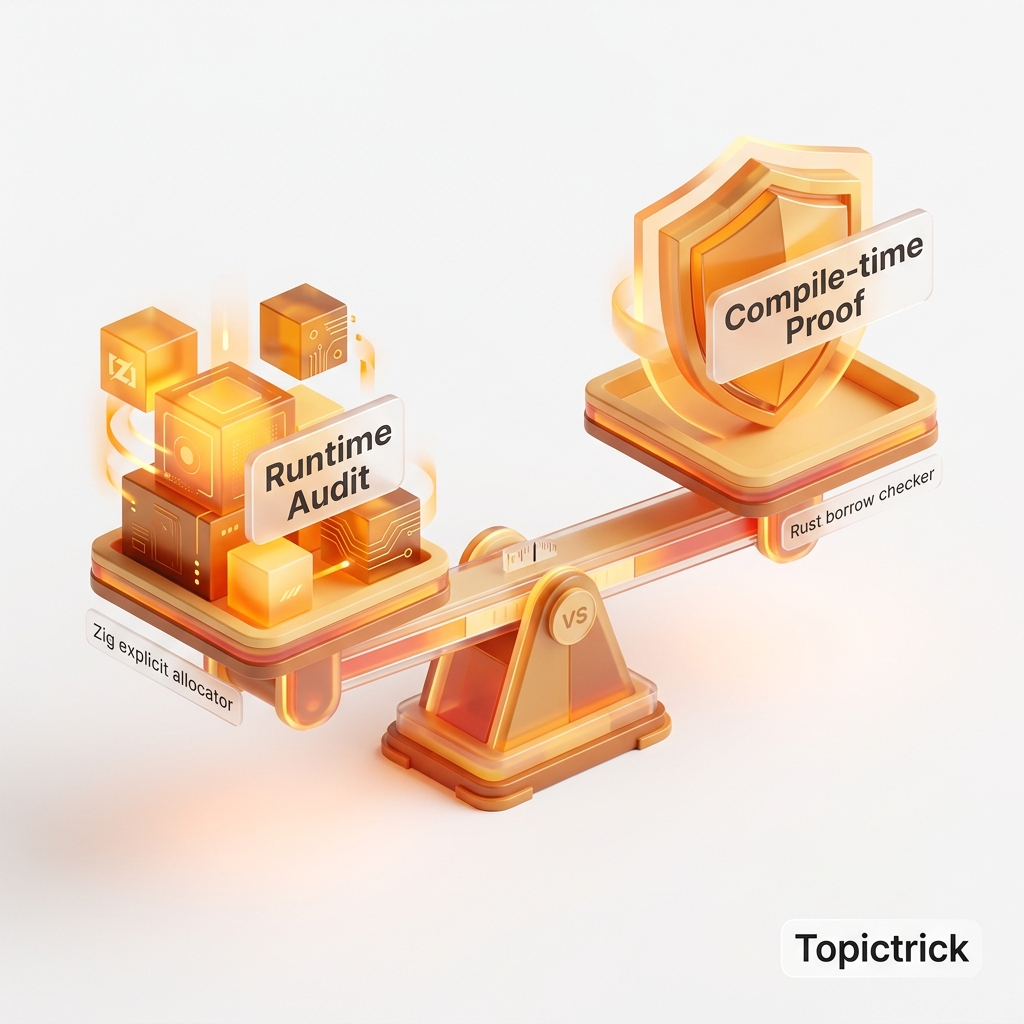
Zig vs. Rust: A Philosophical Memory Comparison
In the modern systems programming landscape, the battle for the successor to C is dominated by two titans: Rust and Zig. Both languages share the goal of eliminating memory corruption, buffer overflows, and null pointer exceptions—the bugs that cause 70% of all security vulnerabilities.
However, their philosophies are diametrically opposed. Rust is built on the concept of "Machine-Enforced Safety," where the compiler is a strict guardian. Zig is built on "Programmer-Owned Simplicity," where the language provides perfect visibility so the engineer can be the architect. This 1,500+ word guide explores the technical trade-offs of 2026 and helps you choose the right "Sword" for your next mission.
1. Rust: The "Hard" Guardrails (Borrow Checker)
Rust's fundamental belief is that the programmer is untrustworthy. Humans are tired, stressed, and prone to mistakes—so the machine must be the ultimate authority.
The Ownership Model
Rust uses a unique system of Ownership and Lifetimes.
- A variable can have only one "Owner" at a time.
- You can "Borrow" a variable (immutably or mutably), but the compiler ensures that the original owner doesn't disappear while you're using it.
- The Result: It is mathematically impossible to have a "Use-After-Free" or a "Data Race" in safe Rust.
- The Cost: The "Learning Curve." Developers often spend their first month "Fighting the Compiler" to prove that their code is safe, often leading to complex syntax like
<'a, T: Clone>.
2. Zig: The "Aware" Systems (Explicit Allocators)
Zig's fundamental belief is that the programmer is the architect. The language shouldn't restrict you; it should provide you with a transparent set of tools that make your intentions clear.
No Hidden Magic
In Rust, calling vec.push(item) might silently allocate memory from a global heap. In Zig, no memory is ever allocated hiddenly.
- To allocate memory, you must pass an Allocator to the function.
- This creates "Visibility." When you see an allocator being passed, you know that memory is being managed.
- The Safety: Zig uses Optional Types (
?T) to eliminate null pointers and Error Sets to ensure failure is never ignored. While it doesn't "Enforce" ownership with a borrow checker, it makes the management so visible that leaks become easy to spot.
3. Comparison: Security and Safety
| Feature | Rust | Zig |
|---|---|---|
| Safety Type | Formal Verification (Static) | Robustness through Visibility |
| Data Races | Forbidden by Compiler | Avoided via Mutex/Atomics |
| Memory Leaks | Rare (but possible) | Caught by GPA/Tests |
| Complexity | High (Trait system, Lifetimes) | Low (C-like simplicity) |
Rust is "Safe by Default." You have to explicitly use the unsafe keyword to do dangerous things.
Zig is "Correct by Design." It gives you the "General Purpose Allocator" (GPA) which automatically catches memory leaks and double-frees during your testing phase, ensuring your production code is hardened.
4. Performance and Binary Size
In 2026, Zig has a slight edge in "Micro-Performance" and "Cold Starts."
- Binary Size: A Zig "Hello World" is essentially zero-overhead. A Rust "Hello World" includes a small amount of runtime metadata for its standard library.
- Compilation Speed: Zig compiles significantly faster than Rust. The Zig compiler is designed for "Incremental Brilliance," while the Rust compiler struggles with the complexity of its own borrow-checking and trait-resolution logic.
5. Use-Case Matrix: Which Language Wins?
When to choose RUST:
- Large Teams: When you have 500 developers and you need the machine to prevent them from crashing the system.
- Distributed Services: Building cloud-native backends where security is the #1 priority.
- Browsers & OS: Where the codebase is so massive no single human can understand the lifecycle of every byte.
When to choose ZIG:
- Game Engines: Where you need absolute control over the CPU cache and memory layout for 144 FPS performance.
- Databases & Kernels: Where "Explicit is better than Implicit" and you need to manage every byte of the hardware.
- Embedded & IoT: Where you have only 64 KB of RAM and cannot afford a runtime or a heavy standard library.
Key Takeaway
The choice between Zig and Rust is not about which language is "Better"—it is a choice of Philosophy.
- Choose Rust if you want the "Protection" of the machine and the safety of formal rules.
- Choose Zig if you want the "Power" of absolute control and the speed of a tool that never hides the reality of the hardware.
You graduate from "Learning a language" to "Architecting a System."
Frequently Asked Questions
Q: How does Zig manage memory compared to Rust's ownership system?
Rust enforces memory safety at compile time through ownership and borrow checking — the compiler rejects unsafe patterns. Zig takes a different approach: it provides explicit allocators and defer/errdefer for deterministic cleanup, but does not have a borrow checker. Zig trusts the programmer to manage lifetimes correctly, offering more flexibility at the cost of fewer compile-time safety guarantees.
Q: Does Zig have a garbage collector?
No. Zig has no garbage collector and no hidden memory management. Every allocation is explicit — you call an allocator's alloc method and are responsible for calling free. This makes Zig memory behaviour completely predictable and suitable for real-time systems, embedded targets, and latency-sensitive applications.
Q: Which language is safer for systems programming: Zig or Rust?
Rust provides stronger compile-time memory safety guarantees, making it harder to introduce use-after-free or data race bugs. Zig prioritises simplicity and gives you tools (allocator interfaces, defer, debug-mode safety checks) to write safe code, but relies more on programmer discipline. Teams that want compiler-enforced safety typically prefer Rust; teams that value simplicity, C interoperability, or embedded targets often prefer Zig.
Part of the Zig Mastery Course — engineering the choice.