
Chaos Engineering: Designing for Failure
Master the art of proactive destruction. Learn how to prove architectural resilience by injecting failure into production systems, and discover why 'Chaos Engineering' is the ultimate test of your automation and observability.
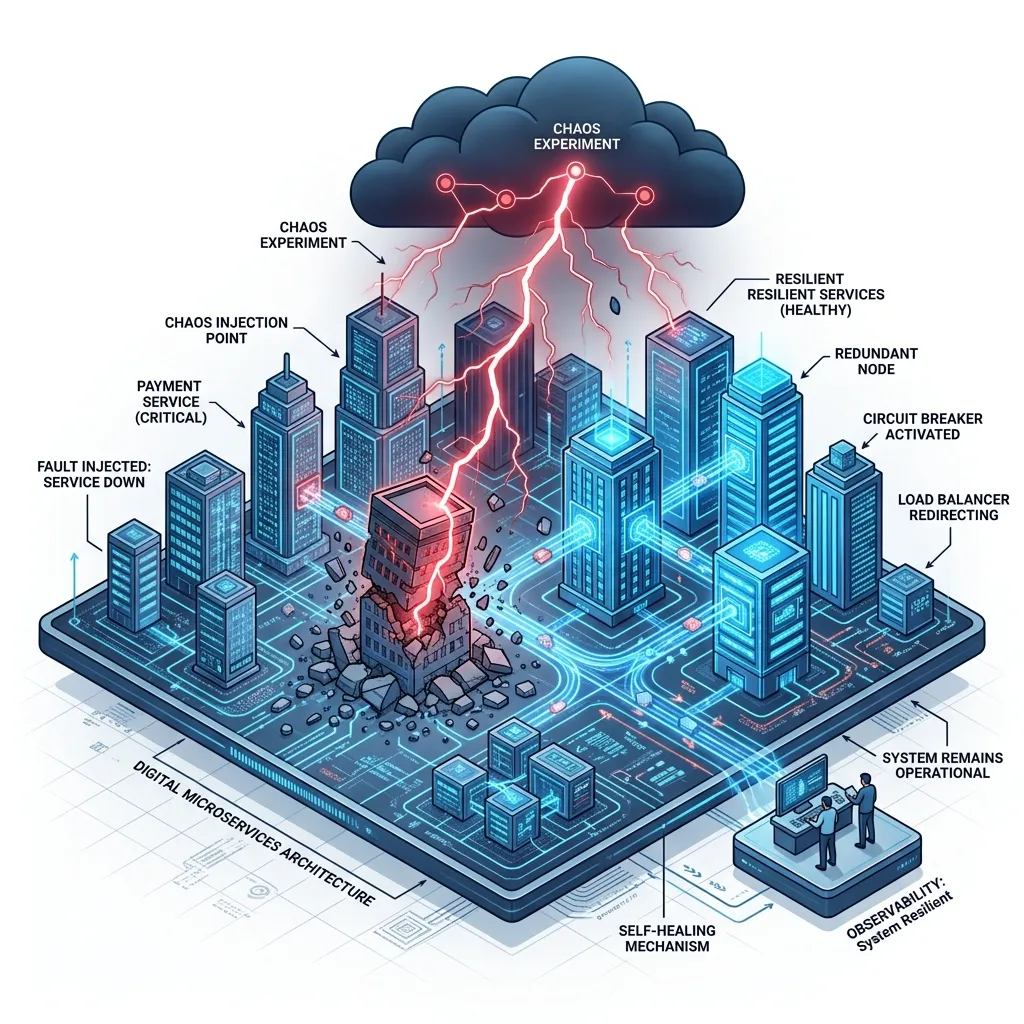
Chaos Engineering: Designing for Failure
In the early days of software, we prayed for 100% uptime. In the modern era of distributed systems, we assume everything is broken 10% of the time. In a microservices ecosystem with 51 services, there is no "Clean State"-there is only Partial, Cascading, and Unpredictable Failure.
This 1,500+ word deep dive investigates the Science of Proactive Destruction. We move beyond the "Hope" that our circuit breakers work and explore how to physically inject failure into the silicon and the network to prove our architecture's integrity.
1. Hardware-Mirror: The Physics of Failure
Failure is not a software bug; it is a physical event.
- The Physics: A "Network Timeout" is often caused by Packet Loss at the NIC level or Queue Overflow in a router.
- The Chaos Logic: To test your system, you must replicate these physical events. Use tools like
tc(Traffic Control) in Linux to inject $500$ms Jitter or 15% Packet Loss. - The Hardware Reality: In a virtualized cloud, your "Neighbor" on the same physical server might be doing heavy AI training. This creates Resource Contention (Steal Time). Chaos Engineering simulates this by spiking CPU and RAM to see if your "Noisy Neighbor" isolation works.
2. The 4 Disciplines of Chaos
Chaos Engineering is a strictly scientific process. It is not "Randomly breaking things."
Step 1: Define the "Steady State"
Measure your system's normal behavior.
- Metric: Not "Uptime," but User Value. (e.g., "We process $200$ orders per minute with a P99 latency of $400$ms"). This is your baseline.
Step 2: Form a "What If" Hypothesis
"If we kill the primary database in the US-East region, the system will failover to US-West in under $60$ seconds with zero data loss."
Step 3: Inject the Variable (The Game Day)
Inject the failure. Stop the database process or cut the regional VPC peering.
- Safety: Start with a Blast Radius of $1$ user or $1$ pod before scaling to a whole region.
Step 4: Analyze and Correct
If the system didn't failover in 60 seconds, you haven't "Failed" the test; you've found a Resilience Gap.
3. The Blast Radius Geometry: Geometric Safety
One of the biggest fears of Chaos Engineering is a " runaway experiment" that takes down the entire production site. To mitigate this, architects must define and enforce a strict Blast Radius.
Header-Based Targeting
Using a Service Mesh (Review Module 69) or a specialized API Gateway, you can inject failure for only a subset of traffic.
- Logic: If
X-Chaos-Groupheader isBeta-Testers, then inject 200ms of latency. - Geometry: This limits the "Blast Radius" to a known and consenting group of users, while the general public remains unaffected.
Incremental Scaling
- Pod-Level: Start by killing 1 pod in a fleet of 50.
- AZ-Level: Move to "Blackholing" a single Availability Zone.
- Region-Level: The final boss. Test the total failure of a geographical region. Rule: Never move to the next "Geometric Level" until your system proves it can handle the previous one with 100% automated recovery.
4. Hardware-Mirror: Simulating Silicon Failure
Software developers often treat the hardware as an abstract, perfect layer. Chaos Engineering forces you to confront the Physical Entropy of the data center.
DRAM Bit-Flips & Memory Pressure
In high-radiation environments or aged hardware, Bit-flips occur. While ECC (Error Correction Code) memory catches most, "Silent Data Corruption" is a real threat.
- The Experiment: Use tools like
stress-ngto intentionally consume 95% of available RAM. - The Observation: Does your Linux kernel's OOM-Killer target your critical process, or does your application have a "Safe Memory Buffer" to survive the pressure?
Disk Latency & I/O Starvation
A failing hard drive or a saturated NVMe interface doesn't just "Stop working." It becomes Incredibly Slow.
- The Physics: As a drive accumulates "Bad Sectors," the firmware must perform frequent retries, increasing I/O latency from 1ms to 2000ms.
- The Chaos: Use
iotoporfioto simulate a saturated disk. - The Architect's Pivot: If your database's WAL (Write Ahead Log) can't flush to disk because of "I/O Starvation," does the application hang or does it fail-over to a healthy node?
5. The Chaos Maturity Model: From Game Days to CI/CD
Resilience is a muscle that must be trained regularly.
- Level 1: Manual Game Days: A scheduled time where engineers watch the system break in a controlled environment.
- Level 2: Automated Drift Detection: Proactively scanning for "Configuration Drift" that would break failover logic (e.g., a US-West DB hasn't been synced in 24 hours).
- Level 3: Chaos in staging (CI/CD): Every pull request is subjected to a "Chaos Test Pipeline." If the code can't survive a network partition in staging, it is never allowed in production.
- Level 4: Continuous Production Chaos: Tools like the "Simian Army" run 24/7. Uptime is no longer a metric; "Recovery Confidence" is the only thing that matters.
4. Stability Pattern: Moving from Resilient to Antifragile
Nassim Taleb defined Antifragile as things that "Profit from disorder."
- Resilient: The system survives the chaos and returns to normal.
- Antifragile: The system Learns from the chaos.
- The Architecture: In an Antifragile system, the chaos experiment automatically updates the Health Check thresholds. If a node is slow, the system "Remembers" and shunts future traffic away from it automatically.
5. Case Study: Netflix and the Simian Army
Netflix didn't become stable by accident. They became stable by Building a Monkey.
- The Goal: To force engineers to design for failure.
- The Action: They deployed Chaos Monkey, a tool that randomly deleted production instances during working hours.
- The Cultural Result: Engineers stopped treating servers as "Special Pets" and started treating them as "Cattle." If a server can die at any time, you Must build the "Auto-Recovery" logic on Day 1.
6. Summary: The Chaos Architect's Checklist
- Observability First: Do not run chaos experiments if you don't have perfect dashboards. You cannot learn from what you cannot see.
- Hypothesis is a Contract: Never break a system just to see what happens. Always write down Predicted Behavior vs. Actual Behavior.
- Minimize Blast Radius: Use Service Mesh (Review Module 69) to target specific traffic headers for your experiment, protecting 99% of your users.
- Automatic Rollback: The experiment must self-terminate if the "Error Rate" exceeds a certain threshold. Never "Manually" stop a disaster.
- Game Day Culture: Chaos is a team sport. Run "Game Days" where the whole team watches the dashboards together. This builds the "Muscle Memory" of incident response.
Chaos Engineering is the ultimate proof of Architectural Integrity. By embracing destruction, you gain the confidence to lead global-scale platforms through any storm. You graduate from "Hoping it stays up" to "Proving it cannot stay down."
Phase 74: Chaos Actions
- Measure your "Time to Detect": How long does it take for your dashboard to show that a pod has been deleted?
- Schedule a "Game Day" for your internal platform and define 3 simple hypotheses.
- Implement a Stop-Experiment Trigger in your observability tool.
- Audit your "I/O Latency Handling": Use
stress-ngin a test environment to prove your DB handles disk saturation without crashing.
Read next: High Availability: Multi-Region Active-Active Design ->
Part of the Software Architecture Hub - architecting for the real world.