
What is CICS? Introduction, History, and Use Cases (2026)
A complete introduction to IBM CICS (Customer Information Control System). Learn what CICS is, why it exists, its history, how it's used in banking and insurance today, and why CICS skills are in high demand in 2026.
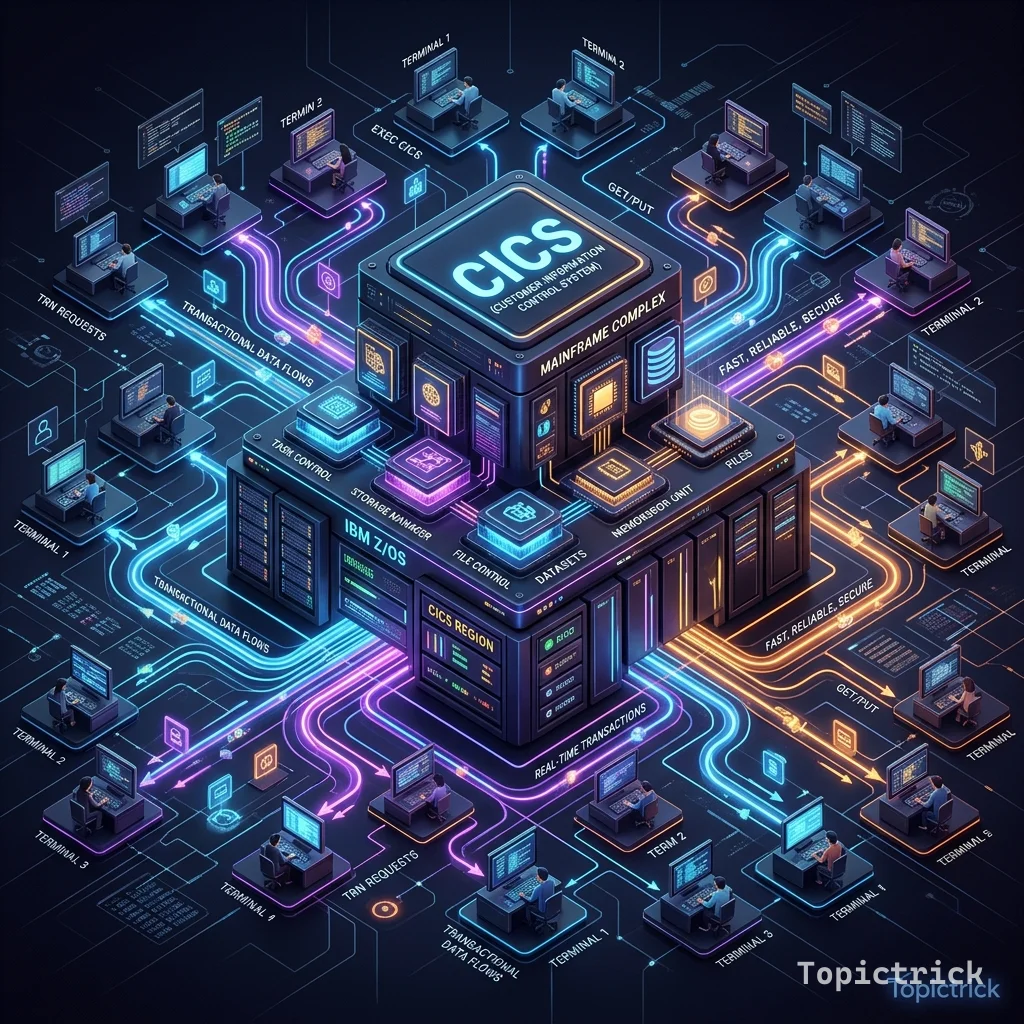
What Is CICS? A Complete Introduction
Every time you use an ATM, book a flight through an airline's reservation system, submit an insurance claim, or pay a bill through a government portal — there is a very good chance you are interacting with IBM CICS. Customer Information Control System is the mainframe software that sits between your request and the data, processing it with the reliability and speed that modern financial infrastructure demands.
CICS has been in production since 1968. It has outlasted dozens of competitors, survived the rise of the internet, and remains one of the most mission-critical software systems on the planet in 2026. Understanding CICS is not just a career skill — it is access to the infrastructure that runs the global economy.
A Brief History of CICS
CICS was developed by IBM and first released in 1968, designed to solve a critical problem of the era: how to allow multiple users to interact with a mainframe computer simultaneously in real time. Before CICS, mainframe computing was primarily batch-oriented — you submitted a job, it ran, you got results hours later. CICS enabled online, interactive computing on the IBM System/360.
Key milestones:
1968: CICS introduced on IBM System/360. Primarily used for airline reservation systems (PARS — Programmed Airline Reservation System was an early CICS application).
1974: CICS/VS released for IBM System/370, establishing the core transaction model still in use today.
1990s: CICS/ESA and CICS/TS (Transaction Server) modernised the architecture for OS/390 and z/OS. Introduction of multi-region operation (MRO) and Client/Server capabilities.
2000s: CICS Transaction Server for z/OS becomes the standard. Web services support added.
2010s–2020s: CICS adds Java Liberty JVM server, RESTful API support, JSON/XML pipeline processing, channels and containers for modern data passing, and integration with cloud platforms.
2026: CICS Transaction Server for z/OS Version 6 continues to evolve, adding cloud-native integration while maintaining backward compatibility with COBOL programs written decades ago.
What Problem Does CICS Solve?
To understand why CICS exists, consider what happens in a bank when a customer walks up to a teller to check their balance:
- The teller types the account number and presses ENTER on a terminal
- The system must retrieve the balance from a database containing millions of accounts
- The result must appear in under a second — the customer is waiting
- At the same moment, 50,000 other tellers across the country are doing the same thing
- Every one of these queries must be correct — a wrong balance is a serious error
Managing this — thousands of simultaneous short, fast, correct transactions — is exactly what CICS does.
CICS provides:
Task management: Each user request becomes a CICS task. CICS schedules thousands of tasks concurrently, giving each the resources it needs and taking them away when done.
Storage management: Memory is allocated and freed for each task. CICS prevents tasks from interfering with each other's storage.
Terminal management: CICS manages communication with thousands of terminals (and today, web browsers, mobile apps, and API clients) simultaneously.
File services: Provides structured access to VSAM files — read, write, update, delete — with locking so concurrent tasks don't corrupt data.
Database integration: CICS works with DB2, IMS, and other databases, managing the connection pool (threads) and transaction coordination.
Recovery: CICS keeps a log of all changes. If a transaction fails midway through, CICS backs out the partial changes, restoring data to its consistent state.
Where CICS Is Used Today
CICS dominates in industries where transaction volume, reliability, and correctness are non-negotiable:
Banking and Financial Services
The majority of global interbank payment processing runs through mainframe CICS. When you send a wire transfer, that instruction typically flows through one or more CICS transactions. ATM networks query CICS to check balances and authorise withdrawals. Core banking systems at the world's largest banks — HSBC, JPMorgan Chase, Bank of America, Barclays — run on CICS.
A major retail bank may process 50,000–100,000 CICS transactions per second during peak hours. These are individual tasks: balance inquiry, fund transfer, statement retrieval, loan payment — each one completing in milliseconds.
Insurance
Actuarial calculations, policy management, claims processing, and premium billing at large insurance companies run through CICS transactions. The calculation engines that determine insurance premiums for millions of policies often live in COBOL programs invoked by CICS transactions.
Retail and Airlines
Airline reservation systems have a long history with CICS. Inventory management for large retailers, loyalty programme point calculations, and supply chain transactions at companies that run mainframes all use CICS.
Government
Tax processing systems, social security and benefit payment systems, electoral roll management, and other government databases in the UK, USA, Australia, and across Europe run on z/OS with CICS.
How CICS Works — The 60-Second Overview
Here is the simplest possible explanation of how a CICS transaction works:
- A user enters a 4-character transaction ID on a terminal (e.g.,
EMPL) and presses ENTER - CICS looks up the transaction definition in its resource tables — it finds that
EMPLruns programEMPINQ - CICS creates a task and loads program
EMPINQinto memory EMPINQis a COBOL program. It usesEXEC CICS RECEIVEto read the user's input data- It queries a DB2 database or VSAM file with
EXEC SQLorEXEC CICS READ - It formats the results and uses
EXEC CICS SEND MAPto display them on the terminal - The program ends with
EXEC CICS RETURN— CICS terminates the task and recycles all resources - The whole thing takes 50–200 milliseconds
While this task was running, CICS was simultaneously managing thousands of other tasks for other users — all sharing the same memory, CPU, and data resources safely.
CICS vs Modern Web Applications
A common question from developers entering the mainframe world: how is CICS different from a Java Spring Boot application or a Node.js REST API?
| Feature | CICS | Modern Web App |
|---|---|---|
| Language | COBOL, PL/I, Java | Java, JavaScript, Python, Go |
| Transaction model | Short, synchronous tasks | HTTP request/response, async |
| Terminal model | 3270 screen or REST API | Browser, mobile app |
| Concurrency | Multi-tasking within one region | Threads, event loop, containers |
| Throughput | Millions of txns/second per LPAR | Varies widely |
| Reliability | 99.999% (five-nines) designed | Depends on deployment |
| Data access | VSAM files, DB2, IMS | Any database |
| Deployment | z/OS LPAR | Linux container, cloud VM |
CICS applications are typically stateless (pseudo-conversational) — each user interaction is a separate task that completes and releases all resources before the user responds. This is actually the same model as HTTP — and it predates HTTP by decades.
Why Learn CICS in 2026?
The mainframe skills gap is real and growing. A 2023 IBM survey found that 60% of mainframe organisations expected a skills shortage in the next five years. Experienced CICS developers are retiring, and too few new developers are being trained.
This creates significant career opportunities:
Salary premium: CICS developers command 20-40% higher salaries than equivalent Java or Python developers in many markets, reflecting the scarcity of skills.
Job security: Core banking and insurance systems cannot be easily replaced. CICS code that has been running correctly for 30 years is not going away.
Interesting work: Modern CICS development involves integrating mainframe transactions with REST APIs, JSON processing, and cloud platforms — it is not the dusty, obsolete work some imagine.
Transferable understanding: Understanding how CICS achieves millions-of-transactions-per-second throughput with five-nines reliability teaches distributed systems principles that apply to any platform.
Getting Started
CICS development requires access to a z/OS mainframe — either through an employer, IBM's Academic Initiative (free for students), or community resources like Hercules + MVS 3.8j. The core language for CICS is COBOL, so if you are new to mainframe development, start with our COBOL Programming Tutorial.
Once you have the basics, this CICS Complete Reference course walks you through everything — from the architecture of a CICS region to writing your first EXEC CICS program, building BMS screens, handling files and queues, integrating with DB2, and preparing for CICS developer interviews.
Start with CICS Architecture to understand how the CICS engine works before writing your first line of code.
Frequently Asked Questions
Q: What is CICS and what is it used for? CICS (Customer Information Control System) is an IBM transaction processing middleware that runs primarily on IBM Z mainframes under z/OS. It provides the runtime environment for online transactional applications — order entry, banking, insurance claims, airline reservations — where many users interact with data simultaneously. CICS manages multitasking, terminal communication, file access, database integration, and recovery, allowing programs to focus on business logic rather than infrastructure.
Q: Is CICS still relevant in modern IT? Yes — CICS processes an estimated 1.2 million transactions per second globally and is deeply embedded in the world's banking, insurance, retail, and government infrastructure. Many of the world's ATM transactions, credit card authorisations, and insurance claim entries flow through CICS systems. IBM continues active development (CICS TS 6.x as of 2024), adding cloud integration, RESTful API exposure, and DevOps tooling. CICS knowledge remains highly valued and well-compensated in the mainframe skills market.
Q: What programming languages can you use to write CICS applications?
CICS supports COBOL (the most common), PL/I, C/C++, Assembler, and Java (via CICS Liberty JVM server for modern web services). All use the same EXEC CICS command interface regardless of language. COBOL remains dominant for legacy systems; Java and Node.js running in CICS Liberty are used for new RESTful microservices that need to access CICS-managed resources like VSAM files and DB2 databases.
Ready to Master CICS?
This lesson is part of the CICS Mastery Course — the complete guide to IBM CICS programming from transaction fundamentals to DB2 integration and REST API modernisation. 22 modules, beginner to senior, free.