
C++ RAII: Resource Acquisition Is Initialization - The Foundation of Safe C++
Deep guide to RAII in C++. Understand why RAII is C++'s most important design pattern, build custom RAII guards for files, mutexes, sockets, and OS handles, implement scope_exit for ad-hoc cleanup, explore exception safety guarantees (basic, strong, nothrow), and learn why RAII outperforms garbage collection for deterministic resource release.
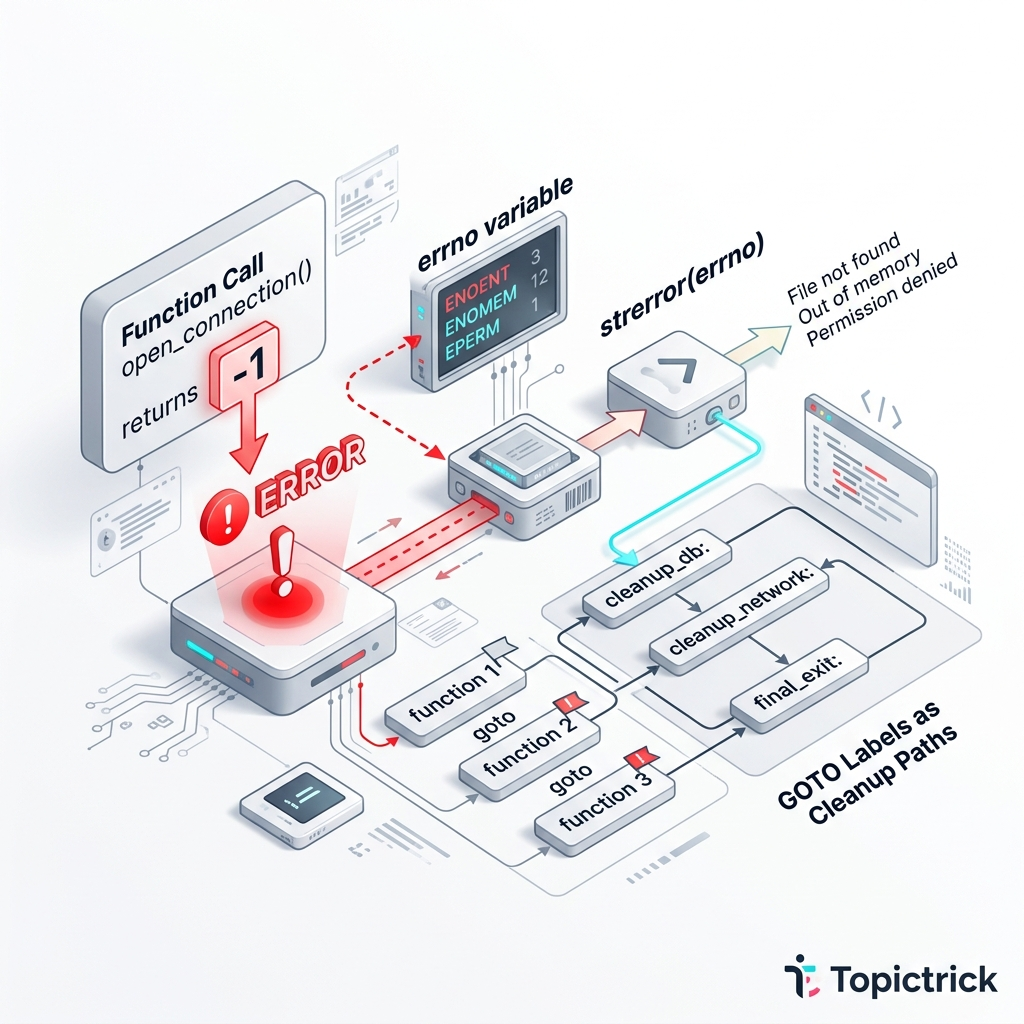
C++ RAII: Resource Acquisition Is Initialization - The Foundation of Safe C++
Table of Contents
- Why Manual Cleanup Always Fails at Scale
- RAII: The Core Pattern
- Building a File RAII Wrapper
- Mutex RAII: lock_guard and unique_lock
- RAII for OS Handles and Sockets
- scope_exit: Ad-Hoc Cleanup Without a Class (C++23)
- Exception Safety Guarantees
- RAII vs Garbage Collection
- Building a Transaction Guard
- RAII Patterns in the Wild
- Frequently Asked Questions
- Key Takeaway
Why Manual Cleanup Always Fails at Scale
Manual open/close, lock/unlock, malloc/free patterns have at least three failure modes:
// Failure mode 1: Early return that skips cleanup
void process_file(const char* path) {
    FILE* f = fopen(path, "r");
    if (!f) return;

    char* buffer = malloc(4096);
    if (!buffer) {
        fclose(f);   // Remembered here...
        return;
    }

    if (parse_header(f) < 0) {
        free(buffer);
        fclose(f);   // Remembered here...
        return;
    }

    // ... 50 more lines of logic, each needing the same cleanup ...

    free(buffer);
    fclose(f); // Finally! But any exception between here and fopen leaks both
}

// Failure mode 2: Exception thrown mid-function
// Failure mode 3: Code reviewer adds an early-return and forgets cleanup
// All three: RAII prevents automatically
Every additional code path doubles the number of places where cleanup must be remembered. In production code with error handling, this becomes unmaintainable.
RAII: The Core Pattern
RAII solves the problem by making cleanup automatic: the destructor runs unconditionally when the object goes out of scope, regardless of how the scope is exited (normal return, early return, exception, thread exit):
class FileHandle {
    FILE* file_;

public:
    // Constructor: Acquire the resource
    explicit FileHandle(const char* path, const char* mode)
        : file_(std::fopen(path, mode)) {
        if (!file_) {
            throw std::system_error(errno, std::system_category(),
                                    std::string("Cannot open: ") + path);
        }
    }

    // Destructor: Release the resource - NO MATTER WHAT
    ~FileHandle() noexcept {
        if (file_) std::fclose(file_);
    }

    // Non-copyable (a file handle has one owner)
    FileHandle(const FileHandle&)            = delete;
    FileHandle& operator=(const FileHandle&) = delete;

    // Movable (transfer ownership)
    FileHandle(FileHandle&& other) noexcept
        : file_(std::exchange(other.file_, nullptr)) {}

    FILE* get() const noexcept { return file_; }

    // Bool conversion for validity check
    explicit operator bool() const noexcept { return file_ != nullptr; }
};

// Now this function is always safe:
void process_file_raii(const char* path) {
    FileHandle f("data.txt", "r");  // Opened in constructor

    if (some_error()) return;       // f.~FileHandle() called here -> closed ✅

    parse_content(f.get());

} // f.~FileHandle() called here too -> closed ✅
// No explicit fclose needed ANYWHERE - impossible to leak
Mutex RAII: lock_guard and unique_lock
The standard library provides two RAII mutex wrappers:
#include <mutex>

std::mutex mtx;
int shared_counter = 0;

// lock_guard: Simple, non-movable RAII lock (prefer this)
void increment_safe() {
    std::lock_guard<std::mutex> lock(mtx); // Locks on construction
    shared_counter++;
    // lock.~lock_guard() -> unlocks unconditionally when function exits
    // Even if an exception is thrown!
}

// C++17 CTAD (Class Template Argument Deduction):
void increment_ctad() {
    std::lock_guard lock(mtx); // No <std::mutex> needed - deduced
    shared_counter++;
}

// unique_lock: Flexible RAII lock - can be unlocked manually, moved
void flexible_lock() {
    std::unique_lock<std::mutex> lock(mtx);  // Locked

    // Do protected work
    shared_counter++;

    lock.unlock(); // Manually unlock when done - reduce lock hold time

    do_slow_io();  // IO outside the lock - better concurrency

    lock.lock();   // Lock again if needed
    finalize();
}  // lock destructor unlocks if still locked

// Try-lock pattern:
void try_access() {
    if (std::unique_lock lock(mtx, std::try_to_lock); lock.owns_lock()) {
        // Got the lock! (C++17 if-with-initializer + try_to_lock)
        process_critical_data();
    } else {
        // Couldn't acquire - do something else
        use_cached_result();
    }
}

// Defer lock pattern:
void deferred_lock() {
    std::unique_lock lock(mtx, std::defer_lock); // Don't lock yet
    // Do non-critical setup
    prepare_data();

    lock.lock(); // Now lock when needed
    write_shared();
}
RAII for OS Handles and Sockets
#include <sys/socket.h>
#include <unistd.h>

// Generic POSIX file descriptor RAII wrapper
class FileDescriptor {
    int fd_;

public:
    explicit FileDescriptor(int fd) : fd_(fd) {
        if (fd < 0) throw std::system_error(errno, std::system_category());
    }

    ~FileDescriptor() noexcept {
        if (fd_ >= 0) ::close(fd_); // POSIX close() for any fd type
    }

    // Non-copyable
    FileDescriptor(const FileDescriptor&) = delete;
    FileDescriptor& operator=(const FileDescriptor&) = delete;

    // Movable
    FileDescriptor(FileDescriptor&& o) noexcept
        : fd_(std::exchange(o.fd_, -1)) {}

    int get() const noexcept { return fd_; }
    int release() noexcept { return std::exchange(fd_, -1); } // Relinquish ownership
};

// Works for ANY type of POSIX file descriptor:
FileDescriptor open_file("/etc/hosts", O_RDONLY);  // Regular file
FileDescriptor sock(socket(AF_INET, SOCK_STREAM, 0)); // Network socket
FileDescriptor pipe_fd(create_pipe());               // Pipe
// All correctly closed when they go out of scope
scope_exit: Ad-Hoc Cleanup Without a Class (C++23)
std::scope_exit (C++23, from <scope>) provides one-shot RAII cleanup without writing a full class - perfect for C API cleanup:
#include <scope>  // C++23

void process_with_legacy_c_api() {
    LibHandle* h = lib_open("resource");
    if (!h) throw std::runtime_error("Failed to open");

    // Guaranteed cleanup - even on exception, even on early return
    std::scope_exit cleanup([h]() noexcept {
        lib_close(h);
    });

    if (lib_initialize(h) != LIB_OK) return; // cleanup runs -> lib_close(h) called ✅

    process(h);

} // cleanup runs -> lib_close(h) called ✅

// scope_success: runs only if scope exits normally (no exception)
// scope_fail: runs only if scope exits via exception
Pre-C++23 equivalent with a simple lambda wrapper:
template<typename F>
struct ScopeExit {
    F cleanup;
    explicit ScopeExit(F f) : cleanup(std::move(f)) {}
    ~ScopeExit() { cleanup(); }
};
// Usage: auto guard = ScopeExit{[&]{ cleanup(); }};
Exception Safety Guarantees
RAII enables formal exception safety guarantees:
| Level | Guarantee | Means |
|---|---|---|
No-throw (noexcept) | Function never throws | Destructors must use this |
| Strong | If exception, state unchanged | "All or nothing" - like a database transaction |
| Basic | If exception, no leaks, valid state | Object usable but state may differ |
| None | Exception leaves state undefined | ❌ Avoid - only for performance-critical hot paths |
// Strong exception safety - copy-and-swap idiom:
class Config {
    std::vector<Setting> settings_;

public:
    // Strong guarantee: either all settings updated or none
    void update(std::vector<Setting> new_settings) {
        Config temp;
        temp.settings_ = std::move(new_settings); // May throw - temp is temporary

        // Copy-and-swap: only AFTER successful construction, swap
        std::swap(settings_, temp.settings_); // noexcept - safe
    } // temp.settings_ (old data) destroyed here
};
RAII Patterns in the Wild
| System | RAII Wrapper | Resource |
|---|---|---|
std::unique_ptr | Heap memory | delete |
std::shared_ptr | Reference-counted memory | delete when count=0 |
std::lock_guard | Mutex | unlock() |
std::ifstream | File | fclose() |
std::jthread (C++20) | Thread | join() on destruction |
std::unique_lock | Mutex (flexible) | unlock() if owned |
gRPC grpc::ClientContext | RPC context | TryCancel() |
OpenGL glDeleteBuffers | GPU buffer | glDeleteBuffers() |
Linux epoll_create1 | epoll instance | close() |
Frequently Asked Questions
Does RAII work with exceptions? Yes - RAII was specifically designed for exception safety. When a C++ exception is thrown and propagates through a scope, the destructors of all local objects in that scope are called in reverse construction order before the exception moves to the next handler. This is called stack unwinding.
Is RAII better than Python's with statement or Java's try-with-resources?
RAII is more composable - it's fully automatic with no special syntax. In Python/Java, you must remember to use with/try-with-resources. In C++, if you use RAII types, cleanup is guaranteed with no special syntax at the call site. RAII also works for values in containers, class members, and return values - all transparently.
Can I use RAII for GPU resources?
Yes - wrapping CUDA, OpenGL, or Vulkan handles in RAII classes is a common pattern. Libraries like vk-bootstrap and modern Vulkan wrappers use RAII exclusively because GPU resource leaks are extremely common without it.
Key Takeaway
RAII transforms C++ resource management from a discipline (remember to clean up) to a type property (this type cleans up automatically). Once you internalize that every constructor is an acquisition and every destructor is a release, resource leaks become structurally impossible for RAII types. std::scope_exit closes the gap for legacy C APIs that weren't designed with destructors in mind.
Read next: STL Containers Deep Dive: vector, map, unordered_map ->
Part of the C++ Mastery Course - 30 modules from modern C++ basics to expert systems engineering.