
Event-Driven Architecture (EDA): Complete Guide for Software Architects 2026
Master the flow. Learn how to build reactive, decoupled systems using Event Streams, Producers, and Consumers.
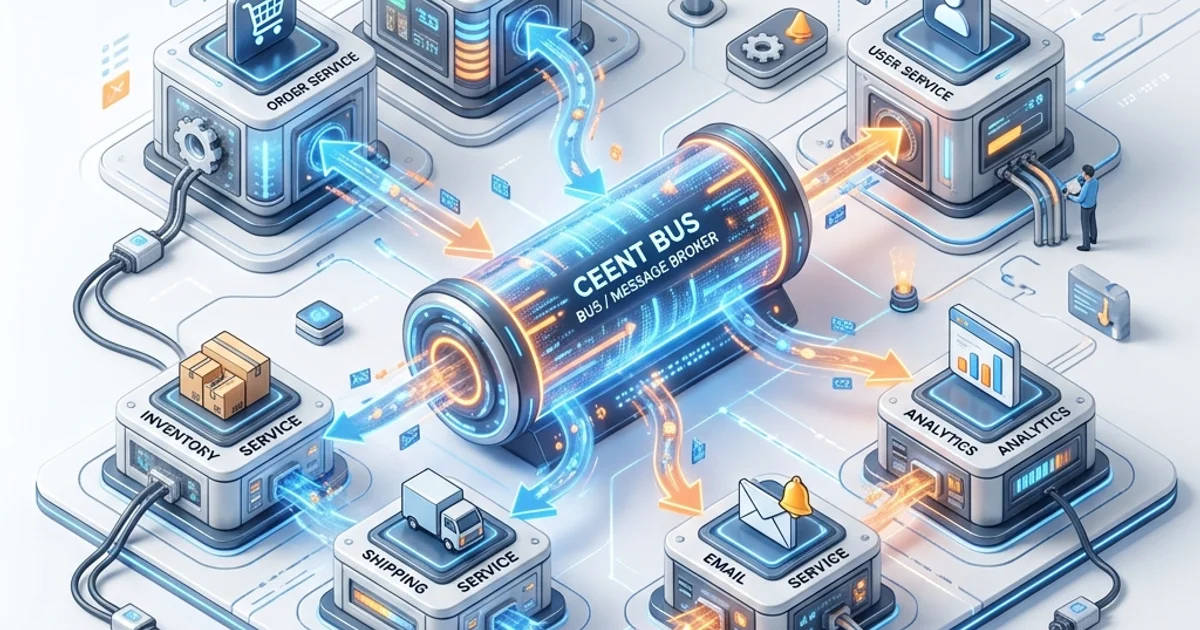
Event-Driven Architecture (EDA)
"In a Request-Response world, you ask. In an Event-Driven world, you react."
Most software is "Polite."
- User: "Can I have this file?"
- Server: "Here is the file." This is Syncronous (Request-Response). But what happens if the server is busy? The user waits. If you have 10 servers waiting for each other, you have a "Distributed Monolith" that crashes every time one small service goes offline.
Event-Driven Architecture (EDA) solves this by changing the logic to: "Something happened! Whoever cares about it, go do something." This 1,500+ word guide explores the "Decoupled" future of systems design.
1. Producer, Consumer, and the "Stream"
- Producer: The service that says: "A user just bought a subscription."
- The Stream (Broker): A persistent log of everything that happened (e.g., Kafka, RabbitMQ).
- Consumers: The 10 different services (Billing, WelcomeEmail, Analytics) that listen to that stream and work at their own pace.
2. The Benefit: "Infinite" Scalability
In an EDA system, if the "Email Service" is slow, it doesn't slow down the "Checkout Service."
- The Checkout service just puts the event into the Stream and moves on to the next customer.
- The Email service catches up $10$ seconds later when it's ready. The Architecture: This is Temporal Decoupling. You have broken the relationship between "Time" and "Success."
3. Event Sourcing: The "Time Travel" Database
In a normal database, you store the Current State (e.g., balance = $500).
In an Event-Sourced system, you store the History (e.g., +$100, +$500, -$100).
- The Power: You can "Replay" the events to find a calculation error from 2 years ago.
- You can "Fork" your data to create a new analytics engine that rebuilds the whole company's history in minutes.
4. The Challenge: Eventual Consistency (Module 103)
If you use EDA, you cannot have "Immediate Consistency."
- The User might click "Check out" and see "Order Pending" rather than "Success."
- You must design your User Interface to be Asynchronous. Use "Spinners," "Webhooks," or "Push Notifications" to tell the user when the work is finally done.
5. Tool Selection: RabbitMQ vs. Kafka
- RabbitMQ: The "Smart Broker." It knows who should get which message. Great for "Direct commands."
- Kafka: The "Smart Log." It doesn't care who is listening. It just records everything forever. Great for "Audit trails" and "Massive Data Streams."
Summary: The EDA Checklist
- Decouple or Die: Ensure your primary service doesn't "Wait" for a secondary service.
- Idempotency: Ensure that if an event is processed twice (because of a network glitch), it doesn't double-charge the user.
- Schema Registry: Use a tool to ensure both the Producer and Consumer agree on the "Message Format."
- Dead Letter Queues: Create a "Trash Can" for events that failed to process so you can fix them manually.
- Choose your Broker: Use Kafka for data; use RabbitMQ for task-routing.
EDA is the "Movement" of the enterprise. By mastering the stream and the resilience of asynchronous logic, you gain the ability to build systems that are indestructible and infinitely fast. You graduate from "Managing requests" to "Architecting Reactions."
Part of the Architecture Masterclass - engineering the flow.