
Layered (N-Tier) Architecture: The Enterprise Standard - Full Technical Deep Dive
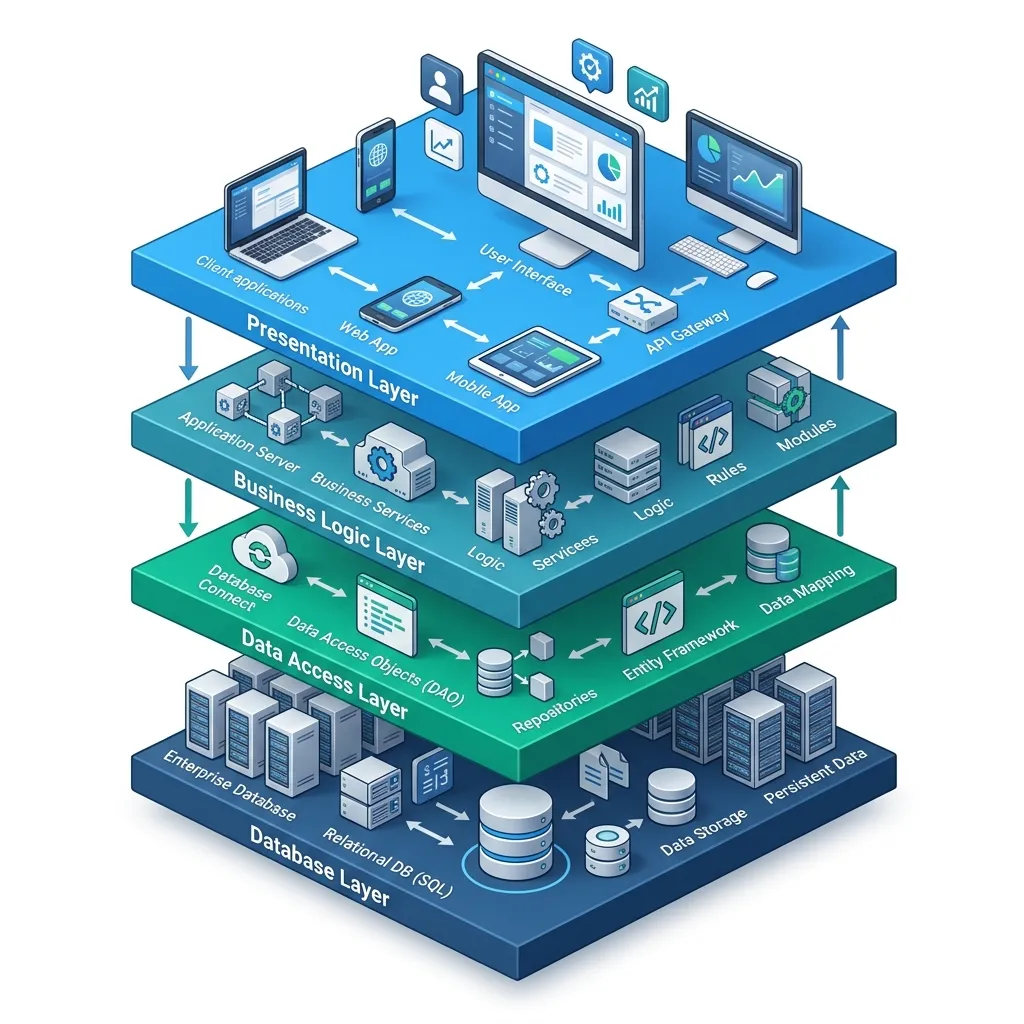
Complete guide to Layered N-Tier Architecture. Understand the four standard layers (Presentation, Application, Business Logic, Data Access), how dependencies flow downward only, closed vs open layers, the difference between N-Layer and N-Tier physical deployment, anti-patterns like sinkhole and layer skipping, testing strategies per layer, and a real Spring Boot implementation with Repository-Service-Controller pattern.
Layered (N-Tier) Architecture: The Enterprise Standard - Full Technical Deep Dive
Table of Contents
- The Core Rule: Dependencies Only Flow Downward
- The Four Standard Layers Explained
- Closed Layers vs Open Layers
- N-Layer vs N-Tier: Physical vs Logical Separation
- Real Implementation: Spring Boot Controller-Service-Repository
- Anti-Pattern: The Sinkhole Architecture
- Anti-Pattern: Anemic Domain Model
- Testing Strategy Per Layer
- When Layered Architecture Breaks Down
- Layered vs Hexagonal vs Clean Architecture
- Frequently Asked Questions
- Key Takeaway
The Core Rule: Dependencies Only Flow Downward
The single defining rule of layered architecture is directional: a higher layer can call a lower layer, but a lower layer must never know the higher layer exists.
Why this matters: If the OrderRepository (Data Access Layer) imports from the OrderController (Presentation Layer), you've created a circular dependency. Changes to the API format ripple into the database code. This is how systems become unmaintainable.
The Four Standard Layers Explained
Layer 1: Presentation Layer (UI / API)
Responsibility: Accept input, display output. Zero business logic.
What lives here:
- REST controllers / GraphQL resolvers
- Request/response DTOs (Data Transfer Objects)
- Input validation (structural only - "is this a valid email format?")
- Authentication middleware (token validation)
- View templates (server-side rendering)
What does NOT live here:
- Tax calculation
- Payment processing
- Business rule enforcement ("can this user do this?")
@RestController
@RequestMapping("/api/orders")
public class OrderController {
    private final OrderService orderService; // ← depends on layer below

    @PostMapping
    public ResponseEntity<OrderResponse> createOrder(@Valid @RequestBody CreateOrderRequest req) {
        // No business logic here - just delegate to service layer:
        OrderDto order = orderService.createOrder(req.toCommand());
        return ResponseEntity.created(URI.create("/api/orders/" + order.id()))
                             .body(OrderResponse.from(order));
    }
}
Layer 2: Application / Service Layer
Responsibility: Orchestrate use cases. Coordinates domain objects but contains no domain decisions itself.
What lives here:
- Transaction boundaries (
@Transactional) - Calling multiple domain services in sequence
- Sending emails/events after a successful operation
- Mapping between domain objects and DTOs
@Service
@Transactional
public class OrderService {
    private final OrderRepository  orderRepo;
    private final InventoryService inventoryService;
    private final EventPublisher   eventPublisher;

    public OrderDto createOrder(CreateOrderCommand cmd) {
        // Orchestrate: check inventory, create order, publish event
        inventoryService.reserveItems(cmd.items()); // Domain service call
        Order order = Order.create(cmd);            // Domain object creation
        Order saved = orderRepo.save(order);
        eventPublisher.publish(new OrderCreatedEvent(saved.id()));
        return OrderDto.from(saved);
    }
}
Layer 3: Business (Domain) Layer
Responsibility: Encode the real-world rules of your business. This is the heart of your system - it must be completely independent of frameworks and infrastructure.
What lives here:
- Domain entities with behavior (not just getters/setters)
- Domain services (multi-entity business rules)
- Value objects (Money, Address, EmailAddress)
- Business rule enforcement ("order total must not exceed credit limit")
- Repository interfaces (defined here, implemented in Layer 4)
public class Order {  // Domain entity - no Spring, no JPA annotations
    private final OrderId id;
    private final Money totalAmount;
    private OrderStatus status;

    // Business rule: orders can only be cancelled if not yet shipped
    public void cancel() {
        if (this.status == OrderStatus.SHIPPED) {
            throw new OrderAlreadyShippedException("Cannot cancel a shipped order");
        }
        this.status = OrderStatus.CANCELLED;
    }

    // Business rule: apply discount only for premium customers
    public Money applyLoyaltyDiscount(CustomerTier tier) {
        if (tier == CustomerTier.PREMIUM) {
            return this.totalAmount.multiply(0.95); // 5% off
        }
        return this.totalAmount;
    }
}
Layer 4: Data Access Layer (Persistence)
Responsibility: Implement the storage mechanics. The domain layer defines what it needs; this layer implements how to get it.
What lives here:
- JPA/Hibernate entities (infrastructure-specific annotations)
- Repository implementations (JDBC, JPA, MongoDB drivers)
- Database migrations (Flyway, Liquibase)
- Cache integration (Redis read-through)
Closed Layers vs Open Layers
Closed Layer (default): Each request must pass through every layer in order. The Presentation Layer cannot skip the Application Layer to call the Repository directly.
Open Layer (exception): Some infrastructure layers (like a shared logging or utility service) can be called directly by any layer. Mark these explicitly in your architecture documentation to prevent confusion.
The danger of too many open layers: without enforcement, developers take "shortcuts" - controllers directly calling repositories. Within 18 months, you have a Big Ball of Mud with no layer structure remaining.
N-Layer vs N-Tier: Physical vs Logical Separation
| Dimension | N-Layer | N-Tier |
|---|---|---|
| Type | Logical (code organization) | Physical (deployment units) |
| All layers | Same process / same binary | Separate servers / containers |
| Communication | In-process function calls | Network (HTTP, gRPC, TCP) |
| Example | Single JAR with packages | React app + Java API + PostgreSQL on separate hosts |
| Latency | Nanoseconds | Milliseconds (network hops) |
| Failure modes | Single point of failure | Partial failure - one tier down, others may work |
Most enterprise applications start as N-Layer, then are physically separated into N-Tier as they scale.
Real Implementation: Spring Boot Controller-Service-Repository
src/
+-- presentation/
|   +-- OrderController.java       (REST endpoints)
|   +--- dto/
|       +-- CreateOrderRequest.java
|       +--- OrderResponse.java
+-- application/
|   +-- OrderService.java          (use case orchestration)
|   +--- command/
|       +--- CreateOrderCommand.java
+-- domain/
|   +-- model/
|   |   +-- Order.java             (entity with behavior - no framework)
|   |   +-- Money.java             (value object)
|   |   +--- OrderStatus.java       (enum)
|   +-- service/
|   |   +--- InventoryService.java  (domain service)
|   +--- repository/
|       +--- OrderRepository.java   (interface - no implementation here!)
+--- infrastructure/
    +-- persistence/
    |   +-- JpaOrderRepository.java        (implements domain interface)
    |   +--- OrderJpaEntity.java            (JPA annotations)
    +--- messaging/
        +--- KafkaEventPublisher.java
Anti-Pattern: The Sinkhole Architecture
The sinkhole occurs when 80%+ of requests pass through every layer without any processing in the intermediate layers:
// ❌ Sinkhole: Application layer adds zero value
@Service
public class UserService {
    private final UserRepository repo;

    // This doesn't belong in a service - it's just delegation:
    public User findById(Long id) {
        return repo.findById(id).orElseThrow(); // No business logic added!
    }
}

// ✅ Fix: Either collapse layers or add real orchestration
// If 20% of requests need actual orchestration: keep the service
// If 80%+ are pass-through: consider collapsing to 3 layers or hexagonal
Anti-Pattern: Anemic Domain Model
Keeping all business logic in the Service Layer while domain objects are pure data containers (only getters/setters) is called an Anemic Domain Model - considered the arch-enemy of proper layered design:
// ❌ Anemic: Order has no behavior - it's a data bag
public class Order {
    private Long id;
    private String status;
    // Only getters/setters - no business rules
}

// ❌ Business logic leaks into service layer:
public class OrderService {
    public void cancelOrder(Long id) {
        Order order = repo.findById(id);
        if (order.getStatus().equals("SHIPPED")) { // ← rule in wrong place
            throw new Exception("Can't cancel shipped order");
        }
        order.setStatus("CANCELLED"); // ← mutation in wrong place
    }
}

// ✅ Rich domain model: Order owns its own rules
public class Order {
    public void cancel() {
        if (status == OrderStatus.SHIPPED)
            throw new OrderCannotBeCancelledException();
        this.status = OrderStatus.CANCELLED;
    }
}
Testing Strategy Per Layer
| Layer | Test Type | Isolation | Example |
|---|---|---|---|
| Presentation | @WebMvcTest | Mock service layer | Test HTTP status codes, JSON serialization |
| Application | Unit test | Mock repos + domain services | Test orchestration logic |
| Domain | Pure unit test | No mocks needed | Test business rule enforcement |
| Data Access | @DataJpaTest | Real DB (H2/Testcontainers) | Test queries and transactions |
Frequently Asked Questions
Is Layered Architecture the same as Microservices? No. Layered architecture is a pattern for organizing code within a single application (monolith or single service). Microservices is a deployment pattern that divides functionality between independent applications. You typically apply layered architecture within each microservice.
When should I switch from Layered to Hexagonal Architecture? When your domain logic is so complex that the directionality constraint becomes limiting - specifically when you want the Business Layer fully isolated from ALL infrastructure (not just databases, but also HTTP, message queues, file systems). Hexagonal (Ports & Adapters) inverts dependencies so the domain has zero knowledge of any infrastructure.
Key Takeaway
Layered Architecture is the default choice because it matches how most teams naturally think: there's a frontend, some business logic, and a database. The discipline it demands - strict downward dependencies, rich domain models, avoiding sinkholes - differentiates systems that stay maintainable for 10 years from those that become unmaintainable in 18 months. Master the discipline here before adopting more complex patterns like Hexagonal or Clean Architecture, which are refinements of the same core idea.
Read next: SOA: The Predecessor to Microservices ->
Part of the Software Architecture Hub - comprehensive guides from architectural foundations to advanced distributed systems patterns.