
Service-Oriented Architecture (SOA): Principles, Patterns and Modern Relevance
Master the integration. Learn how SOA provides the enterprise foundation for modern Microservices using Web Services and ESBs.
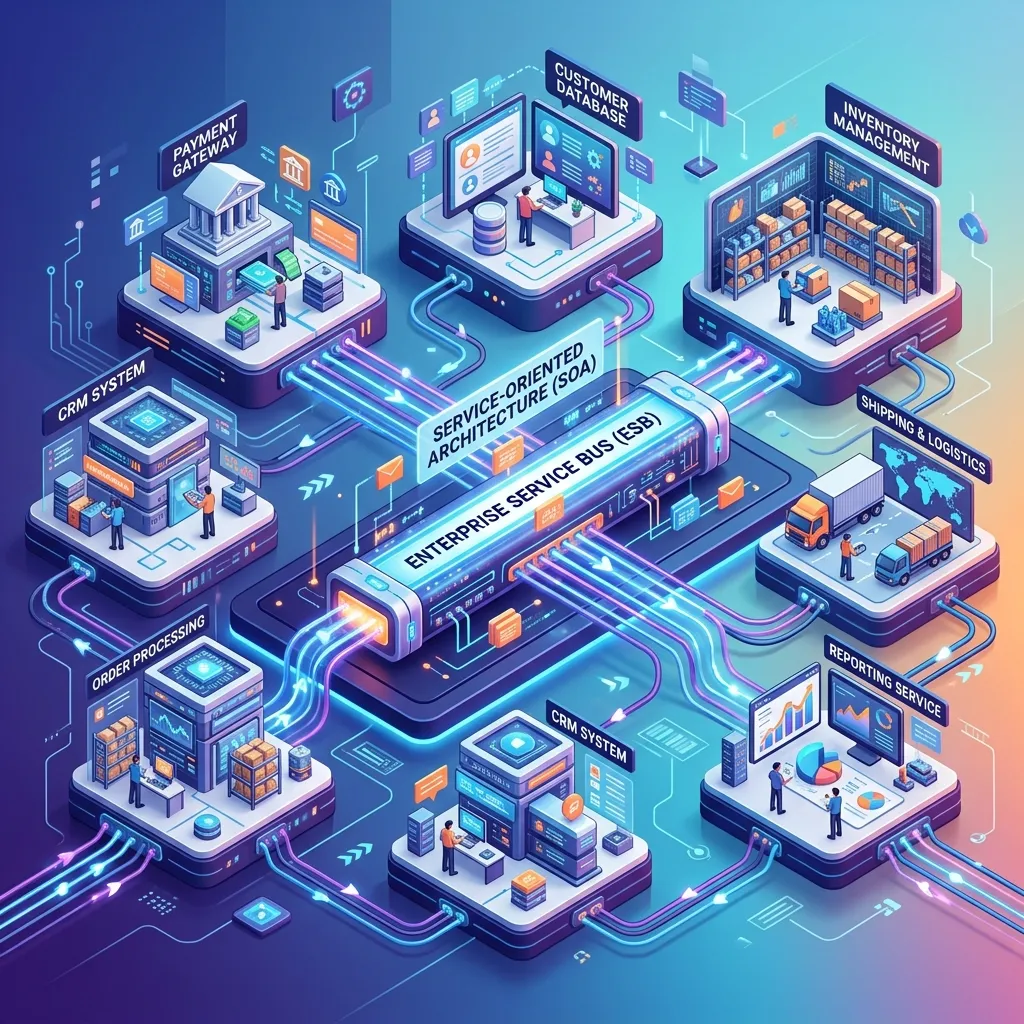
Service-Oriented Architecture (SOA)
"SOA is the grandfather of the modern cloud. You cannot understand Microservices if you do not understand the Enterprise Service Bus."
Before there was "Node.js" and "Docker," massive corporations (Banks, Insurance, Airlines) had to connect their systems. They had a "COBOL" mainframe for billing and a "C++" app for the front desk. How do you make them talk?
Service-Oriented Architecture (SOA) was the answer. It introduced the idea that a "Business capability" (like Check Balance) should be a Service that anyone can call. This 1,500+ word guide is your historical and practical manual for enterprise-level integration.
1. The Core Idea: The "Bridge" between Worlds
SOA's goal is Interoperability.
- It doesn't care what language you use.
- It uses a standard "Protocol" (usually SOAP or WSDL) so that a Java app can talk to a Mainframe without knowing its secrets.
2. The ESB: The "Enterprise Service Bus"
This is the central "Nerve System" of an SOA company.
- Every service talks to the Bus.
- The Bus handles Translation (e.g., converting "JSON" from a web app into "Fixed-Width Text" for a mainframe).
- The Bus handles Security (Checking if the user is allowed to call this service). The Distinction: In Microservices (Module 107), we HATE central buses. We prefer "Dumb pipes and smart endpoints." In SOA, the Bus is the Brain.
3. SOA vs. Microservices: The Scale of Granularity
- SOA: One service might be called "The Banking Service." It handles everything about money (Withdraw, Deposit, Interest).
- Microservices: "The Banking Service" is split into 10 tiny services (e.g.,
InterestCalculator). The Philosophy: SOA is about Reusability across the WHOLE company. Microservices is about Independent Deployment for one team.
4. WSDL and the "Contract"
In SOA, we use WSDL (Web Services Description Language).
- It is a massive XML file that defines EXACTLY what the service does.
- "I take a 32-bit integer called 'account_id' and I return a boolean."
- The Power: You can give this WSDL to a developer, and their computer can "Generate" all the connection code automatically. It is 100% type-safe.
5. Why is SOA "Dangerous" in 2026?
- Complexity: The ESB becomes a "God-Object." If the ESB has a bug, the WHOLE company dies.
- Slow Speed: XML is much slower and larger than JSON or Protobuf.
- Modern Fix: Today, we "Wrap" old SOA services in modern REST APIs to make them accessible to React and Mobile apps. This is called Legacy Modernization.
Summary: The SOA Checklist
- Contract First: Always define your WSDL or OpenAPI spec before writing code.
- Interoperate: Use SOA thinking when you need to connect two "Unrelated" companies or departments.
- Bus Control: If you use an ESB, keep the logic SMALL. Don't put "Business Rules" inside the bus.
- Loose Coupling: Ensure the caller doesn't know the language of the service.
- Legacy Wrapper: Use SOA patterns when you are forced to work with Mainframes or old Java code.
SOA is the "Glue" of the enterprise. By mastering the protocol-agnostic integration of services and the discipline of strict contract definitions, you gain the ability to manage the world's most complex corporate infrastructures. You graduate from "Building new things" to "Integrating the Enterprise."
Part of the Architecture Masterclass - engineering the integration.