
Microservices Architecture: Best Practices
Master the scale. Learn how to build resilient, distributed systems using Microservices while avoiding the 'Distributed Monolith' trap.
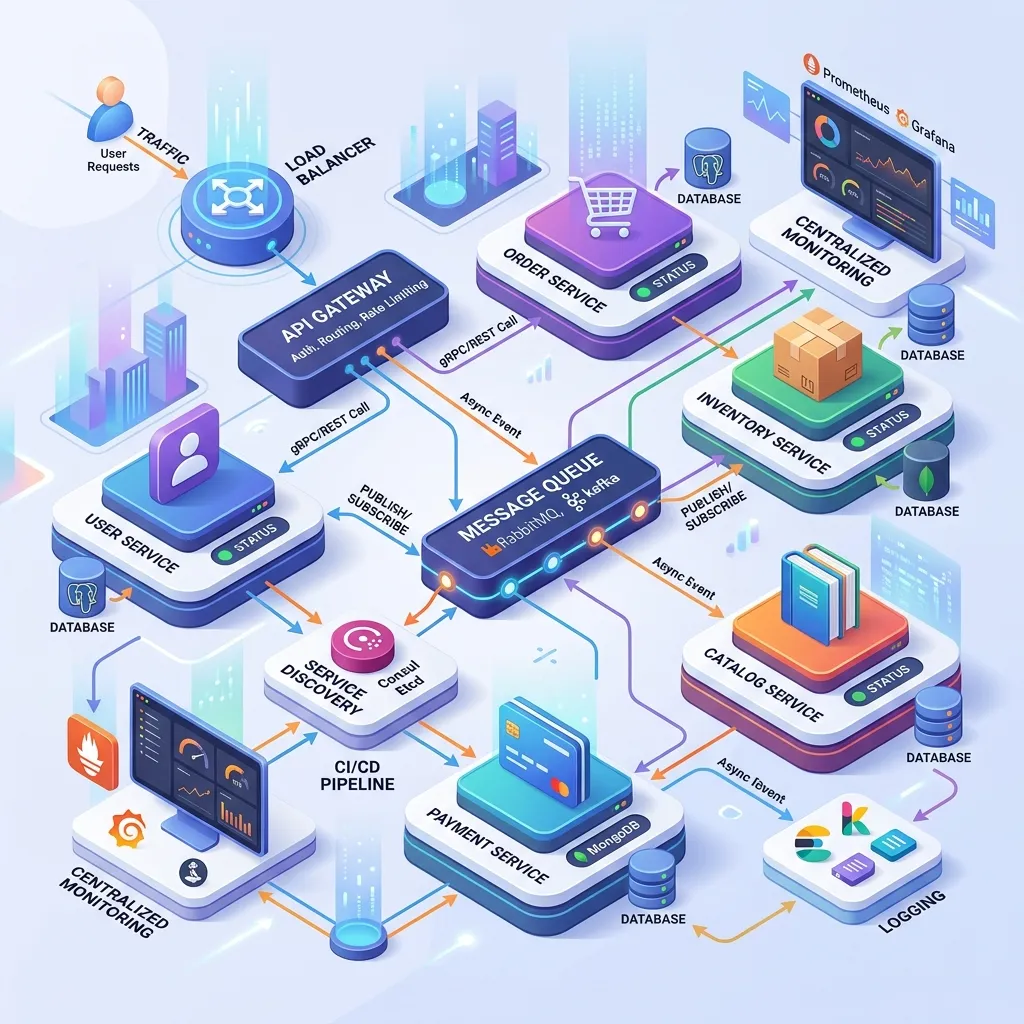
Microservices Architecture: Best Practices
"Microservices are not about Tech. They are about People. They allow 1,000 developers to work without stepping on each other's toes."
Most companies try Microservices because they want "Scalability." But instead, they end up with a Distributed Monolith: a mess of 50 services that all crash together if one of them has a bug.
In this 1,500+ word guide, we will explore the "Survival Rules" of Microservices. We will learn about Database Per Service, API Gateways, and the "Circut Breaker" pattern that prevents one slow service from killing your whole company.
1. Rule #1: Database Per Service
The most common (and fatal) mistake is having 10 microservices all talking to the same SQL database.
- The Disaster: If Service A changes a column, Service B crashes. You have "Tight Coupling."
- The Professional Way: Every service OWNS its own data. If Service B needs a User's name, it must ask Service A via an API.
2. API Gateway: The "Traffic Cop"
Your mobile app shouldn't talk to 50 different microservices. It would be too slow.
- The Solution: An API Gateway (e.g., Kong, AWS API Gateway).
- The App talks to ONE door. The Gateway decides which microservice should handle the request.
- It also handles Authentication and Rate Limiting so your developers don't have to write that code 50 times.
3. Circuit Breakers: Preventing Cascading Failure
If the "Shipping" service is slow, the "Order" service shouldn't wait forever.
- The Circuit Breaker watches the connection.
- If the Shipping service fails 3 times, the Breaker "Opens."
- It tells the Order service: "Shipping is dead. Give the user a 'Try later' message immediately." The Result: The rest of your app stays fast. This is the difference between a "Partial Outage" and a "Total Crash."
4. Observability: Distributed Tracing
In a monolith, you follow the logs in one file. In microservices, a single "User Click" might travel through 5 different servers.
- The Tool: Jaeger / OpenTelemetry.
- You attach a Trace ID to every request.
- You can literally "See" the path of the request as it moves through the cloud, finding exactly which service is the bottleneck.
5. Communication: Sync vs Async
- Sync (gRPC / REST): Fast, but risky. If the other person is offline, you fail.
- Async (Events / Module 104): Slower, but indestructible. You leave a message and move on. The Professional Balance: Use Sync for things that need an immediate answer (Search). Use Async for thing that take time (Generating a Receipt).
Summary: The Microservices Checklist
- Independent Data: No shared databases. Period.
- API Gateway: Use a single entry point for all client traffic.
- Circuit Breaker: Protect your services from their neighbors.
- Centralized Logs: You must have a global view of all 50 services at once.
- Contract Testing: Use tools like "Pact" to ensure that changing Service A doesn't break the expectations of Service B.
Microservices are the "Engine of Global Tech." By mastering the isolation of data and the resilience of circuit-breaking architecture, you gain the ability to build and lead systems that power the world's largest companies. You graduate from "Managing a server" to "Architecting a Constellation."
Part of the Architecture Masterclass - engineering the scale.