
Python Sets and Frozensets: Mastering Unique Collections
Master Python sets and frozensets. Learn union, intersection, difference, and when to use frozensets for hashable, immutable collections. Real examples.
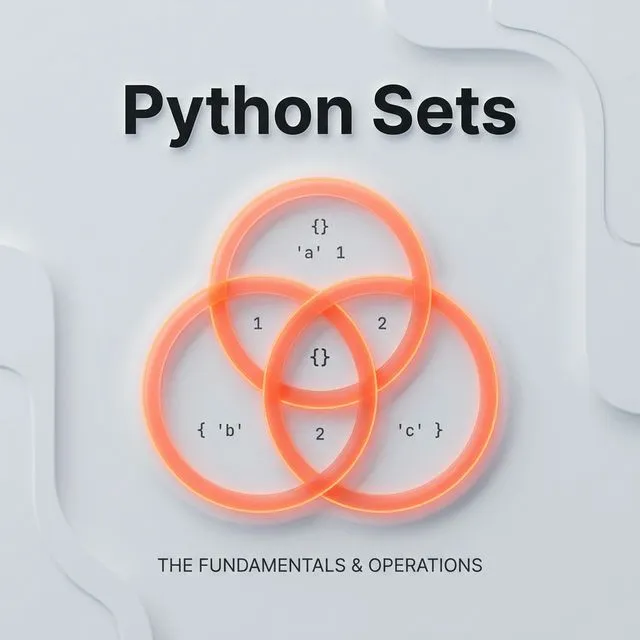
What is a Python Set?
A Python set is an unordered collection of unique, hashable elements. Sets automatically remove duplicates, support O(1) membership testing, and provide mathematical set operations (union, intersection, difference). Use set() for mutable sets and frozenset() when you need an immutable, hashable version.
Introduction to Python Sets
In Python, a Set is an unordered collection of unique elements. They are the ideal choice when you need to ensure that your data contains no duplicates and when you need to perform high-speed membership testing.
Key Properties
Sets are Unordered, Mutable (for standard sets), and contain Distinct elements. Unlike lists, searching for an item in a set is extremely fast.
Creating Sets in Python
You can create a set using curly braces {} or the set() constructor.
# 1. Using curly braces
colors = {'red', 'green', 'blue', 'red'}
print(colors) # Output: {'red', 'green', 'blue'} (Duplicates are removed)

# 2. Using the set() constructor (Empty set)
empty_set = set() # Note: {} creates an empty dictionary, not a set!

# 3. From an iterable
numbers = set([1, 2, 3, 4, 1, 2])
print(numbers) # Output: {1, 2, 3, 4}
Adding and Removing Elements
Since sets are mutable, you can modify them after creation.
fruits = {'apple', 'banana'}

# Add a single element
fruits.add('orange')

# Add multiple elements
fruits.update(['cherry', 'mango', 'apple'])

# Remove an element
fruits.remove('banana') # Raises error if not found
fruits.discard('pineapple') # Safely does nothing if not found
Core Set Operations
The power of sets lies in their ability to perform mathematical operations like Union, Intersection, and Difference.
A = {1, 2, 3, 4}
B = {3, 4, 5, 6}

# Union (All elements from both)
print(A | B) # {1, 2, 3, 4, 5, 6}

# Intersection (Common elements)
print(A & B) # {3, 4}

# Difference (In A but not in B)
print(A - B) # {1, 2}

# Symmetric Difference (In either A or B, but not both)
print(A ^ B) # {1, 2, 5, 6}
What is a Frozenset?
A Frozenset is simply an immutable version of a Python set. Once created, you cannot add or remove elements.
Why use Frozensets?
Because they are immutable, frozensets are hashable. This means they can be used as keys in a dictionary or as elements of another set.
# Creating a frozenset
frozen = frozenset([1, 2, 3])

# Nested sets (Power Set example)
power_set = {frozenset([1]), frozenset([2]), frozenset([1, 2])}
Set Methods Cheat Sheet
| Operation | Operator | Description |
|---|---|---|
len(s) | - | Cardinality (size) of the set |
x in s | - | Test membership |
add(x) | - | Add element x |
remove(x) | - | Remove x (raises error if missing) |
discard(x) | - | Remove x (safe) |
union() | ` | ` |
intersection() | & | Elements in both sets |
difference() | - | Elements in first but not second |
symmetric_difference() | ^ | Elements in either but not both |
issubset() | ≤ | Is s a part of t? |
issuperset() | >= | Does s contain t? |
Set Comprehensions
Just like lists, sets support comprehensions - great for building unique collections from existing data:
# Generate a set of squares from 1 to 10
squares = {x ** 2 for x in range(1, 11)}
print(squares)  # {1, 4, 9, 16, 25, 36, 49, 64, 81, 100}

# Extract unique first letters from a word list
words = ["apple", "avocado", "banana", "blueberry", "cherry"]
first_letters = {word[0] for word in words}
print(first_letters)  # {'a', 'b', 'c'} (order may vary)
Practical Use Cases for Sets
1. Remove Duplicates from a List
raw_data = [1, 2, 2, 3, 4, 4, 4, 5]
unique_data = list(set(raw_data))
print(unique_data)  # [1, 2, 3, 4, 5] (order not guaranteed)
2. Fast Membership Testing
Sets check membership in O(1) time - far faster than lists for large datasets:
# List lookup: O(n) - checks each element
banned_words = ["spam", "phishing", "scam", "fraud"]
"spam" in banned_words  # Slow for large lists

# Set lookup: O(1) - instant hash lookup
banned_set = {"spam", "phishing", "scam", "fraud"}
"spam" in banned_set  # Always fast, regardless of set size
3. Finding Common Elements Between Two Datasets
team_a = {"Alice", "Bob", "Carol", "David"}
team_b = {"Carol", "David", "Eve", "Frank"}

# Who is on both teams?
both_teams = team_a & team_b
print(both_teams)  # {'Carol', 'David'}

# Who is only on team A?
only_a = team_a - team_b
print(only_a)  # {'Alice', 'Bob'}
Related Python Topics
- Python Data Types - sets in context with all Python types
- Python List - the ordered, mutable alternative to sets
- Python Dictionary and its Methods - dicts also use hash-based lookup internally
- Python Loops and Iterations - iterate over sets with
for, though order is unpredictable
For the full method reference, see the Python set types documentation. The frozenset type reference covers all operations available on immutable sets.
Common Set Mistakes
- Creating an empty set with
{}- this creates an empty dictionary, not a set. Always useset()for an empty set. - Using mutable types inside a set - sets require hashable (immutable) elements. You cannot put a list inside a set. Use a tuple or frozenset instead.
- Assuming set order - sets are unordered. Never rely on a particular iteration order; it can change between Python versions and runs.
- Calling
remove()on a missing element - this raises aKeyError. Usediscard()when you are not sure the element exists. - Forgetting that
|,&,-return new sets - set operators do not modify the original sets. Use|=,&=,-=if you want in-place modification.
Best Practices for Python Sets
- Prefer sets over lists for membership testing at scale.
"admin" in roles_setis O(1) regardless of set size; the same operation on a list is O(n). - Convert to a set when you only need unique values, then convert back to a list if order matters:
unique = list(set(raw)). - Use frozensets as dictionary keys when you need to map groups of items to values - frozensets are hashable, lists and regular sets are not.
- Use set comprehensions
{x for x in ...}instead of building a set from a list comprehension - it skips the intermediate list allocation. - Use symmetric difference (
^) to find changes between two versions of a dataset - it returns only the items that changed. - Document why you chose a set when the choice is not obvious. Future readers should understand you are specifically relying on uniqueness or fast lookup.
FAQ
When should I use a set instead of a list?
Use a set when: (1) you need fast membership testing, (2) you need guaranteed uniqueness, or (3) you want to perform mathematical set operations like union or intersection. Use a list when order matters or when you need duplicate values.
Can a frozenset contain mutable objects?
No. A frozenset requires all its elements to be hashable (immutable). You can store strings, numbers, tuples, and other frozensets inside a frozenset - but not lists, dicts, or regular sets.
How do I convert a set back to a sorted list?
Use sorted(my_set). This returns a new list with the elements in ascending order: sorted({"cherry", "apple", "banana"}) returns ['apple', 'banana', 'cherry'].
Conclusion
Understanding the difference between Sets and Frozensets is crucial for writing efficient and bug-free Python code. Sets give you flexibility, while Frozensets provide safety and the ability to use collections as keys.
In our next tutorial, we'll master Python Loops!
Practice Task
Try taking a list with duplicate names and converting it into a set to see how it automatically cleans your data.
Common Set Mistakes in Python
1. Adding unhashable types
Sets require hashable elements - you cannot add a list or another set. Use tuples instead of lists: my_set.add((1, 2, 3)). frozenset is hashable and can be added to a set. See the Python set documentation.
2. Confusing | with or
set_a | set_b is the union operator. set_a or set_b returns set_a if it is truthy, otherwise set_b - not a set operation. Use the explicit set methods (union, intersection, etc.) or operators (|, &, -, ^) for set arithmetic.
3. Using a set when order matters
Sets are unordered. If you need unique elements in insertion order, use dict.fromkeys(iterable) (Python 3.7+) which preserves order while deduplicating.
4. Mutating a set inside a loop over it
Like dictionaries, modifying a set while iterating raises RuntimeError. Collect items to add/remove in a separate list and apply changes after the loop.
5. Using == to compare a set with a non-set
{1, 2, 3} == [1, 2, 3] is False even though they contain the same values - set equality only holds between two sets. Convert explicitly: set(my_list) == my_set.
Frequently Asked Questions
What is a frozenset and when should I use it?
A frozenset is an immutable set - its elements cannot be changed after creation. Use it when you need a set as a dictionary key or as an element inside another set (since regular sets are unhashable). It supports all read-only set operations: in, union, intersection, issubset, etc.
How is Python's set implemented internally?
Python sets use a hash table, giving O(1) average time for add, remove, and in operations. This makes sets far more efficient than lists for membership testing on large collections. The Python Data Model documentation explains the hashing protocol.
When should I use a set instead of a list?
Use a set when: (1) you need fast membership testing (x in my_set is O(1) vs O(n) for lists), (2) you need to deduplicate elements, or (3) you need set arithmetic (union, intersection, difference). Use a list when order matters or when you need duplicate elements.