
SQL Injection: Preventing the Parsing Breach
Master the defense against the world's most dangerous database attack. Learn why raw SQL is a liability, how to implement Parameterized Queries, and the hardware reality of how Query Plan poisoning can cripple your database performance.
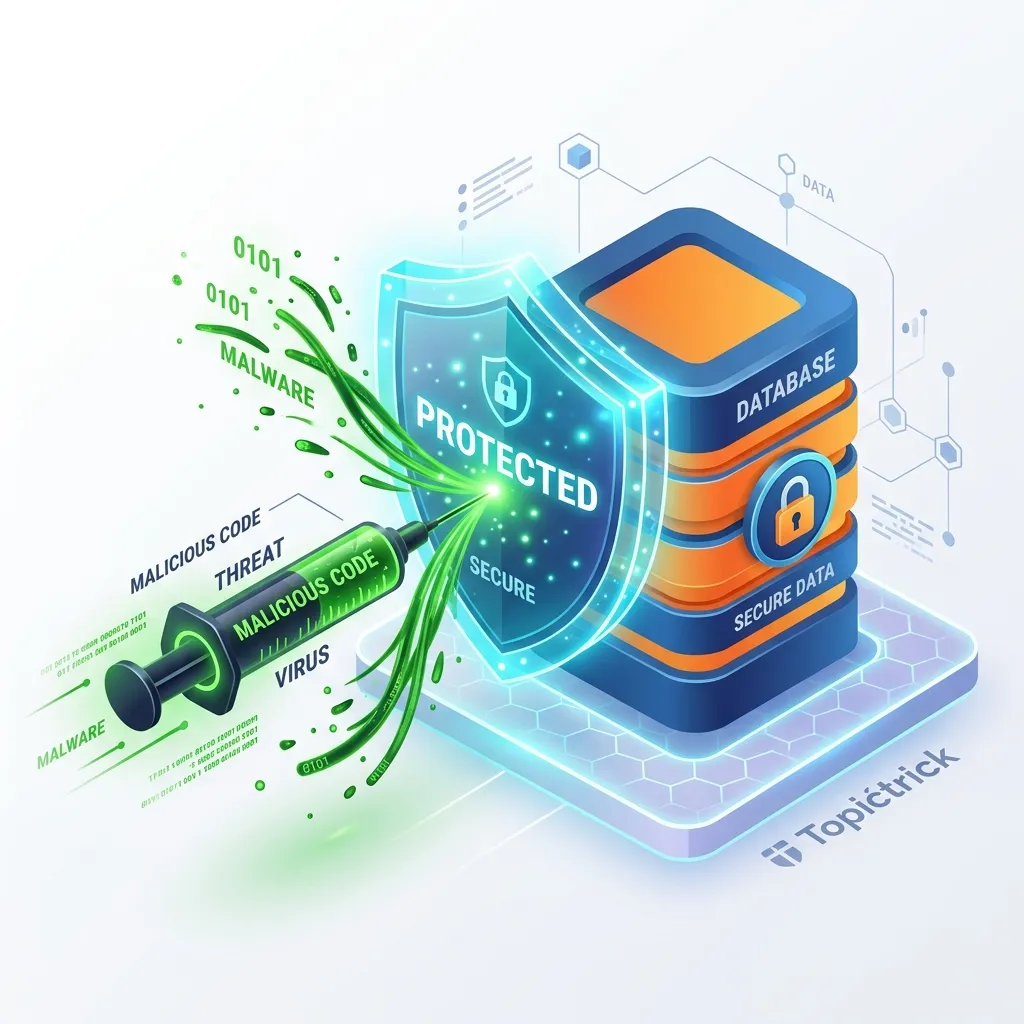
SQL Injection: Preventing the Parsing Breach
For over two decades, SQL Injection (SQLi) has consistently topped the charts of the most critical vulnerabilities. It allows an attacker to interfere with the queries that an application makes to its database. They can view data they are not authorized to see, modify or delete data, and in some cases, gain administrative access to the database or the underlying server.
This deep dive provides the Architect's Standard for permanent mitigation. We move defense from the "Buggy App Code" into the "Atomic Database Engine."
1. Hardware-Mirror: Separating Grammar from Payload
To understand why SQLi happens, you must understand the Parsing Lifecycle. Inside a database engine like PostgreSQL or SQL Server, every query goes through a "Sausage Factory" of processing.
The Parsing Wall
- Lexer/Parser: The engine converts your SQL string into a Logical Syntax Tree.
- Optimizer: The engine decides the most efficient way to walk the tree.
- Executor: The engine visits the disk and fetches the bits.
The Attack Physics: In a vulnerable system (using string concatenation), the attacker's input (e.g., ' OR 1=1) enters the system during the Parsing phase. The engine thinks the OR 1=1 is part of the "Grammar" (the instructions). It builds a tree that says: "Find all users where 1=1 is true."
The Professional Fix (Server-Side Preparation): With a Prepared Statement, you send the Grammar (SELECT * FROM users WHERE id = $1) to the engine FIRST. The engine parses it and closes the "Grammar Door." When you later send the ID 123, it enters during the Execution phase. It is physically impossible for the ID to change the tree because the tree was already built.
2. Binary Protocol Physics: Bypassing the String Parser
In 2026, high-performance database drivers (like pgx in Go or node-postgres) use the Binary Protocol.
The Transfer Mirror
- String Protocol: You send
SELECT * FROM users WHERE id = 5. The engine has to parse the string "5" into an integer. An attacker can sneak a comment--in there to break the string. - Binary Protocol: The driver sends the Query ID (
42) and the value5as a 4-byte raw binary integer. The engine's parser is never even touched. The binary value goes directly into the pre-compiled Query Plan's "Value Slot." - The Result: Total immunity to classical injection. You are no longer "Escaping strings"; you are "Passing Bits."
3. Anatomy of the Attack: From Tautology to Out-of-Band
SQLi is a spectrum of techniques, each one more creative than the last.
- Tautology (
' OR 1=1 --): The "Hello World" of hacks. It makes a condition always true, bypassing login screens. - Union-Based: The attacker uses
UNION SELECTto stitch results from yourpasswordsorconfigtables into the legitimate results of the UI. - Blind SQLi (Timing): When the app shows no output, attackers use
WAITFOR DELAYorpg_sleep(5).- "If the first character of the API key is 'k', wait 10 seconds."
- By measuring the network response time, the attacker "Hears" the data character-by-character.
- Out-of-Band (OOB) SQLi: The most advanced. If the database is behind a firewall but has outbound access, the attacker tells it to make a DNS Lookup or HTTP Request to their server, with the stolen data embedded in the subdomain:
leak-admin-pass-123.attacker.com.
4. The "Raw" Trap: Why ORMs Aren't a Security Blanket
Modern ORMs (Prisma, Eloquent, Hibernate) are fantastic. They use prepared statements for 99% of work. But every ORM has an "Escape Hatch" for complex queries.
The Dynamic Identifier Problem
You cannot parameterize a Table Name or a Column Name.
- The Fail:
db.query("SELECT * FROM " + user_input_sort_col + " WHERE id = 1") - The Mirror Physics: The database engine needs to know the table name during the Parsing phase to find the indexes and verify existence. This means your variable is entering the Grammar phase.
- Architect's Standard: Use a Whitelist.
typescript
const allowedSortColumns = ['created_at', 'price', 'rating'];
if (!allowedSortColumns.includes(userInput)) throw new Error("Security Violation");
5. Case Study: The "Second-Order" Injection
This is the "Silent Killer" of 2026.
- Persistence: A user signs up with the name
' OR 1=1 --. The database correctly stores this as a string because the signup query was parameterized. - The Trigger: A week later, an internal "Admin Report" generates a raw SQL query using that stored name:
SELECT * FROM logs WHERE user = ' + stored_name + '. - The Breach: The admin report is injected by data that was already "Safe" in the database.
- The Lesson: Always treat Database Results as untrusted input. Sanitization is not a one-time event; it is a Chain of Trust.
6. Summary: The Prevention Architecture
- Prepared Statements by Default: Never build a query string using
+or${}. - The Least Privilege Shield: (Module 21) Run your app as a user that can only
SELECT/INSERT. If an injection happens, the hacker can'tDROPyour table. - WAF Protection: Use a Web Application Firewall to block "Malicious Grammar" (e.g.,
SELECT,UNION) in the URL or Body before they reach your app. - Input Type Enforcement: If an ID is a number, cast it to a
Numberin your code. Don't let a string reach the DB driver if it shouldn't be a string. - Audit the "Raw": Use
grepor automated scanners to find every instance of.raw()orexecuteRawin your codebase. These are your "Holes in the Fortress."
SQLi is a failure of Interpretation. By strictly separating the context of "Logic" from the context of "Data," you eliminate the most common cause of database breaches. You graduate from "Writing code" to "Architecting Trust."
Phase 22: Resilience Action Items
- Audit your codebase for any raw SQL string concatenation.
- Configure your database driver to use Server-Side Prepared Statements.
- Implement a Whitelist for any dynamic sorting or filtering logic.
- Review your DB user permissions: Revoke
DROP,TRUNCATE, andGRANTfrom the application user.
Read next: SQL Normalization and Denormalization: The Performance Mirror ->
Frequently Asked Questions
Q: What is SQL injection and how does it work?
SQL injection occurs when user-supplied input is concatenated directly into a SQL string rather than passed as a parameter. If a login query is built as "SELECT * FROM users WHERE name = '" + username + "'", an attacker who enters ' OR '1'='1 as the username gets WHERE name = '' OR '1'='1' - which is always true and returns all users. More destructively, '; DROP TABLE users; -- can delete tables. SQL injection is consistently the top database vulnerability because it turns user input into executable SQL commands.
Q: What are parameterised queries and why do they prevent SQL injection?
Parameterised queries (also called prepared statements) separate the SQL structure from the data values. You write SELECT * FROM users WHERE name = $1 and pass the value separately. The database receives the SQL template and the data independently - the data is never interpreted as SQL syntax. Even if the input contains SQL metacharacters like quotes or semicolons, they are treated as literal string data. Parameterised queries are the primary and most reliable defence against SQL injection - they make injection structurally impossible, not just filtered.
Q: Does an ORM protect against SQL injection automatically?
Yes, when used correctly. ORMs generate parameterised queries for their standard APIs - User.where(name: username) in Rails or session.query(User).filter(User.name == username) in SQLAlchemy use parameters internally. The danger arises when developers bypass the ORM for custom queries: User.where("name = '#{username}'") in Rails or session.execute(f"SELECT * FROM users WHERE name = '{username}'") in Python reintroduce the vulnerability. Always use the ORM's parameterisation API for any query containing external input, even when writing raw SQL through the ORM.
Part of the SQL Mastery Course - engineering the defense.