
Interactive Mock Test: AI-Native & Strategy
Test your knowledge with 20 scenario-based questions covering AI-Native Agents, RAG pipelines, Edge Serverless, and the Strangler Fig migration pattern.
What This Mock Exam Covers
This is the final 20-question mock test in the Software Architecture Hub, covering the AI-Era, Future Patterns, and Strategy & Execution phases. You will be tested on Edge Serverless architectures, AI-Native design paradigms (Agentic Orchestration, Model Routers), Enterprise RAG pipelines, and macro-strategies like the Strangler Fig migration pattern.
Section 1: Serverless & Edge Compute
1. What is the defining operational characteristic of Serverless Architecture (e.g., AWS Lambda)?
2. How does 2026 'Edge Serverless' (e.g., Cloudflare Workers) radically differ from traditional 2018 Serverless (e.g., standard AWS Lambdas)?
3. Evaluate this scenario: Your team wants to use Serverless to process a continuous, high-throughput IoT sensor stream running at 100,000 events per second, 24/7. What is the architectural verdict?
4. What is a 'Cold Start' in Serverless architecture?
Section 2: AI-Native Architecture & RAG
5. What distinguishes an 'AI-Native' Architecture from a legacy app that just wrapped the OpenAI API?
6. Your application frequently hits OpenAI rate limits, and you want to route cheaper queries to Claude Haiku to save money. What architectural component do you need?
7. You want a Large Language Model to answer questions based on your company's proprietary Confluence wiki. Why is RAG (Retrieval-Augmented Generation) preferred over Fine-Tuning?
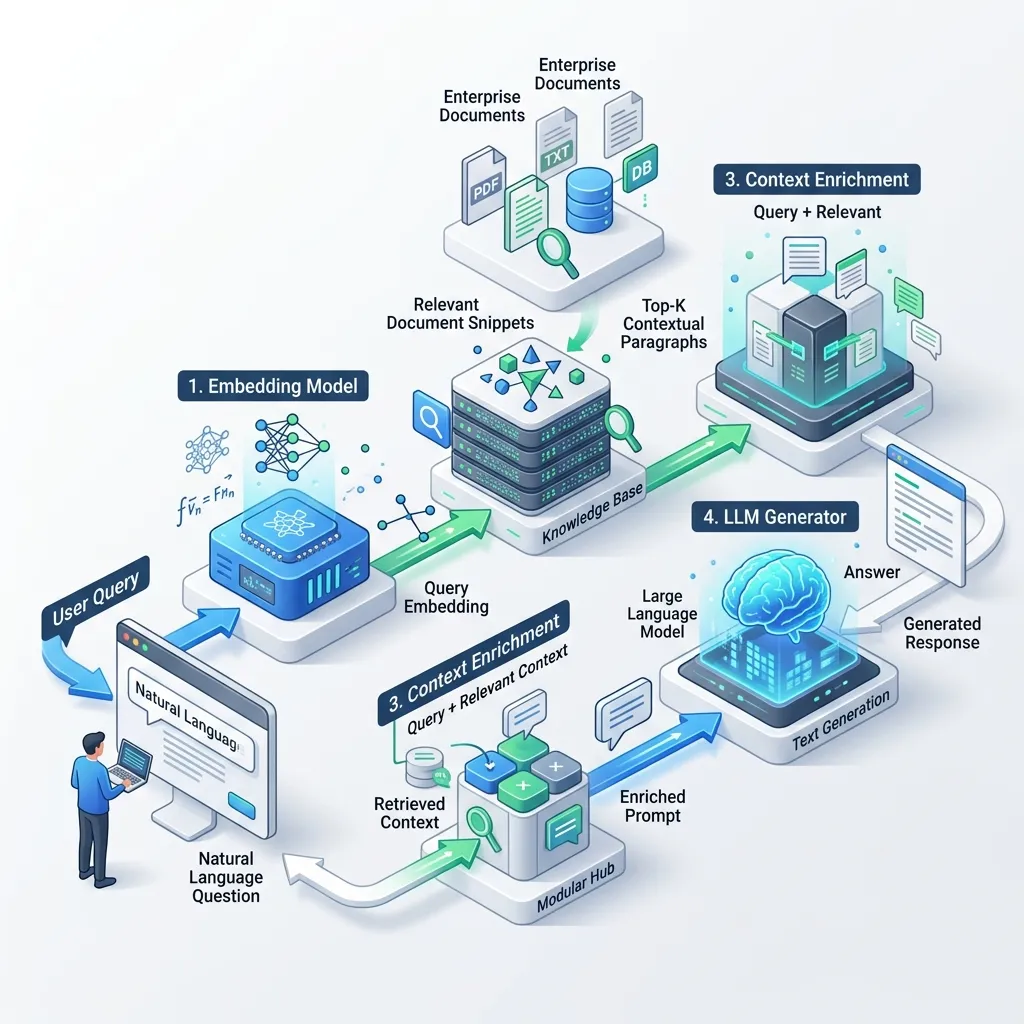
8. In the RAG Pipeline, what is the role of an 'Embedding Model'?
9. Basic RAG is returning too many irrelevant results from the Vector DB. You implement an architecture where a secondary, smaller AI model scores and filters the DB results before sending them to the main LLM. What is this called?
10. In AI-Native Agent architecture, what is 'Inversion of Control'?
Section 3: Architecture Strategy & Migrations
11. Your CTO demands that the engineering team stop shipping features for 2 years to completely rewrite the monolithic legacy system into microservices. What is the industry term for this highly risky approach?
12. You decide against the Big Bang rewrite. Instead, you put an API Gateway in front of the monolith. You build a new 'Invoices' microservice and route only `/api/invoices` traffic to it, leaving everything else alone. What pattern is this?
13. What is the absolute most difficult technical hurdle when migrating a monolith to microservices?
14. According to our Architecture Decision Framework, what is the ideal architecture for a 4-person startup building an MVP with simple business rules?
15. When migrating, you route 100% of user traffic to the Monolith, but the Gateway silently mirrors a copy of the request to the new Microservice to see if it processes it correctly without affecting the user. What is this technique called?
16. What does Conway's Law fundamentally dictate about software architecture?
17. True or False: To have a successful Microservices migration, you must eventually migrate 100% of the monolithic code.
18. In an AI-Native architecture, you must include 'Guardrails'. What is their purpose?
19. What is the fundamental issue with maintaining referential integrity (Foreign Keys) in a proper Microservices architecture?
20. You are designing an architecture for a startup. You know next to nothing about their eventual scale, traffic, or product-market fit. Which pattern should you default to as a starting point?
Summary
Congratulations! You have completed the final Mock Test in the Software Architecture Hub masterclass. By mastering these concepts, you are demonstrating real readiness for elite system design interviews and senior engineering roles.
Be sure to review the Software Architecture Hub if there are any concepts you need a refresher on!