
Compliance Engineering: ISO 27001 & SOC2 for Architects
Master the art of automated compliance. Learn the architectural requirements of ISO 27001 and SOC2 Type II, how to implement 'Evidence as Code', and why hardware-level data residency is the cornerstone of global trust.
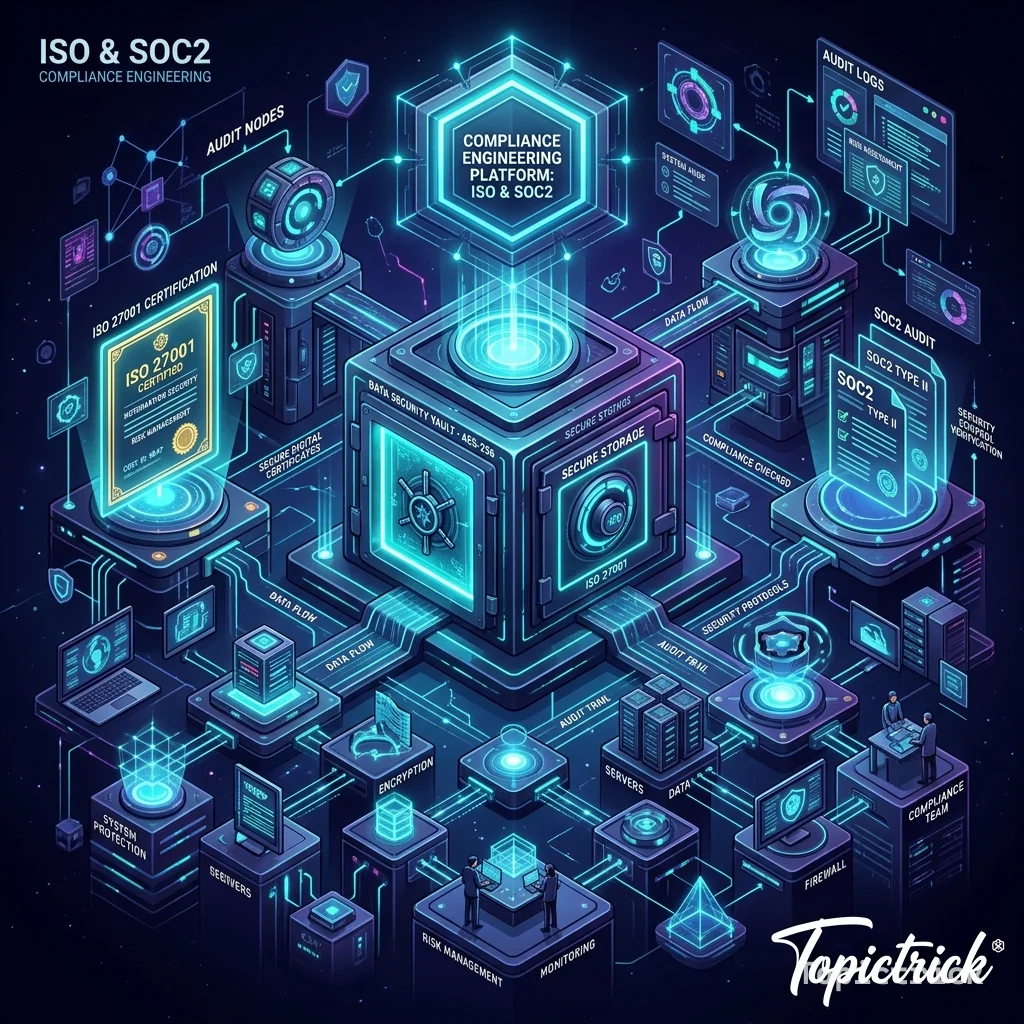
Compliance Engineering: ISO 27001 & SOC2 for Architects
For many startup architects, "Compliance" feels like a distraction from building features. They see it as a pile of paperwork and screenshots collected once a year. In 2026, the leading engineering organizations have flipped this model. They treat Compliance as an Engineering Problem.
This 1,500+ word guide explores the two most critical frameworks-ISO 27001 and SOC2-and how to architect your systems so that compliance is a natural byproduct of your development process.
1. Hardware-Mirror: The Physical Root of Compliance
To an auditor, a "Security Policy" is a document. To the hardware, a policy is a Logic Gate in a Trusted Platform Module (TPM).
TPU and HSM: Silicon Evidence
- The Concept: Compliance is built on "Non-Repudiation"-the ability to prove that a specific person or process performed a specific action.
- The Hardware: We use TPMs (Trusted Platform Modules) on the motherboard to store the "Root of Trust." These chips ensure that the operating system hasn't been tampered with before the audit logs even start.
- The Defense: If an auditor asks, "How do you know your database encryption keys are safe?" you don't answer with a document. You answer with a Hardware Attestation Report proving the keys are physically locked in an HSM and can never be exported as plain text.
Architecture Rule: Implement Hardware-Backed Identity. Use FIDO2/WebAuthn (e.g., YubiKeys) for all administrative access. This provides a "Physical Proof" of identity that satisfies the strictest SOC2 "Access Control" requirements.
1. ISO 27001 vs. SOC2: The Distinction
ISO 27001 (The International Standard)
- Focus: The Internal Management System (ISMS). It is about Process. How do you manage risks? How do you train employees? How do you handle breaches?
- Best For: Companies operating globally, especially in Europe and Asia.
SOC 2 (The Customer Trust Standard)
- Focus: The Five Trust Services Criteria: Security, Availability, Processing Integrity, Confidentiality, and Privacy. It is about Evidence.
- Type I: A snapshot of your controls at a single point in time.
- Type II: A report over a period (usually 6-12 months) proving that your controls actually work consistently.
- Best For: SaaS companies selling to US-based enterprises.
2. The Physics of Data Residency
Data residency is a physical constraint disguised as a legal one.
GDPR and the "Border of Bits"
- The Requirement: Under ISO 27001 and GDPR, certain data must stay within a specific jurisdiction (e.g., the EU).
- The Physics: Data is stored on Physical Platters or NAND Cells in a specific building.
- The Challenge: In a "Serverless" world, your code might run anywhere. To be compliant, you must use Region-Locked VPCs and Storage Buckets.
- The Mirror: Your infrastructure code (Terraform/CloudFormation) becomes your "Compliance Evidence." It physically restricts your data's mobility to authorized silicon in a specific GPS coordinate.
3. Evidence as Code: Automating the Audit
The "Old Way" of compliance involved an engineer spending 40 hours a year taking screenshots of AWS consoles to prove encryption was enabled.
- The Modern Way: Use Compliance Automation Platforms (like Vanta, Drata, or your own Architecture Module 52: Compliance as Code).
- The Pattern: A script periodically queries the AWS API: "Are all RDS databases encrypted?"
- The Result: The tool generates a permanent, timestamped record of compliance. When the auditor arrives, they don't ask for screenshots; they look at the Automation Logs.
4. The Critical Controls: Access and Changes
Auditors are obsessed with two things: Access Control and Change Management.
Access Control
- Proving that only authorized employees accessed PII.
- Evidence: Quarterly "Access Reviews" where managers must explicitly "Re-approve" every team member's tool permissions.
Change Management
- Proving that no code reaches production without a review and a test.
- Evidence: Git logs showing every PR was approved by a second person and passed a CI security scan (as discussed in Module 17: CI/CD Security).
5. Security Awareness as a System Property
Compliance isn't just about code; it's about People.
- You must prove that 100% of your employees have completed security training.
- The Architecture: Integrate your training platform with your IAM system. If a user hasn't completed their training, their VPN access is automatically revoked.
6. Case Study: The 2021 Twitch Data Exposure
The 2021 Twitch "Source Code and Payout" leak was a massive failure of Internal Governance and Change Control.
- The Failure: 125GB of data-including the site's entire source code history and creator payout details-was leaked to 4chan.
- The Compliance Gap: The leak was caused by an "internal server misconfiguration." Under SOC2, a change like this should have been caught by a Mandatory Peer Review and a Configuration Audit.
- The Result: Not only was user trust shattered, but Twitch had to undergo a massive "Remediation Project" to prove to their parent company (Amazon) that their "Change Management" was no longer broken.
- The Lesson: Compliance isn't about the "Hacker"; it's about the Accident. If you don't have an automated audit trail for your infrastructure changes, you are one typo away from a total exposure.
Summary: Designing for Auditability
Compliance is the ultimate form of Technical Governance. By automating the collection of evidence and treating regulatory requirements as architectural constraints, you build a system that is inherently trustworthy.
You are no longer just an architect of logic; you are a Builder of Professional Credibility.
Phase 18: Compliance Actions
- Map your existing infrastructure to the ISO 27001 Controls (Annex A).
- Implement Automated Evidence Collection: Use a tool like Vanta or Drata to continuously monitor your cloud configuration.
- Establish a Quarterly Access Review process where all managers must re-authorize their team's credentials.
- Secure your Build Pipeline: Ensure no code can reach production without a signed, multi-party approval in Git.
Read next: OSINT for Architects: Mapping the External Attack Surface ->