
Event-Driven Architecture: Scaling Beyond Request-Response with Kafka, Idempotency & Choreography
Complete guide to Event-Driven Architecture (EDA) in 2026. Understand events vs commands vs queries, design Pub/Sub vs competing consumers, choose between Kafka and RabbitMQ, implement dead-letter queues for failed messages, ensure exactly-once processing with idempotency keys, design choreography vs orchestration for cross-service workflows, handle schema evolution with Avro and Schema Registry, and use the Transactional Outbox to guarantee atomicity.
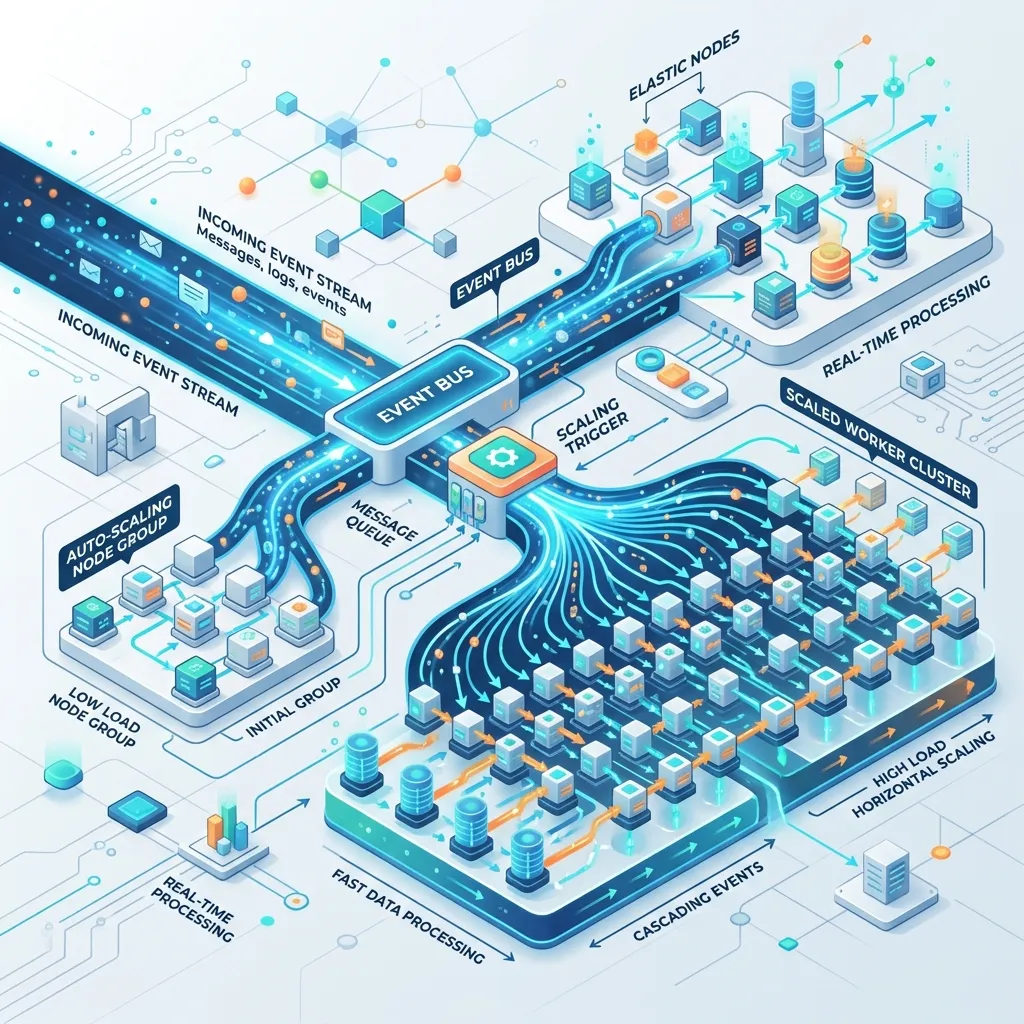
Event-Driven Architecture: Scaling Beyond Request-Response with Kafka, Idempotency & Choreography
Table of Contents
- Events vs Commands vs Queries
- Pub/Sub vs Competing Consumers: When to Use Each
- Kafka vs RabbitMQ: The Honest Comparison
- Designing Events: Schema and Versioning
- Idempotency: Handling At-Least-Once Delivery
- Dead-Letter Queues: Graceful Failure Handling
- Choreography vs Orchestration
- The Transactional Outbox Pattern
- Message Ordering: Partitions and Sequence Numbers
- Observability: Distributed Tracing in EDA
- Frequently Asked Questions
- Key Takeaway
Events vs Commands vs Queries
Understanding the three types of messages prevents architectural confusion:
| Type | Direction | Semantic | Example | Response? |
|---|---|---|---|---|
| Command | One producer -> one consumer | "Do this" - an instruction | CreateInvoiceCommand | Yes (success/failure) |
| Event | One producer -> many consumers | "This happened" - a fact | UserRegisteredEvent | No - fire and forget |
| Query | One requester -> one responder | "Tell me this" | GetUserByIdQuery | Yes (data) |
Why events are different:
- A Command expects something specific to happen - it fails if the consumer rejects it
- An Event records that something already happened - producers don't control or wait for reactions
- Events are past tense (
OrderCreated,PaymentReceived) - they are immutable historical facts
Pub/Sub vs Competing Consumers: When to Use Each
Pub/Sub: One event -> all consumer groups receive it. Each consumer group processes all events independently. New consumer groups can be added without affecting the producer.
Work Queue: One task -> exactly one worker processes it. Adding workers increases throughput - workers compete for tasks.
In Kafka: Both models use the same topic. The difference is consumer group structure:
- Multiple consumer groups = Pub/Sub (each group gets all messages)
- Multiple consumers in one group = Competing Consumers (partitions distributed)
Kafka vs RabbitMQ: The Honest Comparison
| Feature | Apache Kafka | RabbitMQ |
|---|---|---|
| Model | Append-only log (events stored for days/weeks) | Queue (messages deleted after consumption) |
| Throughput | Millions of messages/second | ~50K messages/second |
| Message replay | Yes - any consumer group can replay from any offset | No - once consumed, gone |
| Message routing | Topic + partition key | Exchange + routing key (very flexible) |
| Message ordering | Guaranteed within a partition | Guaranteed within a queue |
| Retention | Configurable (days, weeks, forever) | Until acknowledged |
| Perfect for | Event streaming, audit logs, big data pipelines | Task queues, RPC, complex routing |
| Operational complexity | High (ZooKeeper/KRaft, tuning required) | Lower (management UI, simple ops) |
Rule of thumb: Use Kafka when you need replay, multiple independent consumers, or high volume. Use RabbitMQ when you need flexible routing, request/reply, or simple task queues.
Designing Events: Schema and Versioning
Events are contracts between services. Breaking changes to event schemas break all consumers.
Good event design principles:
{
  "eventId": "7a9f0d2e-4b1c-4a8e-9c3d-123456789abc",
  "eventType": "user.registered.v2",
  "timestamp": "2026-04-17T12:00:00Z",
  "version": 2,
  "correlationId": "request-abc-123",
  "source": "identity-service",
  "payload": {
    "userId": "user-550e8400",
    "email": "alice@example.com",
    "registrationMethod": "GOOGLE_OAUTH",
    "country": "GB"
  }
}
Evolving schemas safely (Avro + Schema Registry):
// v1 schema - deployed first
{
  "type": "record",
  "name": "UserRegistered",
  "fields": [
    {"name": "userId", "type": "string"},
    {"name": "email",  "type": "string"}
  ]
}

// v2 schema - added field with default (backward compatible!)
{
  "type": "record",
  "name": "UserRegistered",
  "fields": [
    {"name": "userId", "type": "string"},
    {"name": "email",  "type": "string"},
    {"name": "country", "type": "string", "default": "UNKNOWN"}
    // No default = BREAKING CHANGE - old consumers can't deserialize
  ]
}
Idempotency: Handling At-Least-Once Delivery
Kafka guarantees at-least-once delivery - a message may be delivered multiple times if a consumer crashes before acknowledging. Your handlers must be idempotent (applying the same message twice has the same effect as once):
def handle_payment_received(event: dict):
    payment_id = event['paymentId']

    # Idempotency check: have we already processed this payment?
    if payment_repository.exists(payment_id):
        logger.info(f"Duplicate payment event ignored: {payment_id}")
        return  # Safe to skip - we already processed this

    # Process the payment (first time only):
    with transaction():
        payment = Payment.from_event(event)
        payment_repository.save(payment)
        # Process only once
        billing_service.reconcile(payment)
        # Mark as processed atomically:
        processed_events.insert(payment_id)  # Prevents future duplicates
Dead-Letter Queues: Graceful Failure Handling
When a consumer fails to process a message (validation error, downstream service down, unexpected data), it must not be lost or block the main queue:
# Kafka consumer with DLT routing:
@kafka_consumer('orders.created')
def handle_order_created(message: Message):
    try:
        order = parse_order(message.value)
        process_order(order)
        message.commit()
    except ValidationError as e:
        # Permanent failure - route to DLT immediately:
        dlq_producer.send('orders.created.dlq',
                          value=message.value,
                          headers={'failure_reason': str(e),
                                   'original_offset': str(message.offset)})
        message.commit()  # Acknowledge to avoid infinite retry
    except TemporaryError as e:
        # Transient failure - retry (do NOT commit):
        time.sleep(exponential_backoff(message.retry_count))
        raise  # Let framework retry up to max_retries
Choreography vs Orchestration
Two patterns for coordinating multi-step workflows in EDA:
Choreography (Decentralized): Each service reacts to events and publishes its own events - no central coordinator:
OrderService:   Emits  OrderCreated
InventoryService: Listens OrderCreated -> Reserves stock -> Emits InventoryReserved
PaymentService: Listens InventoryReserved -> Charges card -> Emits PaymentProcessed
ShippingService: Listens PaymentProcessed -> Creates shipment
✅ Highly decoupled. ❌ Hard to visualize the full workflow. Hard to handle failures.
Orchestration (Centralized): A dedicated Saga Coordinator sends commands and tracks state:
SagaCoordinator: -> Commands InventoryService.reserve(order)
InventoryService: -> Replies success/failure
SagaCoordinator: -> Commands PaymentService.charge(order)
PaymentService:   -> Replies success/failure
SagaCoordinator: -> Commands ShippingService.createShipment(order)
✅ Visible workflow, easy failure compensation. ❌ The coordinator becomes a new dependency.
When to use each:
- Choreography: < 4 steps, well-understood failure modes
- Orchestration (Saga): Multi-step transactions requiring compensating actions
Frequently Asked Questions
How do I guarantee exactly-once delivery in Kafka?
Kafka's built-in Exactly-Once Semantics (EOS) uses idempotent producers (producer ID + sequence numbers) and transactional APIs (beginTransaction, commitTransaction). Combined with read_committed isolation on consumers, this ensures a message is processed exactly once as long as you use Kafka transactions correctly. However, EOS only applies within the Kafka ecosystem - once you write to an external system (database, REST API), you need application-level idempotency.
What is the difference between a topic partition and a consumer group? A partition is Kafka's unit of parallelism on the producer side - messages with the same key (e.g., userId) go to the same partition, guaranteeing per-key ordering. A consumer group is Kafka's unit of parallelism on the consumer side - each partition is assigned to exactly one consumer in the group, enabling parallel consumption without duplicate processing.
Key Takeaway
Event-Driven Architecture enables the loose coupling that makes large distributed systems resilient and scalable. The technical depth lies not in setting up a Kafka cluster, but in the operational patterns: schema versioning without breaking consumers, idempotent handlers for at-least-once delivery, dead-letter queues for unprocessable messages, and transactional outbox for atomic database-plus-event writes. Mastering these patterns is what separates an event-driven system that works in demos from one that runs reliably in production under real-world failure conditions.
Read next: CQRS & Event Sourcing: A Practical Implementation Guide ->
Part of the Software Architecture Hub - comprehensive guides from architectural foundations to advanced distributed systems patterns.