
Platform Engineering Foundations: Golden Paths and IDPs
Discover why DevOps alone doesn't scale for large teams. Learn the 5 layers of an Internal Developer Platform (IDP), how to design 'Golden Paths' that reduce cognitive load, and how to treat infrastructure as a premium product.
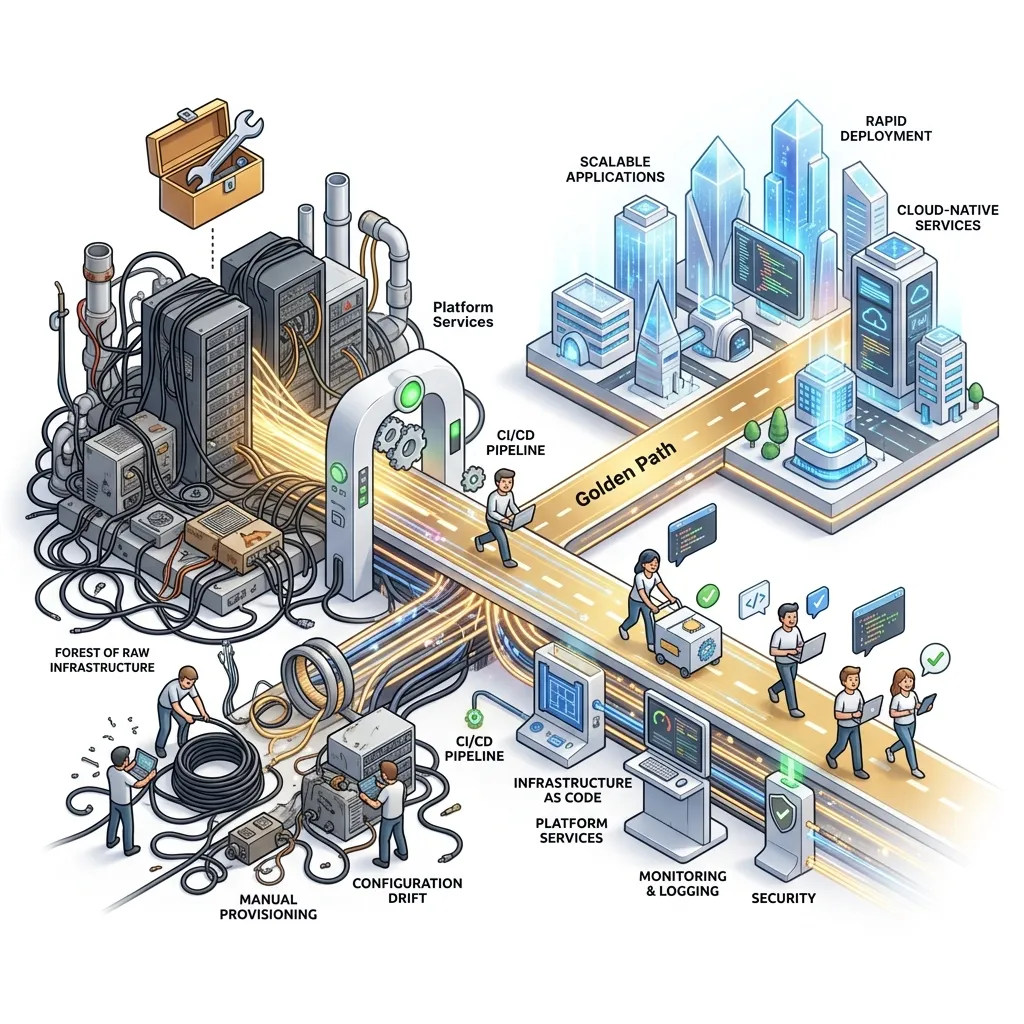
Platform Engineering Foundations: Golden Paths and IDPs
"A developer should focus on the business logic of their application, not the YAML configuration of their load balancer. Platform Engineering is the art of building a bridge that allows developers to cross the chasm of infrastructure complexity without falling into the abyss of cognitive overload."
For a decade, the industry mantra was "You Build It, You Run It." While this accelerated velocity for small teams, it created a crisis for large organizations. Developers were expected to be experts in Kubernetes, Terraform, Security, Networking, and Observability-leaving little time for actual feature development.
Enter Platform Engineering. This 1,500+ word guide explores the architectural shift from "Infrastructure as a Service" to "Infrastructure as a Product" and how to build an Internal Developer Platform (IDP) that scales.
1. The Crisis of Cognitive Load
In a classic DevOps environment, a developer wanting to launch a new microservice must:
- Write the code.
- Create a Dockerfile.
- Write 300+ lines of Kubernetes YAML (Deployments, Services, Ingress).
- Configure CI/CD pipelines.
- Set up secret management (Vault/Secrets Manager).
- Provision a database via Terraform.
This is Cognitive Load. It is the number of things a human must keep in their head to complete a task. When cognitive load exceeds capacity, velocity drops, and errors (like misconfigured security groups) spike.
Hardware-Mirror Rule: For every minute a developer spends debugging a YAML indentation error, they are wasting the "Brainpower" of a high-cost human resource. Platform Engineering is the Optimization of Human CPU Cycles.
2. What is Platform Engineering?
Platform Engineering is the discipline of designing and building Internal Developer Platforms (IDPs) to provide a paved path to production.
- The Platform Team: Acts as a "Product Team" for other engineers. Their "Customer" is the Developer.
- The Result: Instead of a "Ticket" (Wait 3 days for a DB), the developer gets a "Button" (Instant DB via Self-Service).
3. The 5-Layer Model of an IDP
A successful platform is built in layers, abstracting complexity as you move up the stack.
Layer 1: Infrastructure (The Foundation)
The raw cloud resources: AWS EC2, S3, RDS, or on-prem VMWare. This is the Silicon and Fiber.
Layer 2: Cluster Management (The Orchestrator)
Usually Kubernetes. This layer handles the bin-packing of containers onto physical nodes.
Layer 3: Platform Orchestration (The Glue)
This is where tools like Terraform, Crossplane, or Pulumi live. It translates a developer's request into actual infrastructure.
Layer 4: Configuration & Logic (The API)
A standardized way to define what an application needs (e.g., "I need a PostgreSQL DB and 2GB RAM") without knowing the underlying cloud-specific details.
Layer 5: The Interface (The Frontend)
The portal where developers interact with the platform. This could be a CLI tool, a UI (like Backstage), or an API.
4. The "Golden Path" Strategy
A Golden Path is an opinionated, supported, and automated route to production.
- The Philosophy: "You can do whatever you want, but if you stay on the Golden Path, everything is automated, secure, and supported by the platform team."
- Example: If a developer uses the standard "Java-Web-Service" template, they get:
- Automatic CI/CD pipelines.
- Pre-configured Grafana dashboards.
- Standardized logging and tracing.
- Automated security scanning.
Architectural Benefit: By funneling 80% of teams onto a Golden Path, you drastically reduce the Attack Surface of the organization. If a new vulnerability (like Log4j) appears, the platform team can patch the Golden Path template and propagate the fix to everyone instantly.
5. From "Tickets" to "Self-Service"
The ultimate goal of Platform Engineering is the elimination of human-in-the-loop infrastructure provisioning.
- Old Way: Developer opens a Jira ticket -> DevOps engineer sees it 4 hours later -> Runs
terraform apply-> Closes ticket. - New Way (IDP): Developer clicks "Create Environment" in the portal -> IDP executes
terraformin the background -> Developer receives credentials in 2 minutes.
Hardware Impact: This removes the Latency of Humans. Your hardware becomes instantly available to those who need it, maximizing the ROI of your cloud spend.
6. The "Platform as a Product" Mindset
A platform that is "Forced" on developers will fail. A platform that developers "Love" will succeed.
- User Research: Talk to your developers. What keeps them up at night? Is it slow build times? Complex networking?
- Onboarding: A new developer should be able to ship their first "Hello World" to staging within 1 hour of joining the company.
- Documentation: The platform must have "Product-grade" documentation.
7. Tooling: The IDP Ecosystem
- Portal: Backstage (Spotify's open-source framework).
- IaC Control Plane: Crossplane (Kubernetes-native infrastructure management).
- Deployment: ArgoCD or Flux for GitOps.
- Catalog: A central registry of every service, who owns it, and where its documentation lives.
Summary: Designing for Velocity
Platform Engineering is the Architectural Solution to Organizational Friction. By treating infrastructure as a product and building Golden Paths, you enable your developers to focus on what matters: Shipping Code.
You are no longer just managing servers; you are Building the Machine that Builds the Software. When done correctly, Platform Engineering transforms a chaotic fleet of microservices into a synchronized, efficient, and high-velocity engineering department.
Next Steps:
- Explore Module 48: High-Availability Design to see how platforms handle failure.
- Read Module 53: Caching Strategy to optimize the performance of your platform.
Part of the Software Architecture Hub - engineering at scale.